Many of us enjoy a slap-up fish supper. Far too many, unfortunately. Now that the Earth’s population is approaching seven billion, the drain on the denizens of the world’s oceans is becoming insupportable, many aquatic species are hurtling towards extinction, and at this rate the international commercial fishing industry will collapse by 2050.
I think we knew most of this already, quite possibly via Charles Clover’s film The End of the Line, but obviously we’d prefer not to think about it. Sir David Attenborough thinks we can’t be reminded of it too often, and his survey of impending oceanic catastrophe for Horizon was a labour of love, a beautifully shot and sympathetically edited elegy to what could conceivably be the end of a major chapter in human history. “Imagine a world without fish,” as the tagline for The End of the Line put it. Unthinkable, surely?
Attenborough made his case more in sorrow than in anger, and as he advances in years (he’s 84), Sir Dave feels increasingly inclined to lay his cards on the table and inject some naked emotion into his programmes. Latterly, he has noisily banged the drum for any number of environmental causes, from saving endangered species to alternative energy and global population control. He reminds me of John le Carré, emerging late in the day as an unabashed polemicist who’d like you to know what he thinks before the landlord calls time.
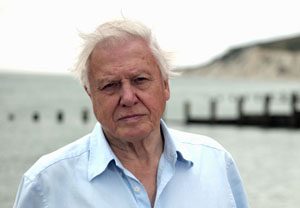
But the venerable Attenborough is also one of the great survivors of the old guard of public service television, so scientific rigour and the imparting of knowledge remained the order of the day (there was no space here for his “save the licence fee” speech). It’s mildly reassuring to hear that Attenborough has been heartened, a bit, by the Census of Marine Life, a vast scientific “baseline survey” of every kind of life existing in our oceans. This is no mere book-keeping operation, since the deep oceans remain almost as unknown as outer space, and scientists are still finding thousands of new species every year. The bleak irony is that as more and more new specimens are found, more and more of the species we know about are being fished out of existence. Attenborough (pictured below, looking stern) hopes the Census might act as a spur to conservation, as the phenomenon of the acidification of the oceans begins to emerge as the latest eco-nightmare.
 Despite its ominous message, Death of the Oceans was crammed with incident, anecdote and dazzling locations. Even if some of the material was familiar, Attenborough had found fresh angles of attack. For instance, out in the Atlantic off Massachusetts Bay, boffins are fixing radio monitors with plastic suckers onto humpbacked whales to plot their movements and to assess the punishing impact on them of constant shipping noise. We saw the evidence on a computer screen, as huge container vessels blotted out the whale signals like sonic typhoons thundering past.
To illustrate the way tumbling fish stocks are causing existential crises in old established fishing communities, Sir Dave tracked down Professor Jeffrey Bolster from the University of New Hampshire, as he perused the elegantly handwritten logs from 19th-century fishing boats. Fishing “is the oldest profession in America”, said the Prof, with an entirely straight face. In 1861, sailing boats using old-fashioned fishing lines were catching 70,000 tons of cod annually. Today’s computerised, refrigerated super-trawlers are currently managing 4,000 tons.
Attenborough’s most potent weapon of all was the sensationally gorgeous photography which has transformed wildlife programmes in recent years. Images of whales, tuna, marlin or a dead turtle hanging helplessly in a fishing net were worth far more than a thousand words. The Australian coral reef specialist, Ove Hoegh-Guldberg, stoutly assessed the value of the oceanic world. “It’s the heart and lungs of the Earth,” he said. “We can’t afford to lose it, so we’re not going to lose it.”
- Watch Horizon: The Death of the Oceans? on BBC iPlayer
- Find The End of the Line on Amazon
- Visit ARKive, the multimedia guide to endangered species