

Sarah Jessica Parker's screen renown as Carrie Bradshaw in Sex and the City has made a London event out of the West End revival of Plaza Suite, the Neil Simon triptych from 1968 that is as definably New York as the TV series in which Parker made her name. But for all that Simon has over the years been dismissed in London as overly frothy and glib, this current production reminds us that his landscape was no less alive to melancholy, even pain.
That awareness lends a sense of discovery to the director John Benjamin Hickey's surprisingly affecting production, seen several years ago on Broadway and now transferred to that rare West End theatre, the Savoy, that very aptly comes with a hotel attached. Let's hope the Savoy's current denizens are rather happier or more fulfilled than the three very different pairings on view in Simon's play, which more than once put me in mind of the Sondheim musical Company, premiered on Broadway two years later, and not just because Simon anticipates his near-contemporary by making telling use of a vodka stinger. 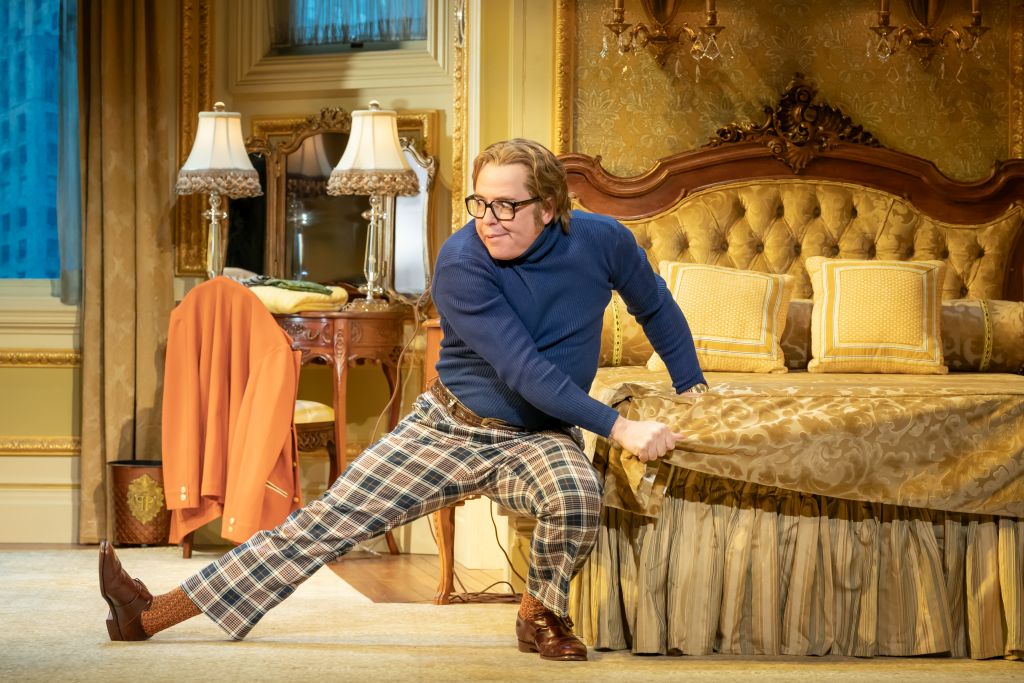 The setting is room 719 of the Plaza Hotel, that Manhattan landmark adjacent to Central Park that was a visual mainstay of my childhood as a New Yorker, just as "Doc" Simon's plays, to allow the author his showbiz nickname, were essential aspects of my own theatrical coming-of-age. Indeed, it comes as rather a jolt to think that Matthew Broderick, Parker's husband and the show's other name draw, won his first of two Tony Awards for Simon's Brighton Beach Memoirs over 40 years ago, and has been returning to the stage regularly ever since. (Indeed, he was seen in London to negligible effect just four years ago, opposite Elizabeth McGovern, in his chum Kenneth Lonergan's The Starry Messenger.)
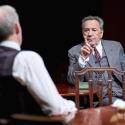
This show is a better fit for Broderick's now-signature affectlessness on stage, and the two playlets seen post-interval make physical demands that he meets with aplomb. But it's Parker, a stage actress as a child long since siphoned off primarily to the screen, who really impresses here and who, one assumes, justifies ticket prices heading towards £400: that said, news of the play's extension into April was quick to report cheaper tickets on offer, as well, lest the headlines be about the spiralling cost of playgoing and not the starry talent.
I confess to not being prepared for the range Parker displays here, and her gift for walking a tightrope between wise-cracking wit and wistfulness that at times really did put me in mind of Chekhov, the master whom Simon admired and upon whom he deliberately modelled his own 1973 play, The Good Doctor. She's in tremendous form in the piece that makes up the first half – "Visitor from Mamaroneck" – in which she plays Karen, an excitable wife approaching 50 who has arrived early at the suite so as to prepare for a giddy anniversary celebration with her husband, Sam (Broderick).
Things of course don't go to plan, and not only because Karen turns out to be somewhat vague as to the details of her age, the number of years she's been married, and whether she's actually got the same hotel room in which she and Sam had such a happy time some years before. Shot through with zingers about a marriage gone south and intimations of mortality that sting, the writing has a robustness that is fully delivered by these headliners, and Parker manages to make anchovies as crucial to this scenario as, say, sardines are to Noises Off.
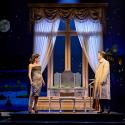
The second piece is the slightest and in some ways the weirdest. "Visitor from Hollywood" finds Broderick dressed in eyepopping plaid as an Austin Powers-esque Hollywood producer called Jesse Kiplinger who clearly doesn't think much of women – his various wives, he reports, were "three of the worst bitches", an assessment that seems not to sway Parker's headband-wearing, self-doubting Muriel. Leggy and alive with self-doubt, she has arrived at the suite on the chance that they might rekindle the magic that the two shared 17 years ago, before Jesse hit the bigtime.
Fame here is the aphrodisiac in a way that is cunningly mirrored by this production itself, and it's fascinating to hear the roll call of talent that turns this pair on. Jesse lives in Humphrey Bogart's former home and hangs with a readily enumerated A-list, though one wonders whether Yvette Mimieux will carry much currency these days: Liza Minnelli presumably still does.
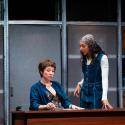
The final sketch, "Visitor from Forest Hills", furthers the connection to Company by focusing on the daughter, Mimsey (Charlie Oscar), of Norma and Roy Hubley who has locked herself away in the hotel bathroom on the occasion of her wedding as her frantic parents try every tactic, physical or psychological, to get her to open the door. (Sondheim must have had this playlet in mind when he wrote his effervescent number from Company "Getting Married Today", on exactly the same topic.)
Even as Norma raises her voice and Roy risks life and limb climbing along the window ledge in the pouring rain, the reason given for Mimsey's marital reluctance is that she doesn't want to become her parents – or, by implication, to end up in the deadening alliance so neatly dramatised in the first play. You laugh heartily at the accelerating insanity of the piece even as you clock the darkness attendant behind it. And Parker's determined good cheer comes, rather brilliantly, to seem like a mechanism for survival in a Plaza Suite that is beguiling, to be sure, but not necessarily all that sweet.


Add comment