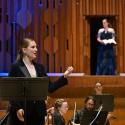
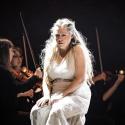
André Messager is one of those fringe composers whose music you feel you know something about until you try to think of a specific piece. His ballet Les deux pigeons is still sometimes revived. But to students of French music, he’s actually best known as the conductor who brought Debussy’s Pelléas to the stage and conducted its first performance. Of his own operas and operettas, Fortunio seems to have been the most successful in its day (1907); but I confess I’d heard never a note of it until this new production at Grange Park by Daniel Slater.
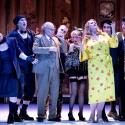
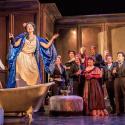
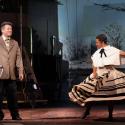
It’s a work which reminds us that French operetta and opéra comique often cross the boundaries supposedly defined by those titles. It starts off apparently as an operetta. A lawyer’s clerk, Landry (Tristan Stocks) tunefully extols the youthful charms of his elderly boss’s wife, Jacqueline, then introduces her to a green youth (Fortunio) recently up from the country; though generally regarded as pure and untouchable, she is quickly seduced by a ludicrous captain of dragoons called Clavaroche (Quirijn de Lang), who is next seen tumbling out of her wardrobe where he’s been hiding from her jealous husband (Timothy Dawkins). (Pictured: Quirijn De Lang as Clavaroche and Ilona Domnich as Jacqueline).
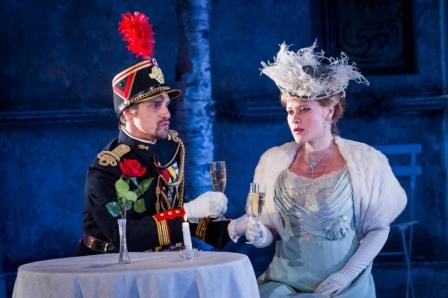 So far so Offenbach. But matters now take a more serious turn. Clavaroche has singled Fortunio out as what the French call a chandelier, that is a decoy to distract the husband from the real threat. But alas, Fortunio falls instantly and passionately in love with Jacqueline, and, worse still, she falls for him, drawn in, like Verdi’s Violetta, by the sheer intensity of his emotion. The final scene, with dragoons patrolling the garden and Fortunio barely concealed behind Jacqueline’s bedroom door, has the makings of a genuinely tragic dénouement. But Messager baulks at this, and instead lowers the curtain with the two lovers in each others’ arms and the situation unresolved.
Like the plot, Messager’s music swings disconcertingly between the frothy and the tortured, between (say) Offenbach and Wagner, a composer he admired and often conducted. There are lovely things in the simple, lyrical style of opérette, more elaborate echoes of Chabrier and Massenet, and a few rather heavy Wagnerisms, half-digested, as usual in fin de siècle French music. Fortunio’s declaration of love surprises the audience as much as Jacqueline by its Tristanesque fervour, but is preceded by a lovely fugal prelude that only Fauré could have inspired. To call the work a hotchpotch would do it an injustice; it hangs together, but only just.
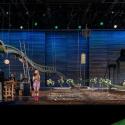
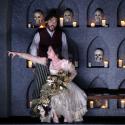
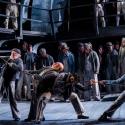
Slater’s staging respects the spirit of Messager’s time: the France of Feydeau and Maupassant, but also of Dreyfus and Zola. Above all he uses the open stage well to help the music move, not cluttering it up with modish apparatus, as in his Garsington Don Giovanni last year and Seraglio this. It’s a very watchable, stylish production. The singing, though, is variable. I like Ilona Domnich’s Jacqueline – a nice blend of the respectable and the sensual; and Alex Vearey Roberts catches Fortunio’s callow directness of feeling while sometimes straining for his notes. With the other singers, all opera specialists, one is often conscious of some attempt to find a particular, not too operatic style to match the vaudeville aspects of the music. They could, one feels, sing this music more richly and beautifully. Perhaps Toby Purser, in the pit, could give them more space, instead of sometimes bullying them into strict tempi that the music, too, resists. The orchestra plays with polish, but now and then ensemble suffers.