There’s an incendiary one-woman monologue to be had from Christine Lahti’s 2018 book about the misogyny of her upbringing, but The Smile of Her feels rather like an early draft of it. Lahti performs it with great candour and pops of dry humour, but you feel it could be even more arresting.
Her book of essays, True Stories from an Unreliable Eyewitness: A Feminist Coming of Age, looks at different aspects of her life from early days to middle age (she is now, unbelievably, a sprightly 76). Somehow she has condensed this swathe of experiences into a 90-minute monologue, but inevitably this means she has a lot of ground to cover in that short space of time.
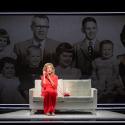
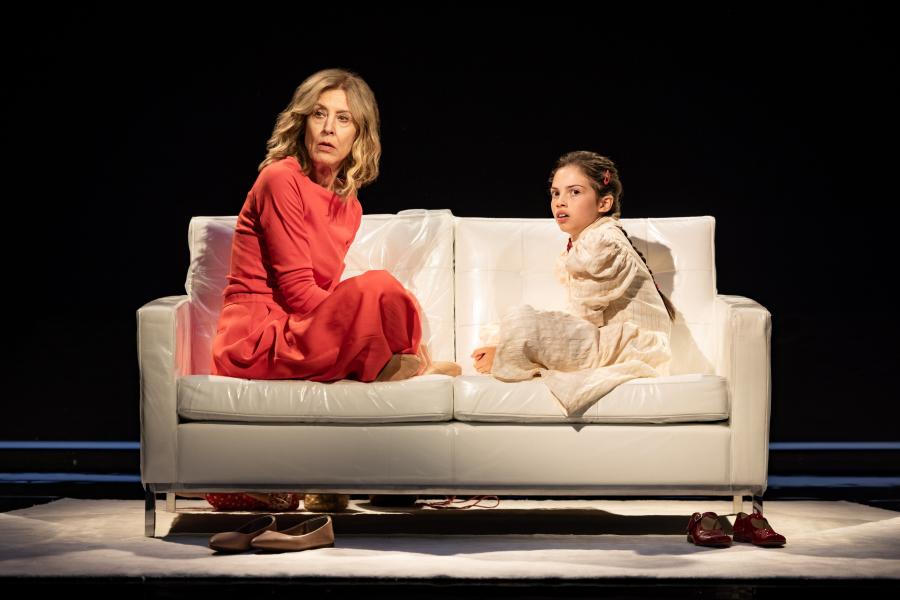
Which she achieves with a breezy narrative style and minimal means: a white sofa, projections on the back wall, a young actress playing her as a perky nine-year-old interlocutor (Jesamine-Bleu Gibbs, pictured below with Lahti). Dressed in vibrant scarlet, she invites us to observe first her large Michigan family (two sisters, two brothers) in one of the black and white photos they had professionally taken for their Christmas cards each year: a portrait of the all-American good life, 1950s-style. Her father, a surgeon, was a taciturn, organ and violin-playing pipe smoker who ruled the roost and "strapped” the wayward, including Christine, with his leather belt. Even his wife was thrown out of the car by him when she smoked on the way to their lakeside vacation home. He never revealed his true thoughts or feelings, so his children learned to hide theirs as well.
Lahti builds up a portrait of her mother, a former nurse turned homemaker, in small details, such as her daily ritual of squidging her stomach, flaccid from multiple pregnancies, into a girdle. The Betty Lahti Smile she flashed, though, transfixed all who met her. At home, late one night, Christine recalls hearing her sobbing; the next day, she and her mother “put their faces on” and went shopping, where her mother revealed that her husband had taken her credit card away. Like a lobotomised patient, she merely told Christine that credit cards were for dads, and “father knows best”, the name, ironically, of the family’s favourite TV show.
It becomes clear that Christine’s 1950s home life is precisely the kind feminists would soon be protesting about, a patriarchal system punishing the weak and the female that Betty has bought into and is seeking to hand down to her daughters. Her all-white living-room, the plastic cover still on the sofa, stands in for this emotional void: “a living room with no trace of living”, as Lahti neatly puts it. Just how inhuman it was is made clear at the end of the piece, presaged by her father throwing a rubbish bin at her three-year-old sister and scarring her for life.
Lahti seems keen to keep her story buoyant, not a misery memoir, so she doesn’t dwell at this point on the unhappiness she and her siblings experienced. Soon she’s moved on to 1968, and her awakening at university, where she first encounters communes, women’s lib and recreational drugs. And male chauvinists playing at being hippies, who expect her and the other women to tender to all their needs, an echo of her home life. The reality of the male dominance all around her is starting to encroach. Her roommate is raped in their dorm and drops out: did she ever feel safe again? Her mother, meanwhile, foresees a lonely life for her.

When she discovers acting and moves to New York, the liberated activist crashes head-on into the sexist realities of the profession, as she amusingly recalls. She begins to believe she is naive for not understanding that the jobs she comes closest to landing will have sexual favours attached. (Cue a barrage of projected images to express her new confusion.) She shaves her legs and armpits, buys a cheap audition outfit and tries to fit in. Her mother, meanwhile, gets a cameo in the narrative, telling Lahti she recently greeted her husband on his return from work buck naked, wearing just a cowboy hat, suspenders and clingfilm.
Somehow Lahti wins a big ad-role — for Spray’n’Vac: her mother must have been proud — and she starts climbing a more formal career ladder, into theatre work and successful TV series, winning a Golden Globe for Chicago Hope — her doctor dad must have been proud. Her mother by now is in the grip of a movement promoting conventional traditional wifeliness and the “Total Woman”.
As a portrait of women’s lives in late 20th century America, this is a welcome piece, and one that gains power as it moves along. When Lahti eventually pulls back the curtain and reveals its true gruesomeness, especially where her sisters are concerned, it’s something of a shock. The narrative looks as if it will turn inconsolably dark. But the Betty Lahti Smile comes to the rescue and gives it the semblance of a resolution, even if the heat of her daughter’s anger has barely gone down a degree. Lahti is a very personable presence and a compelling actress, but her monologue would have even more impact if it were less of a chronological run-through and more tightly focused on her parents, given their key roles in it. Brava to her, though, for bringing this story to a wider public.
- The Smile of Her is at Marylebone Theatre until 29 August
- More theatre reviews on theartsdesk