This was a concert of music by living women composers, and I guess you could call all three of its components protest music. Cheerful or sad, smart or overwhelming, each work had a point to make – and a sense of outrage. For those who were there, its impact was something they are unlikely to forget for a very long time.
(It also drew one of the smallest audiences I can remember for a BBC Philharmonic Saturday night performance at the Bridgewater Hall in recent times: possibly the result of a series booklet which detailed only one of the three items that were finally performed, and even more recent promotion that mentioned only two; probably also because it ignored the cardinal rule of audience gathering on a Saturday – include at least one well-known work.)
The fun came first, in the shape of Gabriela Lena Frank’s Jalapeño Blues, a 21-minute, four-section setting for eight-part acapella chorus of poetry by the Mexican writer Trinidad Sánchez Jr., who died in 2006, shortly after Frank had secured his permission to adapt his texts for composition. She says: “I was at once taken with the lyricism, passion and immediacy of his words”, and you can tell why. They’re evocative of a tradition of Mexican life that appealed immensely to her as a Californian of Peruvian-Chinese and Lithuanian-Jewish heritage, they reflect wryly on subjects such as social justice and sexuality, family and spicy food – and she knows her blues.
Three of the four sections are full of bouncy rhythmic life, the chorus sometimes pointing the beat with clicks and thigh-slaps, reflecting the sense of humour in the English and Spanish texts, sometimes declaiming them in solos against smooth harmony, for climactic moments resorting to the spoken word… and a big shout at the end. But the heart of the piece is its third section, “A Poem about Brandon Dever”, with a very different atmosphere.
Its subject is the suicide of a 15-year-old, orphaned at eight, who hanged himself while in custody (we’re not told for what), and it begins almost like plainsong, proceeding to rich chordal writing and finally a spoken confession by a male solo over a hummed lament.
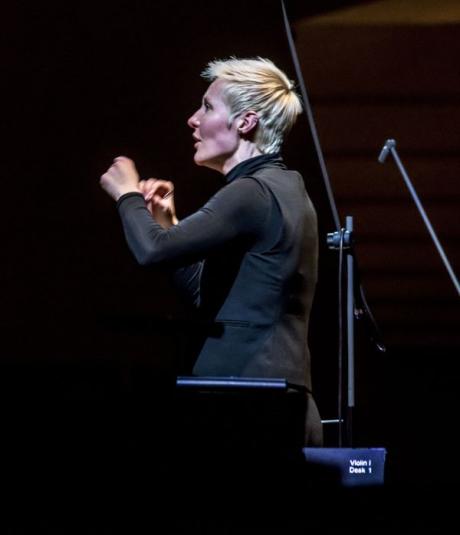
This laughter-and-tears union was created with brilliant characterizations and consummate excellence by the BBC Singers, conducted by Ellie Slorach (pictured), known to us in Manchester, where she trained, principally as the founder and artistic director of Kantos Chamber Choir, and now holding orchestral roles in Scotland and the North East, too.
The Philharmonic’s chief conductor, John Storgårds, took charge of them and the remainder of the programme, beginning with the world premiere of a short orchestral piece by another Manc, Laura Bowler. SCALLOP, for large orchestra (including five percussionists and featuring a thunder sheet) is definitely a protest – about the destruction caused by seabed dredging for scallops and the outrageous fact that so little is being done to curb it. It grows from a repeated brief motif accompanied by breathy noise, which is extended and amplified, to a sustained and impassioned tutti passage, followed by new, briefer motifs and echoes of what has gone before and then a cry of frustration, an altercation of high-pitch cries with some of the foregoing, and what sounds like a series of gunshots before a rapid fade.
The hour-plus, five-movement work for chorus and orchestra by Julia Wolfe, Anthracite Fields, after which the entire evening was titled, received one of its first performances in its new, “symphonic” garb (previously it was scored for chamber orchestra) co-commissioned by the BBC Philharmonic and Louisville Orchestras. The original version was first heard in 2014 and won a Pulitzer Prize the following year.
What I hadn’t realised until I witnessed it was that it’s really a kind of Gesamtkunstwerk, with its compilation of texts and its accompanying film as much part of the experience as its music. Strange, really, that it should be given to a broadcasting orchestra to realise it, as if you hear the radio version you will miss at least one third, and possibly two-thirds, of the actual experience.
It’s about the coal mining industry of part of Pennsylvania, where the raw material is particularly high-quality (“anthracite”), and the role its product has played in American life. As the composer puts it: “to honour the people who persevered and endured in the … region during a time when the industry fuelled the nation, and to reveal a bit about who we are as American workers”.
So it’s partly a memorialization of those who died (a huge list of names of the dead in mining accidents is intoned in the first movement, and they are only the tip of the iceberg), partly a tribute to the young men who worked in its “breakers”, where slack had to be removed from the fresh-hewn coal, in their own rhymes and chants (that’s its scherzo), partly a setting for men’s voices of words from a speech by a mineworkers union leader pleading “before God” for better protection for the men in their work and better security for their families when they died, partly a setting for women’s voices of an interviewee talking about the flowers their families grew in their gardens (its slow movement), and finally a jazzy and increasingly emphatic statement of the imperatives of US life and consumption, all of which once depended on coal for energy… maybe still do.
The films show old photographic portraits of mining men and boys, diagrammatic explanations of the formation of coal seams and how they are penetrated through mining, some of the texts that are sung, pictures of the plants the families grew, and finally the imaginary character of “Phoebe Snow” a railroad adman’s idea of the sophisticated townswoman who could travel to Buffalo without getting her gown dirty, thanks to the boon of coal. (She obviously never ventured to put her head out of the carriage window while on a train drawn by a steam locomotive).
The musical language is straightforward and its intention always clear – laments for the dead, lively and rhythmically repetitive accompaniments for the boys’ rhymes and slow declamation of the sobering sections of the texts, and finally a chorale-like theme that’s heard over the chanting of a motto from the Phoebe Snow setting.
It was sung by the BBC Singers with untiring enthusiasm and superb variety of tone, and the Philharmonic, guest-led by the Hallé’s Emily Davis, were equally devoted to the enterprise. There’s a message in the music, of course, one that’s easier to applaud if we regard the days of coal-powered energy as belonging to the past. For Americans, it must be hard to separate the past and present, when oil is the new black gold. The unfortunate fact is that, whichever way you see it, the damage done by our industrialized way of life is indefinite and unavoidable.