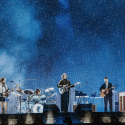
“Tschernobyl… Harrisburg... Sellafield… Fukushima” reads the display above the four figures standing impassively below like toys, suddenly turning these harbingers of the computer age into proselytisers for an anti-nuclear energy policy.
Kraftwerk’s reinvention as agitpop polemicists, if only for Radio-Activity, is just one surprise in a two-hour set that cements their place as a seminal cultural force whose key works reward close reappraisal. It is night two of The Catalogue 1 2 3 4 5 6 7 8, their typically thorough concerts series that sees them play eight albums over successive nights. If it is Thursday, then it is 1975’s Radio-Activity, a conceptual work that turns on the similarity, both verbally and physically, of radio waves to radiation.
While the original “Radio-Activity” admires the waves that continuously exist around us, in recent years the number has become a pointed warning about the effects of man-made isotopes. Tonight Ralph Hütter leaves out the alarming stats he sometimes includes, yet there is still a frisson as the recent Japanese meltdown takes the place of Hiroshima, all the more powerful as one of their group’s more forceful melodic lines glides over us.
You do worry if the four expressionless current members of Kraftwerk are enjoying themselves
“Radio-Activity” is the one Kraftwerk song to undergo such a radical transformation, but coming right at the start of the album they play tonight it fails to impinge on the elegiac quality of the first third of their set. While undeniably modernist, over the years they have come to represent more insistently a lost future, the life of leisure and easy grace that technology was supposed to bring, most strikingly on this paean to the radio age.
The day-glo warning signs that flash as the number progresses contrast starkly with the elegance in which the rest of Radio-Activity is presented. The subdued colours, even black and white imagery, suggest the possibility of a closer synthesis of man and machine is far behind us. The 3D graphics come into their own during the album’s intermission phase (think just before and after flipping over vinyl) when the transcript of “News” flies out and a letter seems to hit you in the face, causing the sort of “ooh”s you get at a firework display.
Sonically, “Airwaves” and “Ohm Sweet Ohm” are just as gorgeous, the latter sounding about as close as silicon chips have come to the rare grace of a chamber orchestra. Thanks to subtle use of a sound system that envelops the audience, crystalline notes float above just as certain images do. You do worry if the four expressionless current members of Kraftwerk are enjoying themselves. The only movement seems to be occasional sideways glance. The group may be backing themselves into a corner with such effortless perfection begging the question, would we come back for more of the same?
There are signs, perhaps, that the group respond to feedback. Tonight’s greatest hits segment feels better paced, with a finely tuned increase in velocity and impact from the electro-funk of “Numbers” through the disco house of “Tour de France 2003” with its synthetic hi-hat to the crunch of “Music Non Stop” that closes the show. The audience are more mobile tonight and Hütter responds, by the end bobbing like a Thunderbirds puppet and looking on proudly as his bandmates in turn play short cameos then take their bows. Kraftwerk’s only surviving founder member departs with a curt “Good night, auf Wiedersehen”. Until the next time, for more future past.