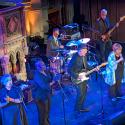
“I tell people this is my first and last big band album,” says Helen Sung about Oracles. The Houston-born pianist received a Guggenheim Fellowship in 2021, and that enabled her to bring what she has called this “dream project” to fruition, to write and record a whole programme of music for big band. The new music she says, “pays homage to the jazz masters whose music, wisdom and generosity changed my life,” and that gratitude fuels an album which is an upbeat celebration of several of the jazz luminaries whom she has known, learnt from and been inspired by.
If Oracles doesn’t get a sequel (who knows?), the reason will almost certainly be because Sung isn’t able to set aside the time to construct one. She is always in such demand everywhere, and also currently has two more album projects under way. She brings such energy and quality to so many different contexts, it is no surprise that she is always busy. As this review is being written, for example, she is about to jet off for concerts in two large halls in Germany as the sole accompanist of vocal legend/(oracle) Dee Dee Bridgewater.
There has been something inevitable about the pianist’s rise to prominence. Having been a member of the first ever student cohort at the Thelonious Monk Institute (now Herbie Hancock Institute), Sung made a significant mark as pianist in the Mingus Big Band (the bassist’s widow Sue was a huge fan). Many of the greats have gone on record to admire her musicianship; the liner note for this album by Wynton Marsalis is a case in point. He writes: “As a soloist, arranger, composer and bandleader she has developed an expansive vocabulary that encompasses the richness, virtuosity, freedom and humanity that defines the best jazz.”
The levels of energy, creative imagination and encouragement that she brings to everything she does are indeed astonishing. Students at Guildhall School in London still talk of the vigour she instilled in them during a week-long residency in early 2025, during which most of the music of Oracles was performed (at that time the project was called “Portraits in Jazz”).
Maybe everything now needs an allergy warning, so, to be fair, listeners who like their music vague, floaty and spiritual or indeed Kamasi-cosmic probably need to look away. Sung has a musical imagination and a mind which are always whip-smart. New ideas and perspectives can be snuck in and can disappear again before some of us have noticed they’ve even been there. There is so much happening in “Wayne’s World”, dedicated to Wayne Shorter, it is like a whole novel packed into a few sentences. The ‘solo’ in it is actually a dialogue between Sung herself on piano, John Ellis on soprano sax, with the full band like a Greek chorus in constant and busy motion. In “R.J.”, a piano feature dedicated to Ron Carter, so much happens in a minute-and-a-half, the logic of the piece only starts to become clear after a few listens. I particularly enjoyed the track dedicated to Jimmy Heath, “A Little Bird Watchin’ ”, not least for a stunning solo from tenor saxophonist Nicole Glover – definitely a name to keep watching out for.
This is an album with no shortage of incident and excitement, but what stays in the mind is its all-pervasive spirit of optimism. And we certainly need that.