

I've known rock photographer Tom Sheehan since we worked together at the Melody Maker in the 1980s, but even I didn't know that his stellar career stretches back "almost 40 years", or so it says in the programme notes for his new exhibition, Analogue, at the Lomography Gallery Store East in Spitalfields. Anyway, anyone who's ever been anyone in the great pop and rock malarky has been memorably photographed by Sheehan (or "painted with light," as he might facetiously put it).
new music features
Kieron Tyler

Kraftwerk closing a festival is a big deal. It’s an even bigger honour when the seminal German outfit reconfigure their set to acknowledge where they’re playing. Last Sunday, Kraftwerk performed the rarely heard “Airwaves”, from 1975’s Radioactivity album, within the honeycomb-windowed Harpa concert hall. They were paying tribute to Iceland Airwaves, the remarkable festival which was drawing to a close
theartsdesk

Of all the rock pantheon, Joni is the one who has evaded definition and over-determination better than anyone. The seemingly ethereal folkstress who partied with the most grizzled rockers and left them weeping for their mothers; the lover of the rock'n'roll life who can sing jazz standards and stand with the very greatest; the musical maestro who prefers to see herself as a painter - for all the reams of text written about her, the depths of armchair psychoanalysis attempted on her, Joni is always something other, and something more than anything you might expect.
Mark Kidel

Making a film about an artist with the phenomenal range and creative effervescence of someone like Elvis Costello was never going to be easy. There have been over 30 albums since he started out in 1977, hundreds of songs, many of which are as brilliant as anything written in the last 50 years, and a series of collaborations with artists including Paul McCartney, Burt Bacharach, Bill Frisell, Chet Baker, the Brodsky Quartet, Emmylou Harris, T-Bone Burnett and many others.
Peter Culshaw

We had heard he was ill, and had a recent liver transplant, but then he always seemed to be off colour. When Lester Bangs interviewed him in 1973 for Let It Rock he seemed ill then. When Bangs met him he had just had his greatest hit album Transformer, and seemed to be immediately blowing his new-found fame. Bangs talked of a “vaguely unpleasant fat man” who said "I can create a vibe without saying anything, just by being in the room."
Joe Muggs

The thought of attending a dance music conference in Amsterdam frankly gave me the creeping horrors. I'd never been to Amsterdam Dance Event before, and the combination of DJ egos, business hustling and relentless partying through hundreds of club venues in a renownedly liberal city presented so many opportunities for both boredom and complete catastrophe, it just seemed like a fool's errand. But this, of course, wasn't fair.
Tim Cumming

"I’m up to my ass in traditional songs," Linda Thompson says in the extensive Q&A published today on theartsdesk. When she talked to me she also discussed her early adventures in traditional folk music. "I was already interested in folk singing in Glasgow," she said. "Great people like Archie Fisher. When I came to London I got friendly with Sandy Denny, who was singing at The Troubadour. I’d been singing seriously since I was 18, in folk clubs, with Martin Carthy, Norma Waterson, all those people. I really liked the music.
graeme.thomson

Following the completion of the White Album, and the conclusion of recording sessions in Los Angeles with new Apple signing Jackie Lomax, in late November 1968 George Harrison and his wife Pattie Boyd departed for Woodstock in upstate New York. They were heading for Bob Dylan country.
Harrison had first fallen for Dylan early in 1964. The Beatles had played his second album, The Freewheelin’ Bob Dylan, over and over again in their rooms in the George V hotel in Paris, and were quickly seduced. On their second trip to America in August of that year they had met him for the first time, smoking grass together in the Hotel Delmonico on Park Avenue.
Writing and playing with Bob definitely gave him an extra sense of validation
Less than 12 months later Dylan had already mutated from reluctant folk prophet to harrying electric hipster with the release of “Like a Rolling Stone”. Harrison was paying close attention; the song's “how does it feel?” refrain seemed to capture something of his growing ambivalence to fame as The Beatles dragged themselves around the United States in August 1965 for the second summer in a row.
Harrison's admiration for Dylan was characteristically intense. His habit of quoting aphorisms from his songs as though they were scripture, often prefaced with a humble “as the man says”, would be a lifelong one. By comparison, the work of The Beatles always seemed to him just a tad juvenile.
His personal relationship with the man behind the words was lubricated by a love for Music from Big Pink, the 1968 album by Dylan’s former backing group The Hawks, now rechristened The Band. Named after the house the musicians shared in the Catskills, the record was the antithesis of everything that was currently in vogue: there was nothing heavy, nothing psychedelic, nothing groovy about the warm, suspended-in-time rusticity of Music from Big Pink. Featuring soon-to-be classic originals like “The Weight” alongside strange, funny and portentous new Dylan songs, this was instead a freshly-minted strain of mythical North American music, stately, spare and intimate.
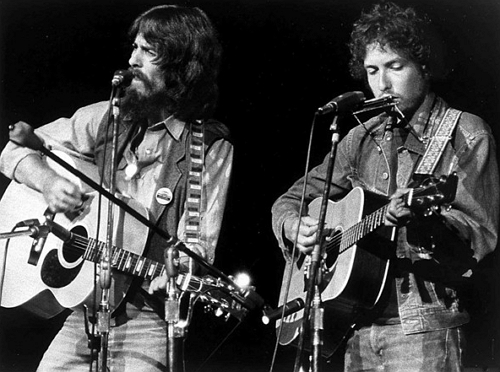 Harrison, already disillusioned with The Beatles’ increasingly fractious and dislocated working methods, headed to Woodstock wanting to know more. “He came to visit with me and met a couple of the other guys,” says The Band's guitarist and principal songwriter Robbie Robertson. “He wanted to see what was real. Like, ‘What do they do up in those mountains?’ He wanted to hang out and have some of this rub off on him.”
Indeed, the frill-free (not to say thrill-free) sessions for Let it Be, which began in Twickenham a little over a month after his visit, were a clear attempt to steer The Beatles in a more organic, rootsy direction. “I think Let it Be was very influenced by The Band: more pared down, much simpler, and that was in part George’s influence,” says Jonathan Taplin, The Band’s road manager at the time, who later worked with Harrison on the Concert for Bangladesh. “Even though I know those sessions were not comfortable and not fun, that was him saying, ‘This is where we should go’.” Robbie Robertson adds: “I just recently got a message from Donald Fagen. He was listening to Let It Be – Naked and he said, ‘Oh my God, were these guys ever influenced by The Band?’”
Going to Woodstock was in part a reconnaissance field trip, but also a much needed breath of fresh air. “It was kind of an escape from Beatledom for him,” says Taplin. “It was quite different from what was happening in London. In Woodstock it was much more grounded, very family-orientated, kids all around.”
During Harrison’s visit Robertson was, he says, “really under the weather, so I hooked it up for him to stay at [Dylan manager] Albert Grossman’s house. I also called Bob and said, ‘George is here, he’d really like to visit with you.’ So George then did go and spend some time with Bob, but he didn’t know if he was even going to see Bob when he came.”
It was an awkward meeting, partly because at the time Dylan and Grossman were at loggerheads, partly because the Beatle and his host were, in the words of former Apple employee and Harrison's friend Chris O’Dell, “both shy people and very private” - and partly because, well, “Bob was an odd person,” says Pattie Boyd. “When we went to see him in Woodstock, God, it was absolute agony. He just wouldn’t talk. He would not talk. He certainly had no social graces whatsoever. I don’t know whether it was because he was shy of George or what the story was, but it was agonisingly difficult. And [his wife] Sara wasn’t much help, she had the babies to look after.”
Overleaf: "The first couple to get their clothes off and screw wins..."
Mark Kidel

Tubular Bells stands alone in the history of late 20th-century music: a rock album without vocals. But it turns out as well to have been a kind of one-hit wonder for multi-instrumentalist and composer Mike Oldfield. The piece apparently came out of the blue – at least that is how it felt in 1973, when Virgin Records adventurously made it their first-ever LP release.
Kieron Tyler

Four days in Norway’s capital attending Folkelarm, the festival of Nordic folk music, raises the perennial and always knotty question of how far music can move beyond the traditional yet still be labelled as folk? With the charming and reassuringly old-fashioned accordion- and string-driven dance band the P. A. Røstads Orkester there’s no such problem. But Slagr, despite the presence of a rootsy Hardanger fiddle in their ranks, are closer to the drone of La Monte Young’s eternal music and could never liven up a Saturday night dance.