Miles Davis’s centenary this year has led to some fascinating work. The MILES play with Jay Phelps at Southwark Playhouse Borough in February – reviewed here – has been the most thought-provoking of the ventures so far. The Theo Croker Mixtape at the Festival Hall In March had only the briefest and most cursory glimpses of Miles, but did welcome Gary Bartz to blast us from the past. Ingrid Jensen was on imperious form with the Porgy and Bess album re-creation at Guildhall in May. But this BBC Prom was the big one, the XXL celebration with Ambrose Akinmusire and his quartet and full orchestra, for which the Royal Albert Hall had sold out.
It was a joy to hear Miho Hazama’s glorious set of arrangements and orchestrations for the Miles Centenary, all being heard for the first time. Hazama and the BBC Concert Orchestra first worked together on Rob Luft’s Concerto in 2023, and for this, their most ambitious collaboration to date, there is ample evidence that their relationship is working like an absolute dream.
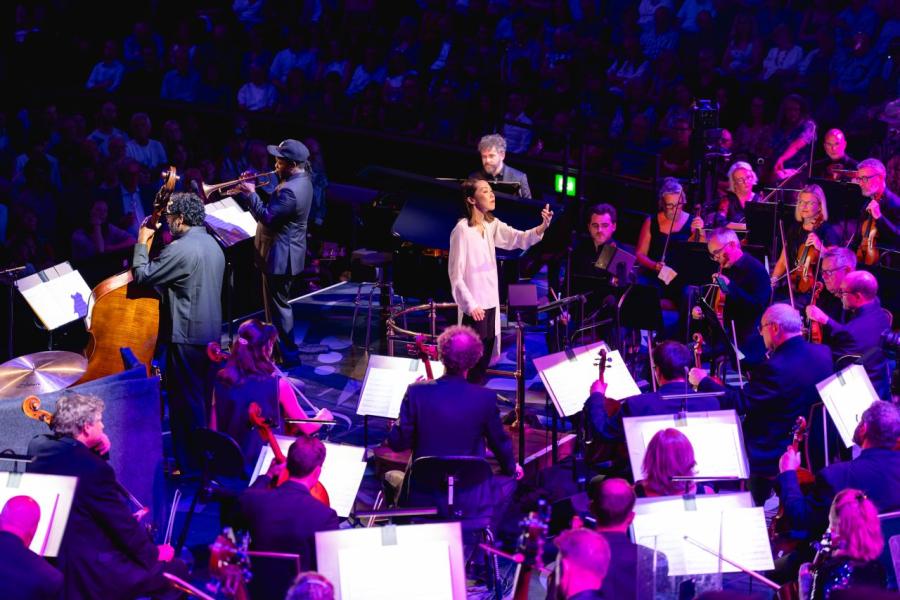
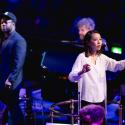
The sheer level of depth and detail that Hazama has been able to pinpoint in her scores, from what I understand were just two full days of rehearsal, was absolutely spellbinding. The exploration and variation of texture, and the flow and fluency of her writing were constantly enlivening. Her way of conducting is totally clear as well. The conscious and effective way that she is able shape and bind the music together – and to signal that intention to the orchestra through just the right gesture – is visible and palpable.
The whole principle of re-imagining jazz, of circling round a song form with full orchestra can be problematic, but when you have a composer/arranger who sees each new iteration of the form as the chance to open up a new page, to reveal a new landscape, it becomes a joy. Again and again those happy unveils happened last night. There is also humour in this writing, with quotations coming out of the blue – such as “Milestones” being slid into the closing pages of “El Amor Brujo”, but there are also sudden and unexpected lurches into, say, Ravel’s Bolero or John Barry’s James Bond theme, and those are fun too.
I also couldn’t help being distracted/amused by watching the position she adopted during the slow quartet number “Henya” from Ambrose Akinmusire’s album Owl Song. She was absolutely immobile, maintaining a fixed crouching position under the music stand for the whole performance. Could that level of invisibility ever been done at the Albert Hall before? Which other conductor would (or indeed physically could!) do that?
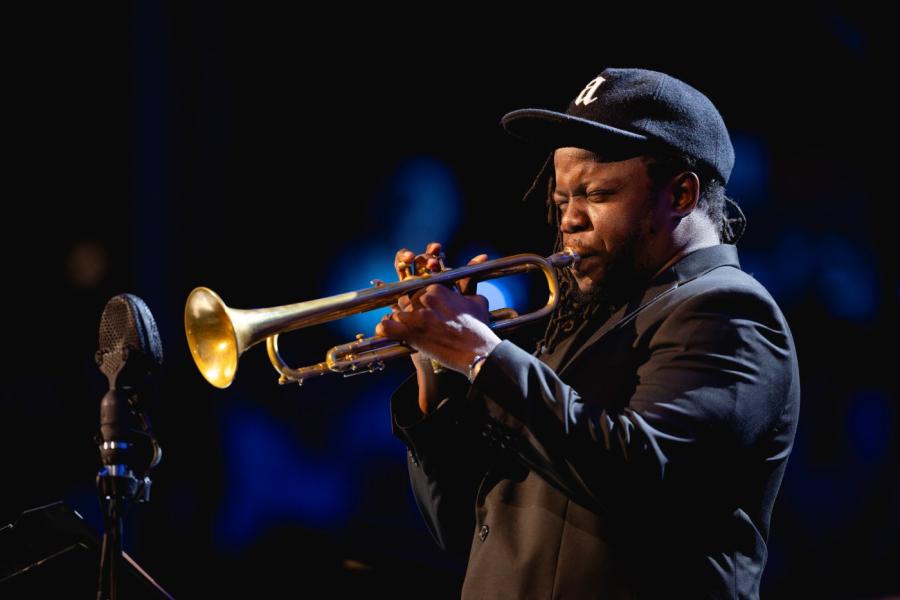
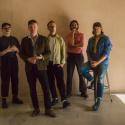
Ambrose Akinmusire’s expressive and tonal range are one of the wonders of the world, and Hazama’s arrangements gave him free range to roam, notably in an astonishing section of Kurt Weill’s “My Ship” where he seemed to be almost painting in sound. He was with his quartet of strong characters from the NYC elite, with the magnificent Taylor Eigsti on piano as a late replacement for Sam Harris, the ever-forceful and characterful bassist Harish Raghavan, and the immense Kendrick Scott, who produces an orchestral range of textures in his own right.
This was a special event on which everyone – and perhaps above all the orchestra in immensely capable hands – rose to the occasion. The BBC CO/ Hazama partnership holds real promise.