Image


For many years Paul Weller had a conflicted relationship with the oldest parts of his back catalogue. It was rare to hear more than one of his pre-1990 songs in concert. Then he started slipping them in, but only a couple.

“John Coltrane, he’s a major influence on this record. The instrumental on the A-side is an abstraction of the jazz musician named John Coltrane. That’s C-o-l-t-r-a-n-e.”
The Byrds’ David Crosby was spelling it out on 28 March 1966 at a New York press conference called to promote – and explain – his band’s new single “Eight Miles High,” issued nine days earlier. His fellow Byrd Roger McGuinn told journalists that Allen Ginsberg had played them Coltrane: that he “wanted that to come out in our music.” A tape was made of what Ginsberg was urging them to assimilate.

“Enola Gay” is perfect pop, the ultimate party-uplift banger. It’s that rare song which only seems to grow better as the years, then decades pass. This is tricky to reconcile with the fact it’s about the atomic bombing of Hiroshima (albeit opaquely). But, when Orchestral Manoeuvres in the Dark play it as the last song before their encore, the subject matter fragments amid its subversively joyous synth riff, as has been the case ever since it was a Top 10 hit, back in 1980. It’s greeted ecstatically, like the old friend it is.

Judy Garland's Carnegie Hall comeback concert on Sunday, 23 April 1961 has often been lauded as "the greatest night in show business history", though that judgment surely depends on where Garland sits in one’s personal pantheon. Elvis’s made-for-television 68 Comeback Special, the king lean in leather, must be up there, and likely Sinatra at Madison Square Garden in 1974. Whatever, the sold-out performance featured some 25 standards, Garland backed by a 40-piece orchestra conducted by Mort Lindsey. Marilyn Monroe, Richard Burton, and Julie Andrews were in the audience.


The Ryland Caravan Festival is an annual festival put together by local musical eccentrics, Independent Country, and held in the outside amphitheatre at the Midlands Arts Centre (MAC) in Birmingham’s Cannon Hill Park.

As Metallica have long known, Ennio Morricone's Ecstasy of Gold is a rousing choice of walk on music. Deadletter might not be playing the stadiums the metal giants ply their trade in, but strolling on to a near pitch black stage with music from The Good, The Bad and The Ugly booming out was a nicely theatrical opening.

“My Ice Queen” immediately makes its case. A mid-to-low tempo chugging rhythm underpins choppy guitar, a contemplative, distant vocal and a general air of disassociation. Brief sections of the song feature – albeit muted – guitar mangling and feedback. The lyrics tell of a “heartbreak machine, coolest girl you’ve ever seen.” Icy? Absolutely.
Then take the similarly restrained “Life Goes on,” so hazy a rumination it seems to have materialised from the mists enveloping Venus.

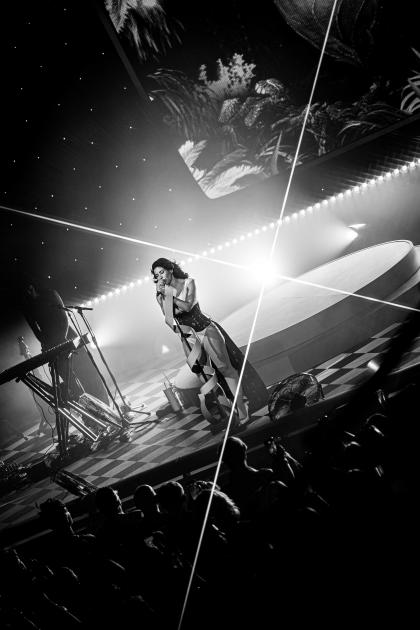
By the time Marina Diamandis rea

Whereas the more venerable European jazz festivals, founded from the 1960s onwards, are typically faced with challenges of mid- or later life, Montrachet Jazz is a newcomer and is different.
2026 was just its second edition, but its early steps are bold and impressive. Not only is a very clever artistic vision already in place, but it is also one which authentically complements and enhances the unique magic of its setting.