

Out of the hundreds of gigs, surprises and collaborations that make up the EFG London Jazz Festival (LJF), this review focuses on four concerts fusing jazz with world music. They are the Korean extravaganza of Dionysus Robot (pictured) at the Queen Elizabeth Hall; British-Bahraini trumpeter Yazz Ahmed’s melding of jazz, Middle Eastern elements and Bahraini history at Ronnie Scott’s; a late-career turn from Ethio-jazz giant Mulatu Astatke at the subterranean Here at Outernet; and the festival’s closing weekend ‘takeover’ by the Aga Khan Master Musicians at the Royal Festival Hall.
Won Il, flautist, composer and musical director of the 2018 Winter Olympics, led a 14-strong orchestra-cum-band onto the Queen Elizabeth Hall stage for Dionysus Robot (***) on the festival’s opening Friday, taking their positions behind a range of traditional Korean instruments including three types of zither, the haegeum fiddle, yanggeum dulcimer and piercing saenghwang, as well as a battery of percussion, guitar, cello and violin.
Won Il sang, played flute, and conducted – sometimes with a roving handheld camera, wandering the stage and heading into the audience. His orchestra of western and Korean hard-hitters were brooding presence exploding behind him, the musical textures ranging from jaggedly unsettling to weirdly spectral to high-volume atonal churn, one crescendo following another as if they were on march. It unsettled more than it settled in; you can have too much discordant musical drama.
On the Sunday, British-Bahraini trumpeter Yazz Ahmed (pictured below) led her quartet at a sold-out Ronnie Scott’s (*****), with drummer Rod Youngs and Ralph Wyld on vibes. They performed striking ensemble music from new album A Paradise in the Hold, which draws on the songs and lore of Bahrain’s pearl divers, and the celebratory rhythms of Bahraini women's drumming circles.
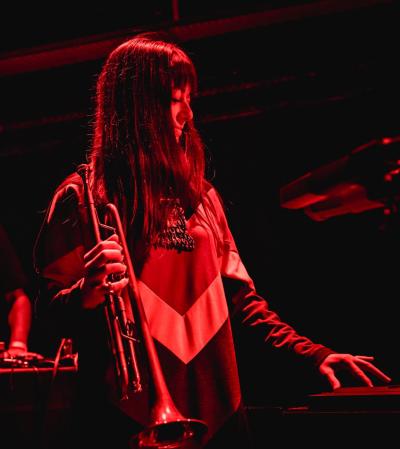
The set began with album opener “She Stands on the Shore” and title track “A Paradise in the Hold”, with Ahmed playing in profile, facing her band as they conjured an ensemble music powered by Youngs’ superb drumming and Wyld’s vibes meshing with Ahmed’s flugelhorn. Soon, the room was bathed in Yazz Ahmed's rich, resonant soundscapes evoking flow, depth and immersion. Ahmed employs a lot of reverb on her horn, at times live-mixing the sound with an effects box with one hand, flugelhorn raised to her lips in the other, playing with impressively fluid dexterity, the quartet smoothly switching between trio, duo and full quartet as the sound layers unfurled and spread out and deepened. With her music’s focus on water, and pearl-diving, and pieces like “Mermaid’s Tears”, it all felt fluid enough to feel like you were bathing in it.
I’d looked forward to similar levels of fluidity at Mulatu Astatke’s sold-out, standing-only gig at Here at Outernet, five floors below ground near Centrepoint (***) but the big band’s post-Bop plan of attack felt more like a blockage at times, choppy and over-busy in its playing, though a more fluid mechanic settled in enough to conjure some superb extended Ethio-jazz classics, the likes of “Yèkèrmo Sèw” with its immortal horn riff, and the funky “Yègellé Tezeta”, Astatke switching between reverb-heavy vibes, electric keyboards and percussion. There was a lengthy guest turn from London’s Kraar Collective, featuring a dancing duo in traditional costume. If only this dismal venue’s sightlines hadn’t been as bad as they were; if you weren’t in the balcony’s first row, your best bet was looking at a small telly on the wall. That, or be seven foot tall.
Sightlines promised to be long, possibly infinite, at the array of Qwaali, Gnawa and other spiritually charged musical traditions at the Royal Festival hall with the Aga Khan’s Master Musicians (***) launching a ‘weekend takeover’ of performances across the South Bank (culminating in Oumou Sangare with the BBC Concert Orchestra this Sunday). Though rather stilted, as a prize-giving-cum-branding event, as well as a concert, and with some peculiarly unsynched live projections, the first half featured two bands of Qwaali brothers, the Warsis and the Saamis, the latter soaring on the back of the spontaneous improvisatory mechanics of the khayal form, which can be traced to 13th-century Sufi mystic Amir Khusrau. You could feel the depths of time rising up in their soaring high notes, held for a truly impressive length. They must have the lungs of pearl divers.
In the second half of this Aga saga, the Aga Khan’s seven-strong band of Master Musicians, featuring French jazz accordionist Vincent Peirani, and Grammy-winning guitarist Michael League, performed a pleasing fusion of musics before Moroccan Gnawa malaam Hamid El Kasri excelled with a short but potent slice of tagnawwit Gnawa, before the Master Musicians joined in for some easy-going fusion that didn’t really hit any hot spots. A shame, as El Kasri, a veteran of the Gnawa Festival in Essaouira, knows how to forge powerful fusions with jazz playes in the fury of the moment. Here, it felt like a bit of a missed opportunity.





Add comment