

Seeing the statue of Saddam Hussein toppled in Baghdad in April 2003, I felt a rush of euphoria despite deep reservations about the American invasion. My (misplaced) optimism was shared by the Iraqi student, Ayass Mohammed. ’“Suddenly I felt freedom,” he told reporters; for him the fall of the statue symbolised the end of tyranny and the arrival of hope.
visual arts reviews
Marina Vaizey

"The objects in pictures look out at us serene or severe, tense or relaxed, comforting or forbidding, suffering or smiling." Thus said Paul Klee (1879-1940) in a lecture on modern art in 1924. It is an entirely accurate description of his own work, drawing as it does on dream and nightmare, fairytales and apocalyptic visions, not to mention landscape, portrait, architecture, aquatic scenes, the world around him and abstract imaginings: the whole gamut.
Sarah Kent

American ladies, in the 18th and 19th centuries, passed their time in fashionable pursuits such as embroidering samplers and cutting out portraits of family and friends. Harking back to those days, Kara Walker has covered three walls of the Camden Arts Centre with a panoramic installation of cut-paper silhouettes, which she calls Auntie Walker’s Wall Samplers (main picture and below right: Auntie Walker’s Wall Sampler for Savages).
Sarah Kent

In the 25 years she has spent taking photographs, Dayanita Singh has accumulated a huge body of evocative and memorable images. For instance, there’s the girl lying face down on a bed (main picture), dressed in what looks like her school uniform. She lies awkwardly, her legs stretched diagonally across to the edge of the mattress, presumably so that her shoes won’t dirty the sheets. Why didn’t she take her shoes off?
fisun.guner

“We should pity the age which finds its reflection in this ‘art’”, wrote one critic in 1911, after seeing too many Vienna Secession paintings. From the quotation marks, we see the despairing critic was attacking the art rather than the age. Nonetheless one is inclined to agree: with the Hapsburg Empire on the brink of collapse, with war on the horizon, and Vienna itself a hotbed of neuroses and anti-Semitism, we should indeed pity the age, and the society and the artists that reflected it.
fisun.guner

I read someone recently describe Sarah Lucas’s sculptures as “aggressive”. Perhaps being greeted by a roomful of huge plaster cocks, mechanised wanking arms and greasy doner kebabs with two fried eggs in an abject arrangement of the female sex can feel a little confrontational, but aggressive? There’s surely something deflecting and bluntly one-note when it comes to the merely aggressive. “Aggressive” rarely lets other emotions in, and Lucas’s work is a many shaded affair.
Marina Vaizey

Sex please, we are Japanese. This astonishing collection of about 170 paintings, prints and illustrated books from 300 years of Japanese art, known as “shunga” or spring pictures, come in part from the culture of the “floating world” (ukiyo-e) mostly located in Edo (modern-day Tokyo), from the mid 17th- to mid-19th centuries.
Sue Hubbard

A queue of artists, press and glitterati snaked its way through Kensington Gardens waiting to be let into the private view for the opening of the Serpentine’s new Sackler Gallery this week, housed in The Magazine, a former 1805 gunpowder store, located a few minutes’ walk from the Serpentine Gallery on the north side of the Serpentine Bridge.
Sarah Kent

Gazing out of my window pondering how to start my review of Ana Mendieta, I noticed a creeper engulfing the house at the end of my garden. Having covered the wall, one window and a chimney, the tentacles are spreading along the gutter and over the roof. Meanwhile, my neighbour’s roses have encroached six feet into my territory and, next door the other way, a vine is assiduously working its way along the hedge and into the branches of a tree. Nature, it seems, is quietly overwhelming north London.
David Nice

What is the extraordinary, crowd-drawing appeal of a picture collection reunited, for a short time only, with its original surroundings? Well, for a start, this is no modest assembly of old masters, and Houghton Hall's elaborately crafted ensemble rooms constitute no conventional stately home. The feat of remarrying them has been so successful that Houghton Revisited has been extended for another two months, until 24 November.
Clearly following in the rear of fashionable London, most of which seems already to have zipped to north Norfolk to see the wonders, I arrived from King's Lynn last Sunday with fellow hikers from the previous day’s walk for the Norfolk Churches Trust and found we could buy tickets from the man in the car-park kiosk for any slot that afternoon. Do so too, if you encounter a "sold out" online. This really is a once in a lifetime experience. It hasn’t happened for 234 years, and it probably won’t happen again.
 In 1779 the original collection assembled half a century earlier by discerning Sir Robert Walpole, Prime Minister to Georges I and II, was sold to Catherine the Great of Russia to pay for the gambling debts of his grandson, the capricious Third Earl of Orford (the otherwise excellent little booklet accompanying the “show” avoids placing the blame altogether). The wholesale delivery - by frigate to St Petersburg that spring - sets the sale apart from previous grand dispersals, like that of Charles I’s goods, by virtue of its concentration in the Hermitage. By no means every picture that’s come back to a temporary roost hails from there; where would Houghton Revisited be, for example, without Velázquez’s power-study head of Pope Innocent X, courtesy of the National Gallery of Washington (the larger, half-length portrait hangs in Rome's Palazzo Doria Pamphilj; the ever so slightly disputed Houghton/Washington painting is pictured above)?
Oddly, the decision back then would seem to have been the right one. It saved the house, very nearly all of a piece in its resplendently consistent rooms which were William Kent's first major project (Colen Campbell and Thomas Ripley were responsible for the building's noble proportions). The mahogany of the Great Staircase and the carved marble in the Great Hall stun before you catch a whiff of rehang. The staircase’s grisaille mythologies and John Michael Rysbrack’s fantasy classicizing of Walpole, not to mention the French bronze copies of the Borghese Gladiator and the Vatican Laocoön in striking settings, would alone be worth a trip to Houghton. In the rooms proper, the Mortlake tapestries of Stuart royals and their pristine, brightly coloured Flemish counterparts of Venus’s lovers enrich Kent’s rigorous decorative schemes.
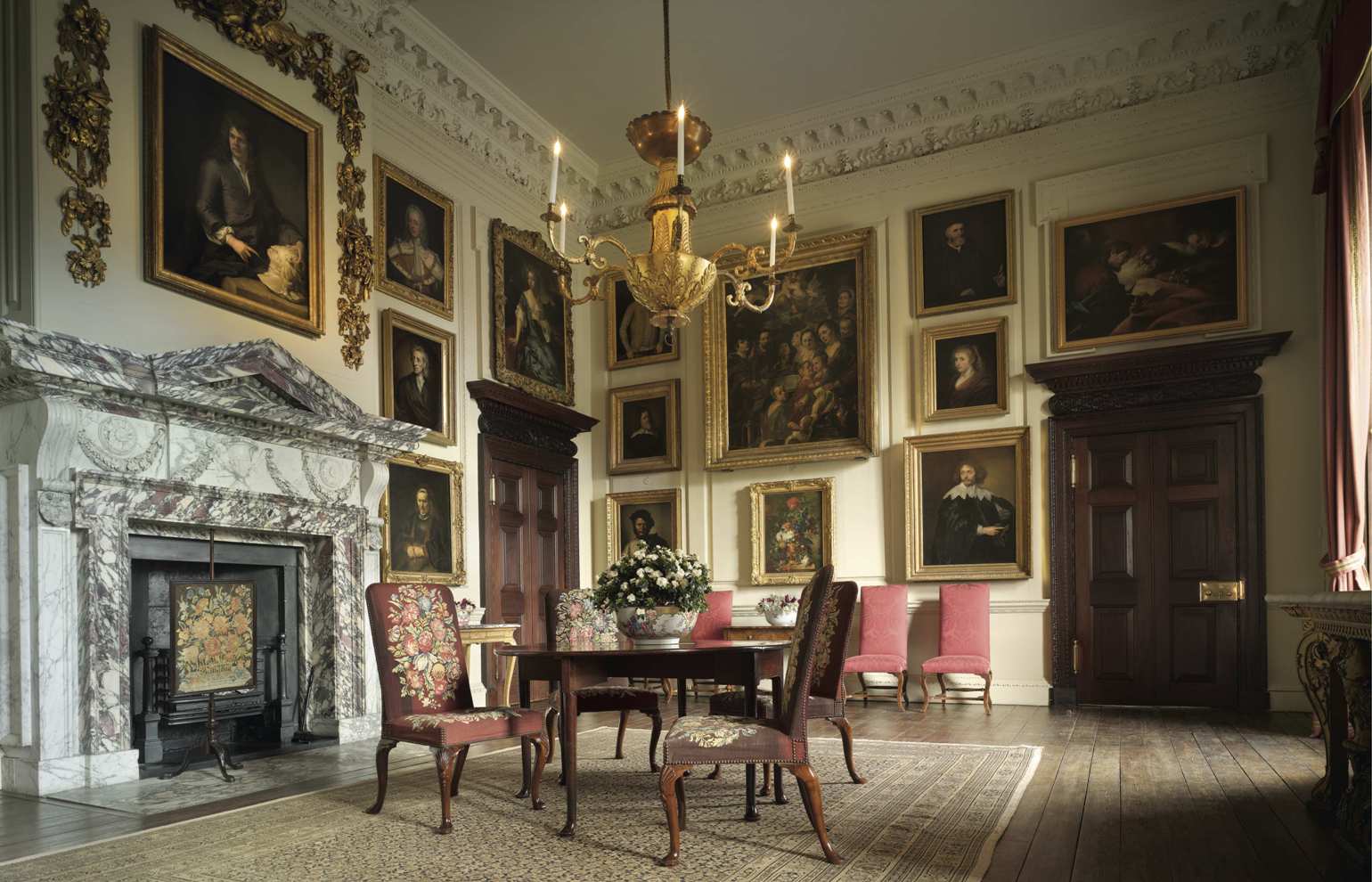 But then there’s the picture collection, and most strikingly where its treasures hang, and why. It might seem odd to centralize and glorify Kneller’s very handsome portrait of Grinling Gibbons above the Common Parlour's fireplace (pictured left) when such masterpieces as the Velázquez, Rubens’ Head of a Monk and – surely the most valuable – Rembrandt’s Portrait of an Elderly Lady seem shunted to side and lower places of eminence. But the garland of pear-tree wood around Gibbons’ portrait is surely by the master himself, so that's a neat reunion.
Next page: collecting fashions and Van Dycks among the grapes