

The downstairs of the Whitechapel Gallery has been converted into a ballroom or, rather, a film set of a ballroom. From time to time, a couple glides briefly across the floor, dancing a perfunctory tango. And they are really hamming it up, not for the people watching them – of whom they are apparently oblivious – but for an imaginary camera.
We seem either to be witnessing a film in the making or the reenactment of a well known scene from an old movie. There they are again, upstairs. This time the couple appears on screen performing the same sequence (main picture), but for a camera on a dolly. It’s a film within a film and it’s rather confusing, deliberately so. The downstairs ballroom is a reconstruction of a set from Ettore Scola’s 1983 film Le Bal, in which the director evokes 50 years of French history through scenes on a dance floor. We are in a world of artifice.
Then comes a reconstruction of the bedroom from Gillo Pontecorvo’s 1966 Battle of Algiers (pictured below), a film based around the Algerian war of Independence. Next comes the morgue from Luchino Visconti’s L’Etranger (1967), a film version of Albert Camus’ novel The Outsider about a man in Algeria whose profound sense of alienation leads him to commit a murder. In each case, the stage lights are on and the cameras are ready to roll, but the actors have yet to show up so there’s an air of expectation; everything is in limbo, awaiting the director’s call for “action”.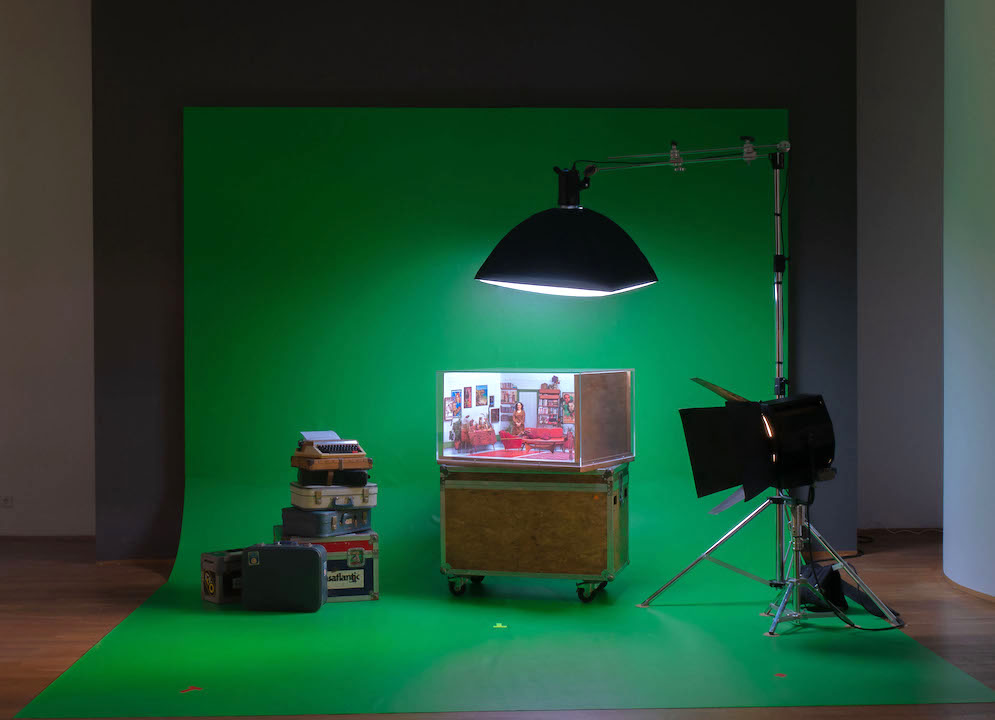 There’s another installation lit as though in readiness for filming, but instead of a full-sized set it’s a little model of the artist’s living room in Brixton (pictured above). Beside the model, someone has left a stack of suitcases that suggest recent arrival or imminent departure; meanwhile the packing crates used to transport the filming and lighting equipment are strewn all over the place. It feels either as if I’ve arrived too early, before Zineb Sedira’s installation is finished, or else I’ve come too late, when filming has ended and the crew is about to pack up. Parallel universes exist here, side by side, and the feeling of being simultaneously on and off stage (in an exhibition and on a film set) is very unsettling. Everything seems to be in a state of transition.
A moment later, though, you are able to touch base – in a full scale mock up of the artist’s living room, where you can enjoy the surroundings from the comfort of a three piece suite. Any impression of homeliness is short lived, though. The sideboard is real but the bookshelves, fireplace, pictures, lamps and ornaments look like xeroxes or poor quality prints, and some things are present both in the flesh and as reproductions. To take it all in, your mind has to switch back and forth between reality and its facsimile, between homeliness and distanciation. “Home” is made to feel as much of a construct as a film set.
Meanwhile, on television artist Sonia Boyce and Whitechapel Gallery Director Gilane Tawadros share their experiences of growing up in London – trying to fit in while, at every turn, being made to feel unwelcome and “other”. Both are friends of Sedira, who was born in Paris of Algerian parents. She moved to Brixton in 1986 and now spends her time between London and Paris, so has spent much of her life learning to fit in.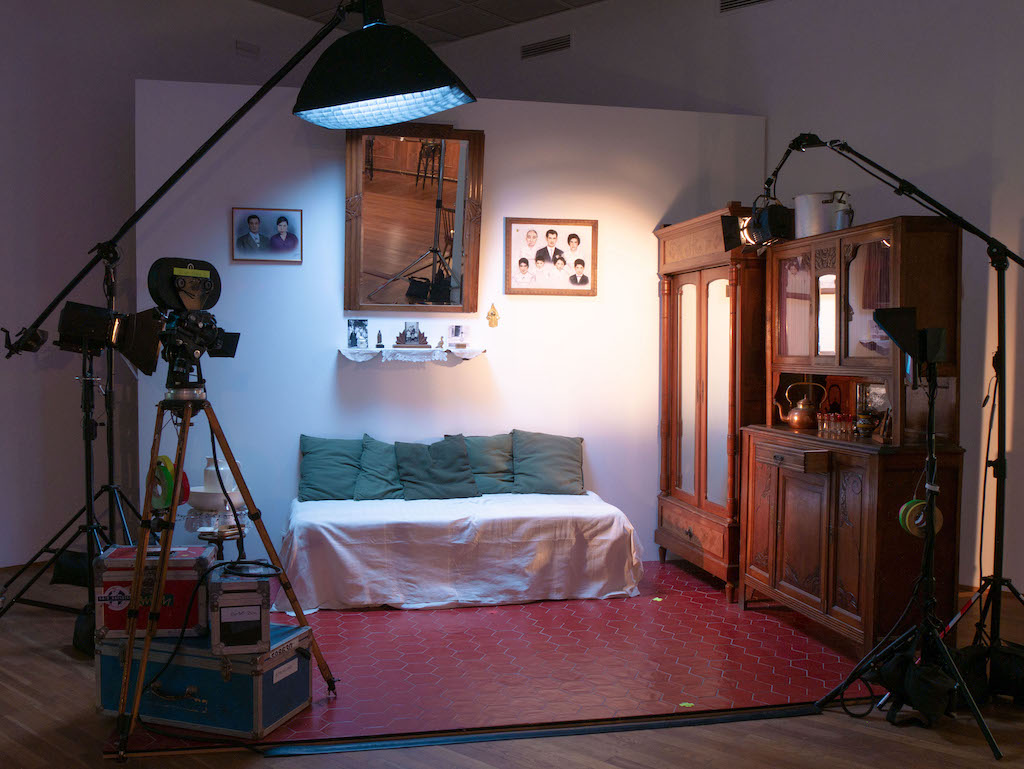 Her film Dreams Have No Titles is a kaleidoscopic meditation on colonialism, what it means to be an immigrant and the roles played by music, film, friends and family in creating a sense of identity in a foreign land where you don’t readily belong.
Her exhibition is not an easy ride; I found it profoundly unsettling. Despite the many shows I’ve been to addressing the topic of displacement, this is the first time I’ve had an inkling of what dislocation actually feels like along with the sense that, no matter how much effort you put into creating a home, as an immigrant it might always feel a bit like play acting – creating a set on which to perform a scene about belonging.
- Zineb Sedira: Dreams Have No Titles at the Whitechapel Gallery until 12th May
- More visual arts reviews on theartsdesk


