For admirers of Henri-Georges Clouzot or Brigitte Bardot, this Criterion restoration of their rarely seen 1960 collaboration is a must have. La Vérité may not be Clouzot’s greatest film, the pace is a little slow and for British viewers uninterested in the French legal system, the courtroom scenes may occasionally drag, but it’s a powerful film nonetheless.
Bardot plays coquette Dominique Marceau, bored of life in her provincial home town and her working class family. She persuades her parents to let her live in Paris with her prim older sister Annie (Marie-José Nat) a violin student at the conservatoire. High drama ensues when the siblings fall in love with the same man, the posh Gilbert Tellier (Sami Frey) a promising young conductor.
T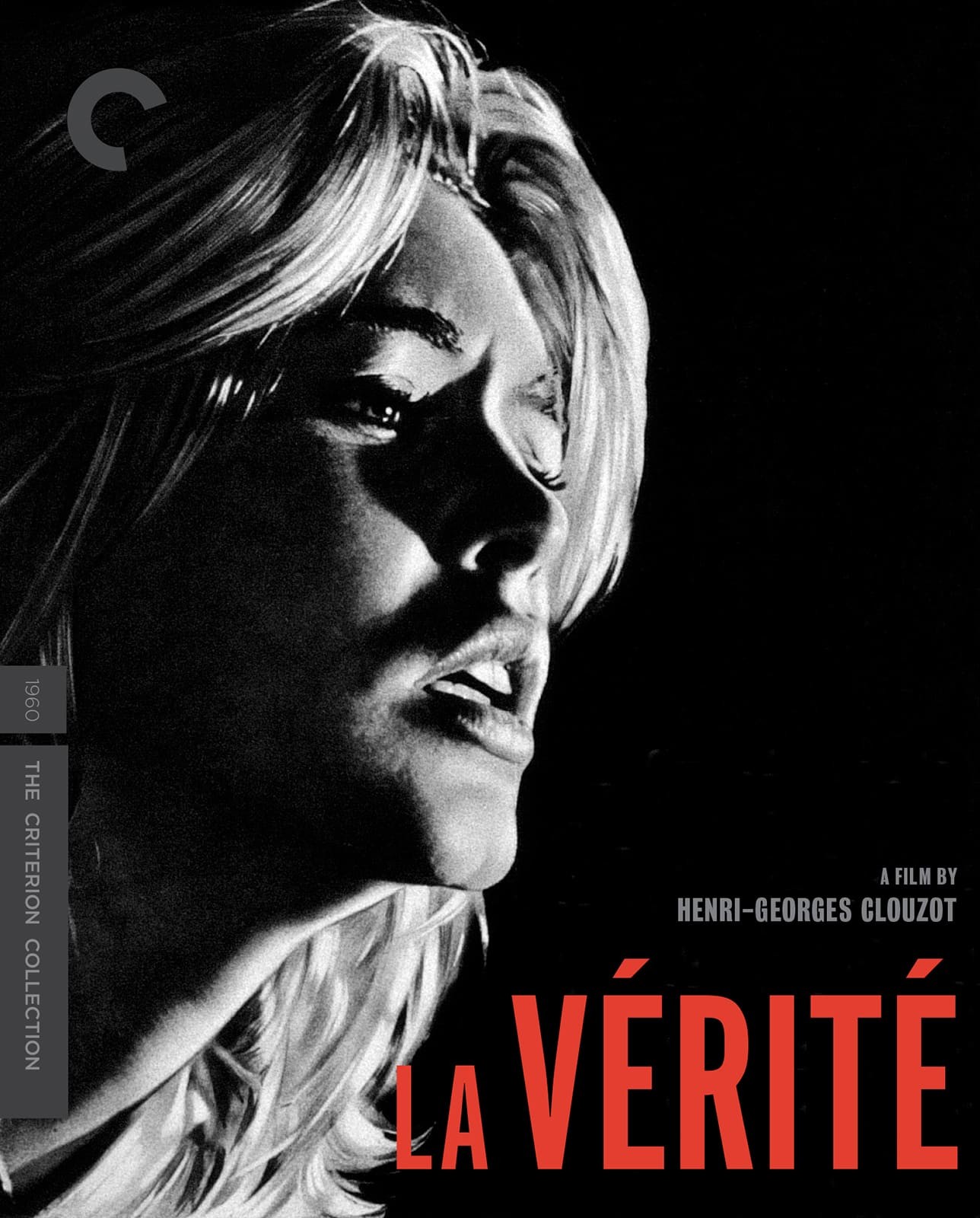 he narrative of La Vérité is weighted toward the lengthy legal scenes where Dominique is on trial for murder with the only question being whether she acted out of premeditated, innate wickedness or was driven to perform a crime passionel in a moment of despair at her failed romance. We leave the courtroom repeatedly for extended flashbacks which show the months leading up to the murder. Predating the French new wave, Clouzot created his own portrait of 1959 Paris with well-staged street scenes. The city has rarely looked more alluring as small-town girl Dominique revels in the beatnik clubs with their moody intellectuals and the late night bars complete with pinball machines and exotic black patrons.
Bardot in the scenes outside the court room is the quintessential minx. She's often bare legged, revealing quite a slice of pert derrière and always gorgeous. In one sequence in the dingy garret she shares with her sister, she performs a dance to some samba music playing on the gramophone. She is at once both lascivious and lazy; she’s lying down naked but for the sheets on her bed. But it's not all about her pouting and tossing that famous mane of blonde hair. La Vérité was Bardot's big chance to be taken seriously as an actress and in the courtroom scenes she gives it her all. There’s no make up and no holding back; this is a young woman who is not always lovable or even sympathetic but always a passionate presence. It’s an astonishing performance and will be a revelation if you’ve mainly seen her in sex kitten mode.
There’s an odd overlap between La Vérité and the underrated British film, Yield to the Night, made in 1956 and based on the Ruth Ellis story; it saw another screen siren, Diana Dors also striving to be taken seriously as she played a woman guilty of a crime of passion. Unfortunately Le Scandale Clouzot, the excellent documentary included as one of Criterion’s extras, doesn’t explore whether Clouzot had seen the earlier British film, which was also shot in black and white. Produced by the French cultural broadcaster Arté in 2016, Le Scandale Clouzot is an engrossing hour-long portrait of Clouzot’s troubled career, ranging from his earliest days as a witty lyricist to the controversies around his 1943 Le Corbeau (unique for being banned both by the German authorities occupying France and also by the Free French). The documentary provides ample psychological background on his tormented relationships with his wives and mistresses while covering his heyday as the writer-director of Quai des Orfèvres, Wages of Fear, and Les Diaboliques. In his prime, Clouzot rivalled Hitchcock for the title of Master of Suspense.
Arté lined up a range of insightful interviewees, including Bertrand Blier and Pierre Assouline and the quality and judicious use of film extracts and other archival material is particularly good. This edition of La Vérité also includes a 1960 TV studio interview with a very dry, self-deprecating Clouzot. He discloses that Sophia Loren was originally meant to be the star of La Vérité and how he had completely re-written the script to accommodate Bardot. There’s also an engrossing extract from a 1982 interview with Bardot herself, where she recounts the pressure she felt in the climactic courtroom scene as an untrained actor; friends and news coverage from the era explore how the film echoed events in her own turbulent personal life. Fascinating.