

The youngest of the seven children officially fathered by 1908-16's liberal Prime Minister, the writer-director Anthony Asquith was a socialist who wore a blue boiler suit on the sets of his films. If that was a gesture of solidarity with his crew’s gaffers and grips and the British working class generally, it carries over into the second of his four silent films, Underground, a light romantic-triangle melodrama that morphs unexpectedly into a cruel thriller and culminates in a vertiginous chase.
Asquith appears to pluck three of his four main characters at random from the hoi polloi packing the London Underground’s trains, platforms, and escalators. He clearly relishes the company of commoners Nell (Elissa Landi), a buoyant sales girl at a department store; Bill (Brian Aherne), an affable station guard; and Bert (Cyril McLaglen), a Lots Road power station electrician whose Jack the Lad aura is deceptive. As if unable to participate fully in metropolitan life, Kate (Norah Baring) is a neurotic seamstress who works at home, though she's eventually coaxed into the tunnels to frame Bill.
 Having first encountered Nell on a train, Bert begins to stalk her, but she’s barely fazed when he pins against her a wall on a Thistle Grove street and kisses her. (Elissa Landi and Cyril McLaglen, pictured right.) Instead, she falls for Bill, who returns a pair of gloves she's lost and takes her on an idyllic first date to a park.
There are moments in Underground that indicate the cineaste Asquith was familiar with the European “city symphony” vogue, but the sequence in which a sweet urchin approaches the lovers to snaffle food from their picnic is Dickensian. So is a long take in Kate’s room when the fidgety, ghostly pale girl, sexually manipulated and abandoned by Bert, goes mad.
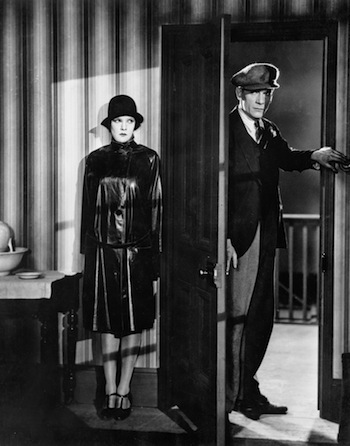
Scenes in a station stairwell and the shadowy house where Kate and Bert separately live draw on German Expressionism. Asquith would combine that style with Soviet montage in his great final silent, A Cottage on Dartmoor (1929), another story of sexual jealousy starring Baring.
The DVD and Blu-ray extras include a short on the BFI’s Underground restoration; brief footage of the boy Asquith with his parents at an airshow; and three shorts. spanning 1910-48, that show developments in the tube system. Neil Brand, who composed the film’s new music, contributes an essay.
Watch the trailer for Underground


