

Too Late Blues has many individual aspects which, on their own, would make it notable. Released in 1961, it was John Cassavetes’ second film as a director following the ground-breaking Shadows, one of America’s first full-length expressionist art films. As Shadows had, it centres on jazz and depicts a world which was then thriving, showing it from the inside. It stars Bobby Darin, one of America’s most important and multi-faceted musical figures. When taken together, with the added impact of its female star Stella Stevens, its inclusion of black cast members and disabled children, Too Late Blues was a rare, seamless combination of the unconventional and the mainstream.
After Shadows, Cassavetes had acted in the lead role and directed episodes of the TV series Johnny Staccato. The television experience informs Too Late Blues’ claustrophobic atmosphere, especially the close-up shots of characters conversing with each other and set-ups with a camera travelling through crowds.
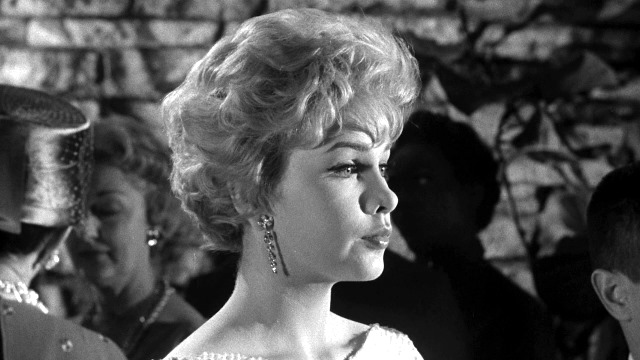 But this was made with cinemas in mind. The arc of the story of Darin’s John "Ghost" Wakefield and his involvement with Stevens’ brassy yet diffident Jess Polanski (looking remarkably like Darin’s real-life wife Sandra Dee) could not have been contained in under 60 minutes. In keeping with the film’s edginess, their complex romance and entanglement was never going to steer either of them towards suburban bliss. Yet the film’s sudden changes of gear make it feel like one episode of a TV series bleeding into the next. (Pictured right, Stella Stevens as Jess Polanski)
Too Late Blues is a rollercoaster, a sensation reinforced by the strength of both Darin – whose Ghost provocatively asks Jess, “You want be on top?” – and Stevens. Though described in his on-screen commentary (the package’s only extra) by critic David Cairns as a “top crooner”, Darin was much more than that. He knew from his youth as a sickly child that he was to die young and manically sought to excel at everything he turned his hand to: as a pop singer, interpreter of serious European compositions (“Mack the Knife”), songwriter, music publisher and actor – he never failed to make an impact. The package's fine booklet includes a thoughtful interview with Stevens,
Although often overlooked in favour of better-known and more challenging Cassavetes films like Faces and The Killing of a Chinese Bookie, the high-octane Too Late Blues should be sought out.
Overleaf: watch the trailer for Too Late Blues
Watch the trailer for Too Late Blues


