Strongroom is a film to be endured as much as enjoyed, Vernon Sewell’s low-budget thriller almost unbearable to watch in its final stages. Released in 1962 as a supporting feature, Strongroom depicts what happens when a bank heist goes badly wrong, leaving the branch manager and his secretary locked in a vault with just 12 hours of air. Unfolding over a long Easter weekend, the three gang members realise that if the bank staff suffocate, they’ll face a murder charge and capital punishment.
Colin Gordon and Ann Lynn spend most of their screen time in perspiring in their cramped, overheated cell, the relationship between them evolving as their oxygen and water supplies are consumed. Gordon’s strait-laced Mr Spencer tears off his tie, revealing that he never wanted to work in a bank but squandered his one chance to change tack, a man raised to believe that “to show emotion in any form is a sign of weakness”. Lynn is terrific as the introverted, intelligent Rose.
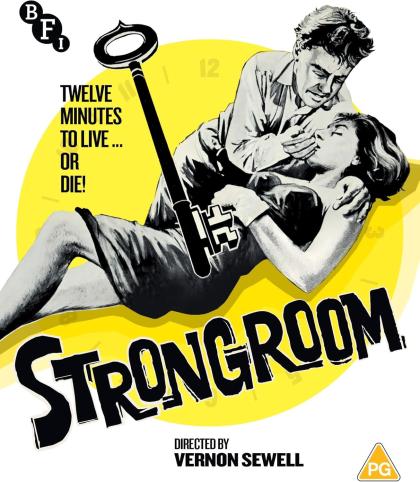
Meanwhile, Derren Nesbitt, Keith Faulkner and Morgan Sheppard squabble about how they can release the pair without incriminating themselves, their first plan being to leave the vault keys in a telephone call box and tip off the police anonymously. Nesbitt and Faulkner as Griff and Len are a charismatic double act. Strongroom’s final act sees the pair attempting to bore a hole in the strongroom door with an oxy-acetylene torch, and we’re desperate for them to succeed. It’s a gruelling but compelling film, lasting barely 80 minutes.
Nesbitt and Faulkner were cast after taking lead roles in Sewell’s previous thriller, 1961’s The Man in the Back Seat. It’s included here as a bonus, a superb London noir tracing the aftermath of a violent assault on a bookie. Here, the catch is that the holdall containing the loot is chained to the bookie’s wrist, the injured man bleeding to death in the back of his own car while Nesbitt (especially weaselly here) and Faulkner argue about how to offload him and make off with the money. Look out for the great Carol White as Nesbitt’s feisty wife, and steel yourself for another uncompromisingly dark conclusion.
BFI curator James Bell’s booklet essay provides a fascinating biography of an unsung figure in British film history, with Sewell described by Michael Powell as “the most competent man I have ever known”. A former engineer who stumbled into cinema after the Wall Street Crash, Sewell’s gift for devising inventive low-budget special effects led him to work on Powell’s The Edge of the World and The Spy in Black. Offered prestigious directorial opportunities after World War 2, Sewell declined, preferring to work with smaller studios where he had greater creative freedom. Among the extras on this BFI disc is one of his early shorts, a 27-minute drama about the perils of STDs sponsored in part by the Central Council for Health Education; this being 1937, gonorrhoea isn’t actually mentioned by name. Donovan Winter’s near-silent short film The Awakening Hour is an interesting curio, and we get a one-minute crime vignette called Footpads, shot, incredibly, in 1896. Josephine Botting and Vic Pratt provide bonus commentaries on the two features, and there’s an engaging Central Office of Information short from 1979 starring Colin Welland about the perils of driving at night.