Last year, Chineke! delivered one of the Proms’ more hard-hitting offerings, in a programme including Shostakovich’s Symphony No. 10, “50 minutes of brutality, despair and terror”, and Valerie Colman’s Fanfare for Uncommon Times, reflecting on the COVID pandemic and social upheaval. This year, by contrast, they blended nostalgia with unfettered escapism, mixing Dvořák’s uncharacteristically cheerful Symphony No. 8 in G major with the glitz and glamour of songs including Gershwin’s "Love Is Here to Stay" and Irving Berlin’s "Puttin’ on the Ritz".
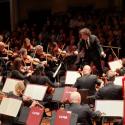
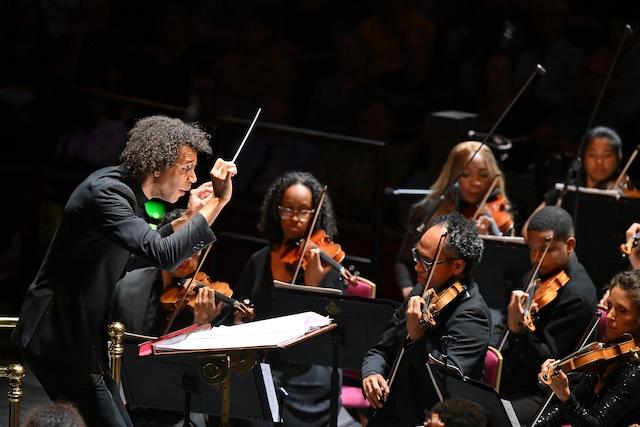
Conductor and Chineke! Interim Artistic Director Jonathon Heyward presided with style and élan over the entire evening. Each beat of the music seemed to pulse through his body as he shifted between gravity-defying euphoria and fast-paced panache.
The evening began with a polite soufflé of a ballet suite in three movements by the Africa-American composer Edmund Thornton Jenkins – rearranged by his great-nephew Tuffus Zimbabwe. Jenkins – who tragically died of appendicitis aged 32 in 1926 – was a pioneer in introducing jazz, blues, and other African music into his orchestral compositions. This felt like one of his more European works – after the shimmering brass fanfare at the opening, the strings and woodwind conjured up a world of birdsong, airy playfulness and velvety nights. Occasional thunderclouds loomed with Paul Philbert’s ominous timpani, but it was never long before the weightless joy of sunshine reveries intervened again.
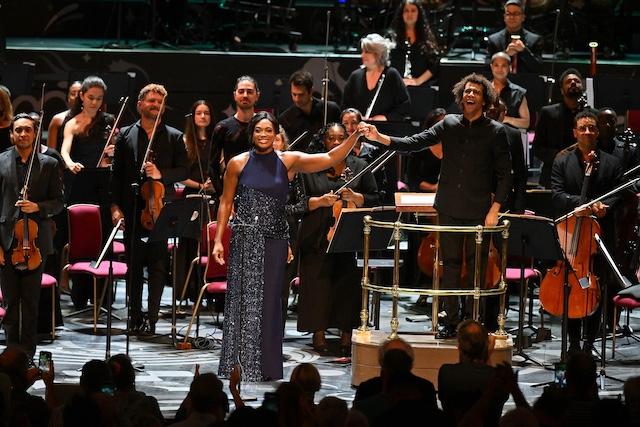
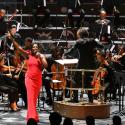
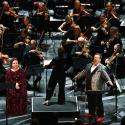
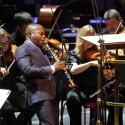
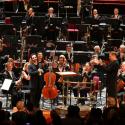
The second piece introduced the section of the evening in which soprano Angel Blue (pictured above and middle) performed works looking at different aspects of America. The first was Samuel Barber’s exquisitely melancholic Knoxville: "Summer of 1915", a setting of James Agee’s prose poem about a typical evening for his family in Tennessee the year before his father was killed in a car accident.
Blue – in a dress that shimmered like a dark waterfall – excavated all the ache and longing from harmonies that evoked the twilight world of families sitting “on their porches, rocking gently and talking gently and watching the street…”. The woodwind opening instantly transported us into the more meditative atmosphere of dusk. Later the woodwind, strings and brass combined would conjure up the rattle and rush of a “streetcar raising its iron moan; stopping; belling and starting,” in a jazzy passage heightened by sliding pizzicato effects. From time to time a magnificent French horn would deepen the sense of nostalgia.
We had been promised "Puttin’ on the Ritz" for the next number, but in a slight shake-up of the programme we were given Gershwin’s "Love Is Here to Stay". Blue had exited the staged in a jazzy passage heightened by sliding pizzicato effects. From time to time a magnificent French horn would deepen the sense of nostalgia.
Blue had exited the staged to return in a suitably jazzy red dress, dancing along to the orchestral accompaniment as she delivered top notes that swooped through the auditorium like summer swifts. The deep velvety tones that she deployed in "That Old Black Magic" sometimes had more of a problem navigating their way to the other side of the arena, but she was back on form for "My Funny Valentine", and her eventual jaunty delivery of "Puttin’ on the Ritz" (complete with a scene stealing trumpet solo) sent us all dancing out into the interval.
Dvořák, who was apparently among other things a great pigeon enthusiast, composed his Symphony No. Eight in a rush of creativity in the August and September of 1889 while relaxing at his summer retreat near Prague. Yet though it is overall one of his most joyful symphonies, it is also one of his most unconventional and complex, beginning with an angst-ridden melody in G minor played by the cellos, before evolving into a sunnier pastoral section in G major. Heyward deftly managed the shifting moods, whether he was drawing out gossamer-delicate playing from the violins as the flutes lilted like birds, or summoning up sudden tempests from the brass and timpani. Each twist and turn of this unexpected movement was managed with subtlety and precision.
The Adagio began with the smoothness of polished wood. Highlights included the recurring woodwind motif that seemed to evoke a Middle Eastern world significantly beyond Dvorak’s native Bohemia, contrasting with the bucolic simplicity of passages made up of descending scales on the violins. The sweeping waltz of the Allegretto grazioso movement brought a vigorous joy to the arena, while the Allegro ma non troppo, with its blazing trumpet fanfare opening, introduced an exhilarating series of variations ranging from a nimble flute section to a Turkish march.
A big part of the evening’s thrill was the sheer degree to which this orchestra’s musicians were attuned both to each other and to the angular dynamic figure of Heyward who seemed to function as a lightning conductor for the electricity in the hall. I’m looking forward to hearing them tackle something more meaty again in the future, but this was a fantastic effervescent diversion for a balmy summer’s evening.