
theartsdesk in Zanzibar: The Nightingale Still Sings | reviews, news & interviews
theartsdesk in Zanzibar: The Nightingale Still Sings
theartsdesk in Zanzibar: The Nightingale Still Sings
Performers at the Sauti Za Busara Festival argue that music has never had a more vital role
Sunday, 10 March 2013
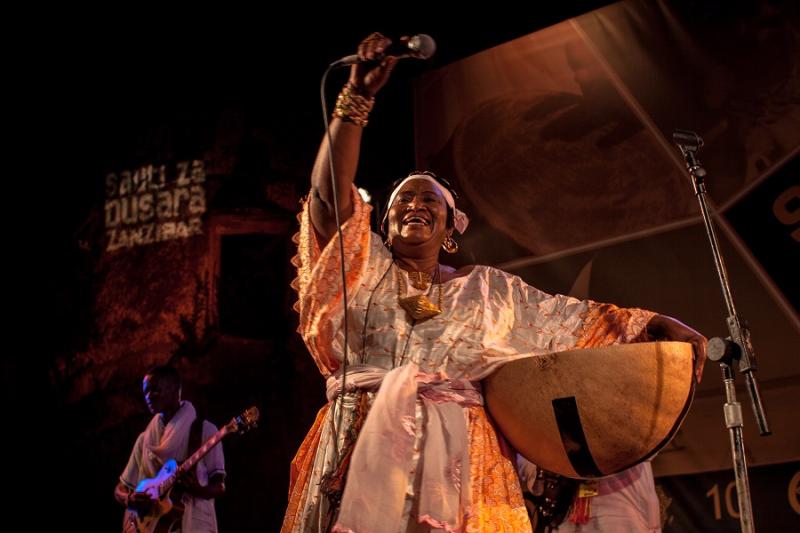
Khaïra Arby, the Nightingale of the North, performs at the Busara FestivalAll images Peter Bennett
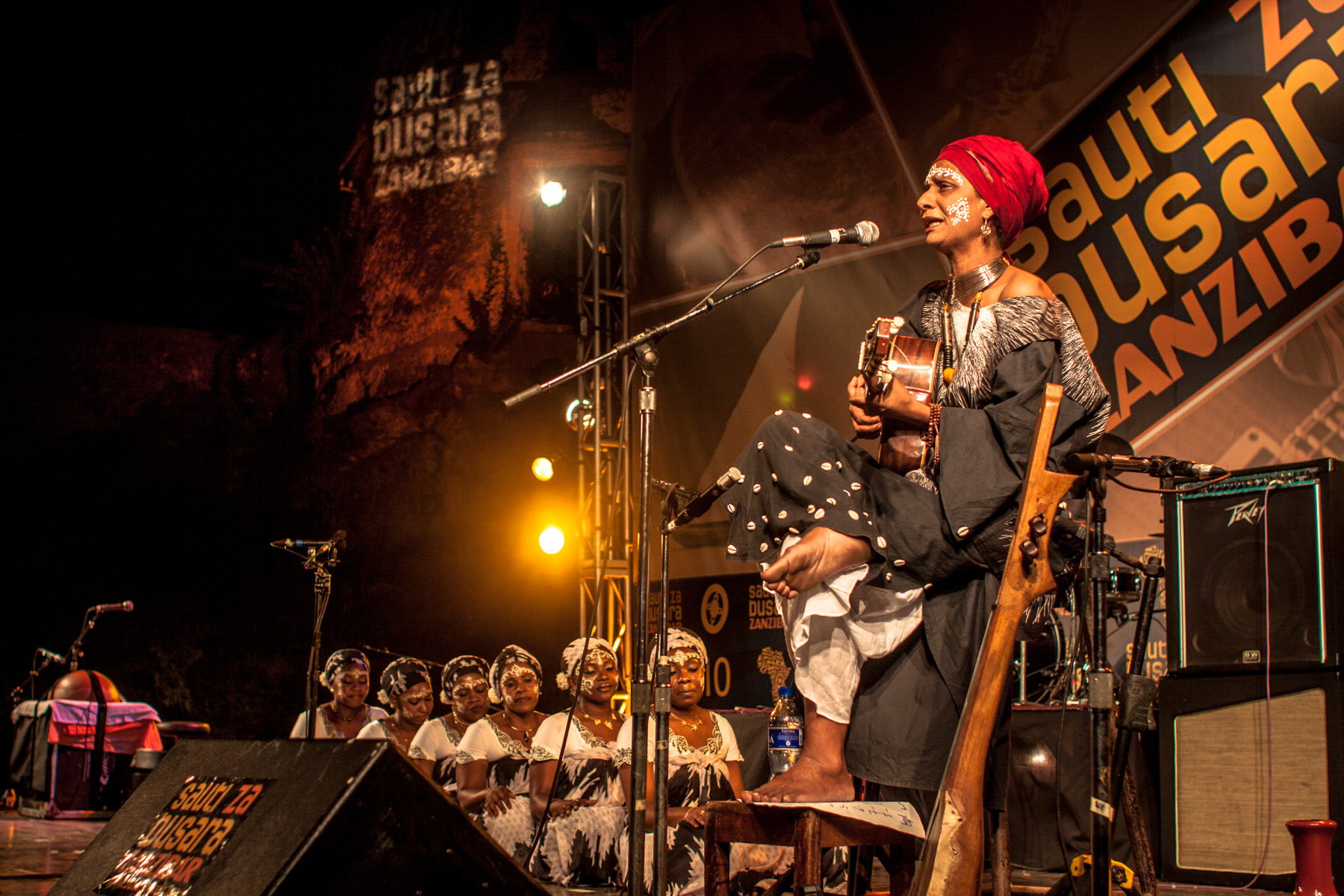
A crowd of men and younger women in full burkahs gathers, bewildered by the sight: an African woman, in West African “Mumu” (khaftan) and a covered head, playing Ghazals (Islamic calls to prayer). Accompanied by an acoustic guitar, a clear voice, sitting on a café terrazza, Nawal transports us: until it is broken. “How dare you use the name of Allah in a song?!” cries out a dishevelled street vendor, visibly upset. “But you use keyboards in your praise of Allah” she retorts calmly.
It is 1pm, several hours before the Sauti Za Busara festival is about to begin. From the 12th-century Omani fort behind us, the sound of musicians doing sound checks. It's a few days before the rainy season is due to start, it's unbearably hot and dusty. Nawal (pictured below) however, who has just flown in from the Comorros, and wrapped in several layers of cloth, seems unperturbed.
I’ve seen friends who’ve had their hands cut off for the ring tones on their mobile phones
Even now, in 21st-century Zanzibar, population 99 percent Sunni Muslim, music has the power to inflame, just as it did in the sixth century in Persia, when music, mosaics and poetry were created or invoked to be “nearer to Allah/God”. The ancient divisions remain. The more tolerant Sufi branches of Islam believe arts and music are expressions of meditation. The more conservative factions believe devotion should be silent, personal, contemplative reverberate with existential questions. What is faith? What is your relationship to spirituality? What does it mean to follow a true path?
In Sudan the vibrant and dynamic musical group Camiraata tries to address these problems: bringing together families, tribes, clans from Sudan, North to South, they sing their way through serious political and domestic issues. “Music and culture is about understanding,” says band member Da’Affallah, who is also director of Sudan’s Music and Culture Academy in Khartoum. “If you know my music, my religion and my culture, you respect me.”
 For the Sudanese, as for many across Muslim Africa, music is integral in community disputes, initiation rituals, the unusual and the everyday. “We never ever stop singing!” Da’Affallah explains, and as if to illustrate the point he breaks into song. “Music in Sudan is absolutely everywhere, and has been for many, many centuries. Music is life in Sudan, from birth to death. When the woman makes tea or coffee in the morning she has a special song [he starts singing]. She has a song and she grinds out the pestle in time as she grinds coffee. Then we have special ‘albaramka’ for tea, this is a group song, using our voices.” It sounds like Mongolian throat singing. “We sing love songs to our camels, because we depend on them. We sing to the desert, so it won’t kill us. If we have problems in the community, we bring together everyone to solve the problem, we consult the elders, we talk, we sing, we talk more!”
Khaïra Arby (main picture) looks regal with her plush blue dress plumped out, and dramatic head wrap. She sits on a wonky plastic chair which is incongruous in a 12th-century fort. Her face is lined and tired. She has just got off a plane, after 14 hours’ travel from West Africa. Just stepped out of a war zone and a country that is dominating the headlines: Mali. “Yes, it’s true, I’ve seen it myself, they will cut off your tongue if you sing. I’ve seen friends who’ve had their hands cut off for the ring tones on their mobile phones”.
Adored by Malians north and south, Khaïra is affectionately called the Nightingale of the North. She was born in the village of Abaradjou in the Sahara Desert north of Timbuktu, her parents came from different ethnic backgrounds, mother Songhai and father Berber. Her music, which is vastly more popular at home than that of her internationally famous cousin Salif Keita, captures the numerous ethnic groups, styles and poetry of the north of Mali.
 After persistent threats from the Islamists – including smashing up stereo systems in markets and people’s homes, confiscating radios and even SIM cards with music on them - Khaïra relocated to Bamako, Mali’s capital, to stay with Salif Keita on his island just outside the city.
Salif Keita is also resigned. After the Islamists desecration in 2012 of the ancient shrines in Timbuktu's mosques which are UNESCO World Heritage sites, he says “If there's no music, no Timbuktu, it means that there is no more culture in Mali." Timbuktu, it is now accepted, is part of a chain of African kingdoms that were educated, literate and intellectual long before Europe. Timbuktu was the site of one of the largest Islamic libraries in Africa, and a meeting point for scholars, who contributed to the established Islamic tradition of debate and interpretation of the Koran.
 However last June, the shrines were declared by the Islamists to be idolatrous. Like many, both in Mali, and in the diaspora, Khaïra Arby (pictured right) is bewildered: “There’s not a single part of the Koran that forbids music, I‘ve read it all, I can tell you honestly, there’s nothing in there that says don’t sing. I’ve never seen, never, that music is forbidden.”
Nawal (pictured top), a committed practising Muslim from the Comoros islands (thousands of miles from Mali), is also clear that there’s nothing in the Koran that forbids singing. She sees herself as a bridge between secular and religious, Africa and Europe, earthly and mystical. She is currently being considered by the UN as woman’s ambassador. “I am unique, I can say, because I sing the Muezzin, the call to prayer. The woman in my country they can sing the Muezzin only if there’s no man available, and without the microphone. I sing for my hopes, my values, it’s like a communion. I want the public to forget I am an artist. I don’t say, ‘Let’s go pray.’ I just say, ‘God is big, there is nothing that is not God.’ So if someone kills me for saying that, they kill me for praising God. I am not here to change people, I am here to shine, the more I become light, the more I become the sun, the people they can see it, if they are ready.”
 She recounts a story at an international festival in Belgium when the mostly Muslim crowd complained, and nearly revolted. Only later did Turkish, Palestinian, Tuareg and Syrian Muslims of both genders come up with tears in their eyes, having realised that her “songs” were moving and profound.
Dozens of Malian musicians have fled south since the crisis began, and the Malian government recently asked its own citizens and Diaspora to fund the war effort (hundreds of private businesses have donated undisclosed sums). The international West African community is attempting to band together to draw attention to the situation which has far-reaching effects across West Africa.
Cheikh Lô (pictured above left), a Senegalese veteran and the Miles Davis of African music, is passionate and angry. He is also a firm believer of Islam, in the Baye Fall Sufi tradition, and has practised for many years. “These people misuse the name of Islam, they are nothing to do with Islam, they are terrorists and we must have the dirigence [direction, composure] to drive them out. Since the Seventies we’ve seen Mali and Senegal penetrated by Islamists.”
 He’s getting really animated now, despite the intense afternoon sun; his thick heavy three foot long dreadlocks must be very hot. The Busara stage (pictured above with N'Faly Kouyaté performing) is being prepared behind us. “It’s really tricky, the issue of complicity: Africa doesn’t have a single arms factory! Not a single ability to make airplanes, arms, bazookas, so the Europeans are complicit as well, it’s Europe that’s selling us the arms, allowing these conflicts to flourish. It’s the same people who come to Africa with their arms, watch us kill each other, tak tak, and then ask us for the money! Why? It has to stop! How is it that Europe, with 12 states, it’s one community? USA 52 states, they are both unified as one community. Why is it Africa cannot unite as a continent?”
Khaïra Arby is also highly skeptical about the Western media’s conventional portrayal of Mali’s conflict. “This war is about drug-running and arms trafficking. It’s about controlling important routes through a very long-term trade area. It’s about money, politics and control. It’s not about religion.”
All these African musicians are united behind the idea that in these times of strife, Muslim musicians are more important than ever. “The real musician does not go out to nightclubs,” says Da’Affallah, “but he stays in the community, and leads to the right way. This means peace, unity, understanding, communication. We must reflect the reality.” “We have an obligation to sing, to dance,” says Khaïra, “to respect and to show appreciation for the suffering and the endurance and bravery of the people who are fighting for us, for those who cannot sing; we must compose beautiful songs before the war, during the war, after the war, to celebrate what we have.”
The future of Arts Journalism
You can stop theartsdesk.com closing!
We urgently need financing to survive. Our fundraising drive has thus far raised £49,000 but we need to reach £100,000 or we will be forced to close. Please contribute here: https://gofund.me/c3f6033d
And if you can forward this information to anyone who might assist, we’d be grateful.

Subscribe to theartsdesk.com
Thank you for continuing to read our work on theartsdesk.com. For unlimited access to every article in its entirety, including our archive of more than 15,000 pieces, we're asking for £5 per month or £40 per year. We feel it's a very good deal, and hope you do too.
To take a subscription now simply click here.
And if you're looking for that extra gift for a friend or family member, why not treat them to a theartsdesk.com gift subscription?
more New music
 theartsdesk on Vinyl 91: Sex Pistols, Pink Floyd, Tropical Fuck Storm, Sparks, The Sisters of Mercy and more
The vastest regular record reviews in the galaxy
theartsdesk on Vinyl 91: Sex Pistols, Pink Floyd, Tropical Fuck Storm, Sparks, The Sisters of Mercy and more
The vastest regular record reviews in the galaxy
 Album: Durand and the Indications - Flowers
Langourous neo-soul to chill by
Album: Durand and the Indications - Flowers
Langourous neo-soul to chill by
 Music Reissues Weekly: The Sonics - High Time
Handsome box set of seven-inchers celebrating the ferocious Sixties rockers
Music Reissues Weekly: The Sonics - High Time
Handsome box set of seven-inchers celebrating the ferocious Sixties rockers
 Album: Benson Boone - American Heart
Retro-Americana, pop-rock sheen, and big-hearted ballads - all with a wink
Album: Benson Boone - American Heart
Retro-Americana, pop-rock sheen, and big-hearted ballads - all with a wink
 Album: Yungblud - Idols
Dominic Harrison’s latest disc fails to live up to the hype
Album: Yungblud - Idols
Dominic Harrison’s latest disc fails to live up to the hype
 Patrick Wolf, Rough Trade East review - the Kent-based bard refashions his new album ‘Crying the Neck’
Despite its record shop setting, this magnetic performance is a show as such
Patrick Wolf, Rough Trade East review - the Kent-based bard refashions his new album ‘Crying the Neck’
Despite its record shop setting, this magnetic performance is a show as such
 Album: Loyle Carner - Hopefully!
Carner takes a deep breath with his latest release
Album: Loyle Carner - Hopefully!
Carner takes a deep breath with his latest release
 Album: HAIM - I Quit
The Californian trio convincingly continue their ascent to the top of the pop-rock tree
Album: HAIM - I Quit
The Californian trio convincingly continue their ascent to the top of the pop-rock tree
 Bonnie Raitt, Brighton Dome review - a top night with a characterful, very American blues rock queen
The US star concludes her UK tour with a rockin' south coast send-off
Bonnie Raitt, Brighton Dome review - a top night with a characterful, very American blues rock queen
The US star concludes her UK tour with a rockin' south coast send-off
 Hidden Door Festival 2025 review - the transformative Edinburgh event's most site-specific festival yet
Art and machinery align in former paper factory
Hidden Door Festival 2025 review - the transformative Edinburgh event's most site-specific festival yet
Art and machinery align in former paper factory
 Pulp, O2 Arena review - common people like us
Jarvis Cocker's mature muse proves ready to follow fans through their lives
Pulp, O2 Arena review - common people like us
Jarvis Cocker's mature muse proves ready to follow fans through their lives
 Sam Fender, St James' Park, Newcastle review - Geordie Springsteen scores with celebratory homecoming
The singer's set was a passionate, emotional display of rock music
Sam Fender, St James' Park, Newcastle review - Geordie Springsteen scores with celebratory homecoming
The singer's set was a passionate, emotional display of rock music
Add comment