

With a reputation as the prince of unflinching emotional catharsis, Kenneth MacMillan emerged from the Royal Ballet’s triple bill marking the 20th anniversary of his death as a lord of lyricism. The new bill presents MacMillan three ways, his academic instincts, intellectual imagination and emotional vision - a bold versatility you (whisper it) almost never see from today's choreographers. And it was a surprise that the most heart-felt performance came in the elegiac melancholy of his ballet Requiem, commemorating his own death quite as evocatively as it must have originally lamented that of his friend John Cranko, for whom he created it in 1976.
The draw-factor for balletomanes was something more characteristic of his general reputation, a tight, compressed little horror-drama that the Royal Ballet has only twice before performed, Las Hermanas (The Sisters), in which sex brings downfall to all. Very MacMillan - and about time this company (which is steeped in his large three-acters) attempted one of the higher-proof one-acters that reveal the radical in this most intriguing choreographer’s soul.
It was made for the less conventional German troupe of Stuttgart in 1963, the start of his best creative period as a dissident from the Royal Ballet, and it blazes hallmarks of modernism. It opens with a silent tableau, as (cinema-style) we see a passionate kiss, and the girl creeping back into her house - this much, realism - and joining her four sisters, as they seem to clutch their stomachs in pain in a row of rocking-chairs monitored by a fierce mama - this switching to expressionism.
The music has a peculiar, woozy quality which makes me think of the dentist’s, and the kind of pain you anticipate from a long way off
The picture designed by Nicholas Georgiadis is all black and white, the lighting stark, the clothes stark, the movement like a semaphore of frigid no-no or orgasmic yes-please. The dance argument extracted by MacMillan from the original play by Federico García Lorca, The House of Bernarda Alba, is that sex's vast repertoire of body language is a code for all sorts of other political ideas (he's done much sexier sex in other ballets).
The eldest sister, sitting far left in the row of rocking-chairs, must be married first, before the option passes down the line from left to right, in age order. The fact that - in Zenaida Yanowsky’s wrenchingly powerful performance - the eldest loathes and fears sex with every fibre of her being, and the further fact that the intended husband has already had her eager youngest sister, add up to a fatal outcome. But in parallel to the plot is a very powerful image, that of five sisters, and the way MacMillan has them invade and scurry through the stage, clumping in little alliances, falling into line, or attacking each other, creates a strange invitation to see them as aspects of one complicated person - the creator, the viewer.
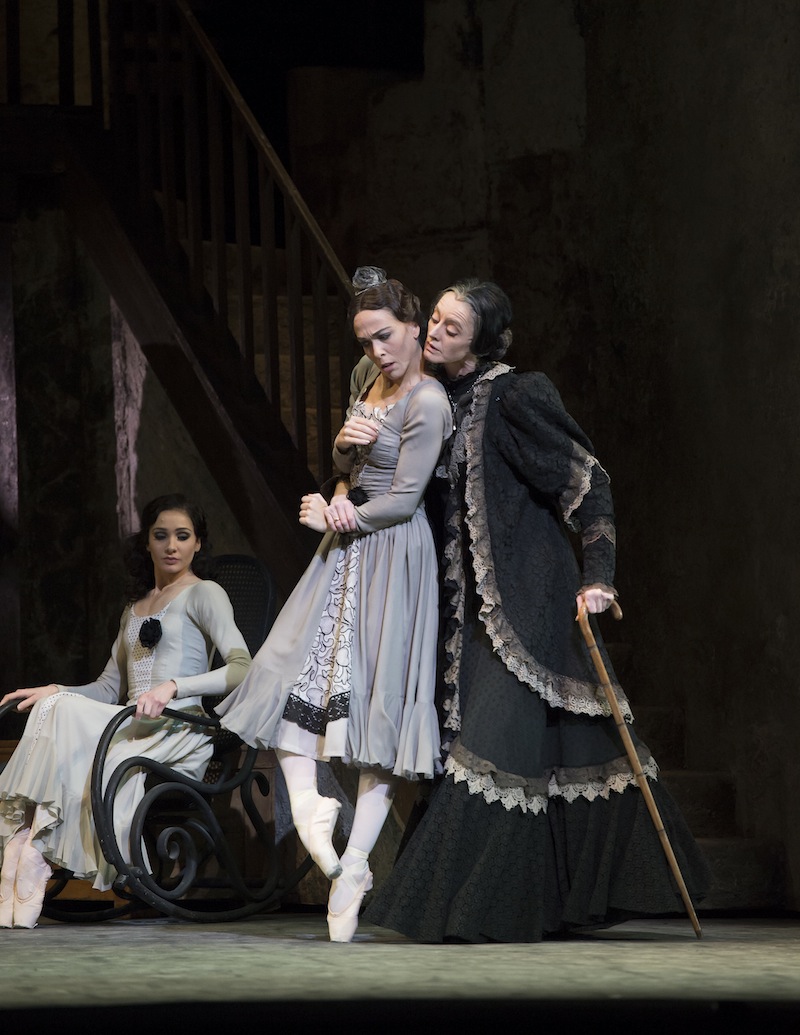 Frank Martin’s music, with a harpsichord central, has a peculiar, woozy quasi-baroque quality to it which makes me think of the dentist’s, and the kind of pain you anticipate from a long way off. The piece is tightly constructed, the choreography verges on mime, and toppling over that line is the trap that needs to be avoided as this talented first cast settle in (if they can, given just three performances).
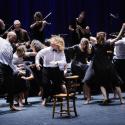
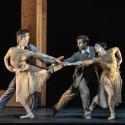
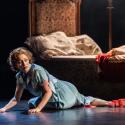
The lacuna in the drama was Elizabeth McGorian’s Mother, stomping like a panto witch with her stick, rather than a hurt woman with decades of fiery anger banked up (as I recall Genesia Rosato doing in a show in 1998). The Mother should bully the stage, dictate the timing, force us all into line. As it was, Yanowsky did all the work to carry the piece, and she couldn’t do it all on her own. (Pictured right, McGorian terrorises second daughter Laura Morera.)
Thiago Soares was fine as the opportunist, hirsute husband-to-be, dirtily assessing the shagging qualities of all the sisters. The thing MacMillan’s choreography brings out strongly with its marionette gestures, teetering circles and furtive glances is that in this particular household entire lives ride on absolutist decisions that countermand natural differences; there is no soft tissue there, no learning possible. From time to time Martin's music jars with a movie melodrama and the grotesquerie of the end misfired on the first night, but this is a ballet of many ideas worth exploring by the cast.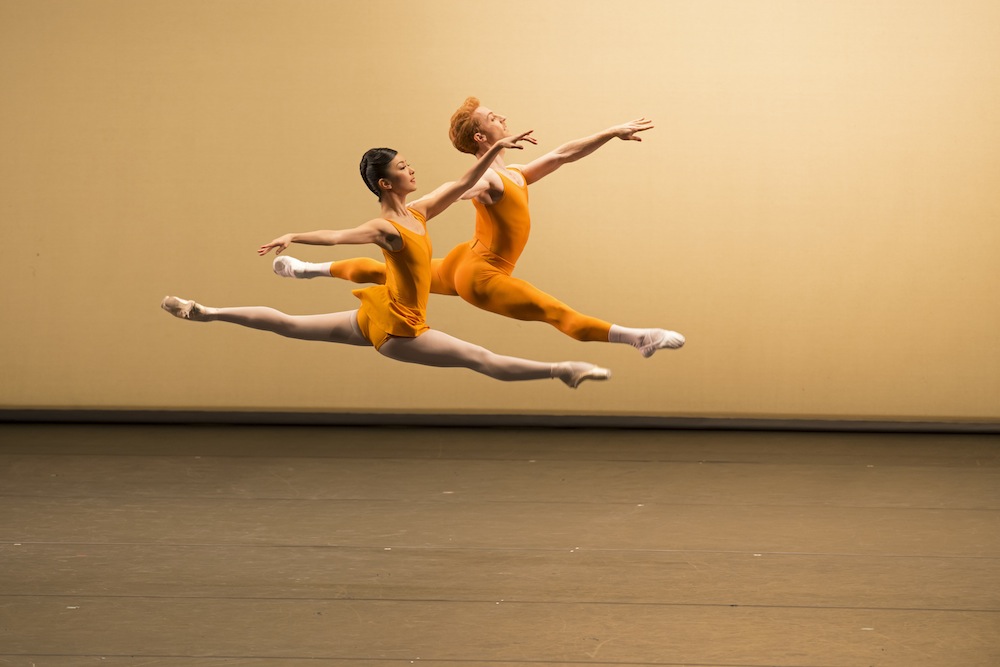 Before it comes the variably interesting neo-classical Concerto, whose first movement is a weak school-level sortie towards Balanchine, but which suddenly flowers in the poised, dreamily inventive adagio, and a lively deployment of formation-ballet in the third movement. Part of the trouble is the oddity of Shostakovich’s second piano concerto, sandwiching a luscious Rachmaninovian romance between two schoolroom pastiches of Prokofiev and piano exercises (here played in workaday fashion by Kate Shipway).
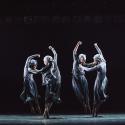
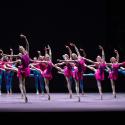
The prime draw of this work is the slow movement pas de deux and its haunting trio of couples behind, and you beg for some goddess of sculptural opulence of today to emerge to emulate the divine voluptuousness of Lynn Seymour, its original muse. Cast here we had Sarah Lamb, who is a slender moonbeam of a creature capable of drawing refined lines of lovely planetary remoteness, but wrapping space around her like a warm cloak is not something natural to her. She was supported with fine discretion by the handsome Ryochi Hirano, a truly promising squire of old-fashioned porteur virtues. But with an under-excited opening couple, Yuhui Choe and Steven McRae (pictured above), the inferior first movement fell flat, and a miscast Itziar Mendizabal was not capable of the fizz of the third movement’s ballerina role.
What a difference a believing, familiar, totally comprehending cast makes
After a so-so Concerto and semi-achieved Las Hermanas, MacMillan’s full lustre rested on Requiem - and what a difference a believing, familiar, totally comprehending cast makes. Requiem has one of the most breathtaking sets in all ballet - tall, celestial light-boxes by Yolanda Sonnabend - an expertly emotive score by Fauré, and some of MacMillan’s most fluid ensemble sculpture, but it has never in my memory registered so strongly as it did here, with this mature cast and some rapt singing from the Royal Opera chorus.
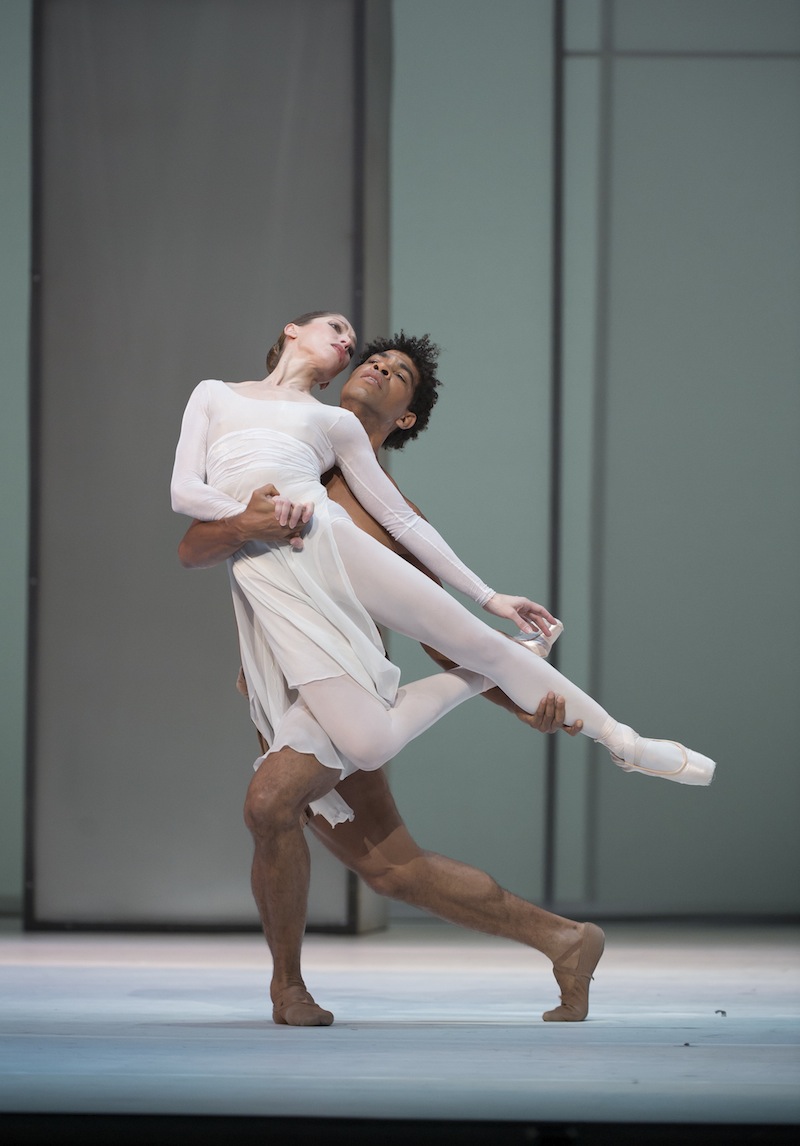 The choreography makes a compelling balance between group formations and three individuals - a man half-naked in a loin-cloth, a woman in a soft white tunic and another woman in sexless all-over tights scribbled with purple tendrils leading the ensemble. Between them they evoke images of the dead, the living, the Madonna, the newborn, the soul, hope - while the dance chorus, linked in constantly graphic variations like friezes circling around ancient Greek pots, have an emotional role as powerful and suggestive as the crowd we all belong to.
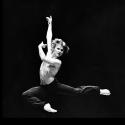
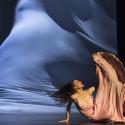
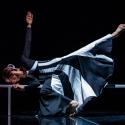
Carlos Acosta now dances the vulnerable man with a gripping, piercing economy; Leanne Benjamin remains the ne plus ultra of the ethereal, airborne Madonna/child/dove in white, a quite extraordinary interpretation with her tiny body and big, merciful hands; while I think Marianela Nuñez may have done nothing finer than the proud, gracious Everywoman. This devoted company performance revealed something about the dancers, that they knew without doubt (as they did not with the other two works) that this is a ballet to rediscover self-belief in, testament to a great choreographer of superb imagination and most honest humanity. (Pictured right, Benjamin and Acosta)
Listen to Dmitri Shostakovich playing the central adagio movement from his own second piano concerto in 1958 with conductor André Cluytens and the Orchestre National de la Radiodiffusion Française:



Add comment