
Vengerov, St Petersburg Philharmonic Orchestra, Temirkanov, Barbican Hall | reviews, news & interviews
Vengerov, St Petersburg Philharmonic Orchestra, Temirkanov, Barbican Hall
Vengerov, St Petersburg Philharmonic Orchestra, Temirkanov, Barbican Hall
The Russian violinist's London return is a little subdued, but the orchestra lets rip
Sunday, 25 March 2012
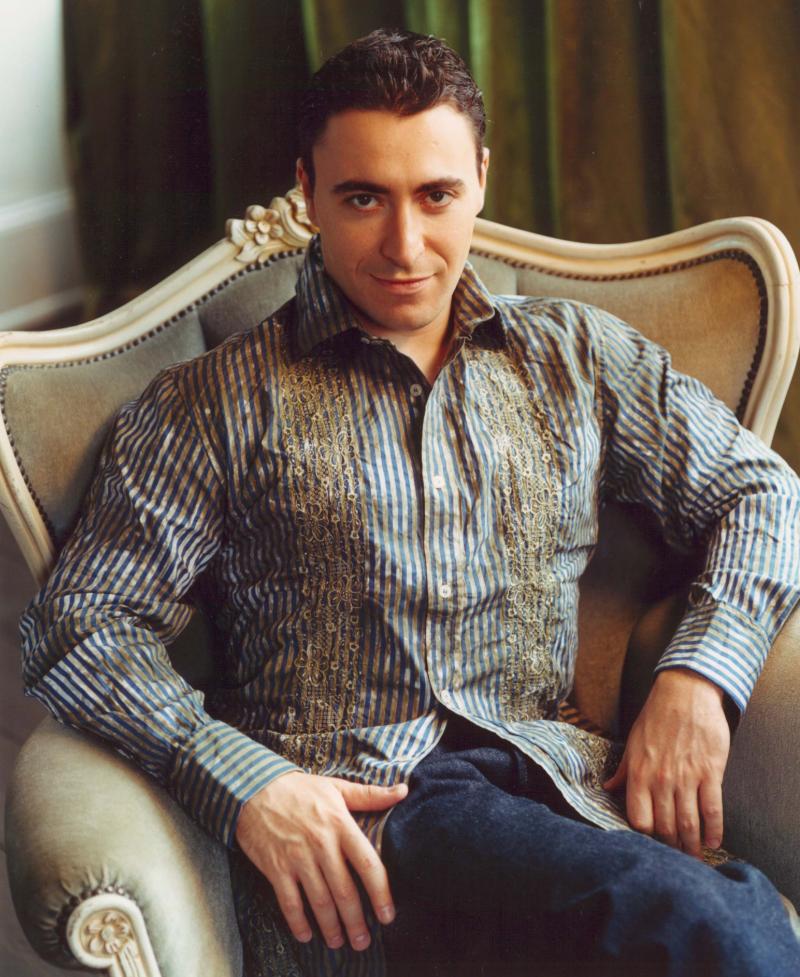
Maxim Vengerov relaxing, minus his violinSheila Rock
Originally, this concert was to open with that mercurial wonder Martha Argerich playing an unspecified piano concerto. Then its first item became Martha Argerich not playing anything, for the good lady, almost as rare a visitor to Britain as the Man in the Moon, did what she’s famous for doing. She cancelled. Acting with award-winning panache, the Barbican then found a substitute artist who’s recently become even rarer, the violinist Maxim Vengerov.
Known for his golden tone, charisma and fire, Vengerov last performed in Britain with his violin in 2007: the year of his serious shoulder injury (on his bowing arm, too), which prompted prolonged rest and a recalibration of a stellar career. Since then he’s spent time gearing up to be a conductor. He’s developed a music school for gifted pupils in Israel. He’s worked on humanitarian projects. He’s got married. What he hadn’t done, until last year, was appear anywhere with a fiddle under his chin.
He conjured the sounds of lurching Russian peasants, even saw mills
But he did so in London last night. As he launched upon Prokofiev’s Violin Concerto No 1, the hors d’oeuvre in the St Petersburg Philharmonic’s Russian feast, it was clear that things had altered. The tone was wirier, less flamboyantly lustrous, more vulnerable – a colouring actually suitable to the decorative silver threads that make up much of this gorgeous concerto’s solo part. At opportune moments, when the notes allowed, Vengerov kept fussing with his violin, adjusting the chin position here, slipping in a spot of quiet tuning there. Was this nerves, or good husbanding? Both, perhaps.
The playing also seemed more studied than before, more sober and responsible, less a force of nature. The old Vengerov would have carried us airborne in the finale, the notes effortlessly spinning forth without pause. The new Vengerov didn’t make it seem so easy; it’s as if he was afraid of heights. At the same time, you had to be refreshed and jolted by his swift and various changes of attack, the tone suddenly shifting, say, from limpid sighs to husky croaks. Down in the lower register, as Prokofiev’s dazzling kaleidoscope turned this way and that, he conjured the sounds of lurching Russian peasants, even saw mills. I also heard, especially in his Bach sarabande encore, masterful and heart-stopping moments of pensive beauty: hopefully a good omen for his Wigmore Hall recital on 5 April (sold out, of course).
With all eyes and ears on Vengerov, it was easy to forget that the St Petersburg Philharmonic and Yuri Temirkanov, their Principal Conductor of almost 25 years, were actually in the building. But they came into their own in Shostakovich’s Leningrad Symphony, inspired by their own city’s wartime agony. The blaze produced at the end was incredible: weighty, resplendent, but almost frightening. When he’s working as a guest conductor Temirkanov can be unpredictable; but with his own players under his fingers he buckled down to a powerful, entirely sensible reading, conveying as strong a sense of sustained argument as Shostakovich’s sometimes wandering score allows.
Was it Hitler’s war or Stalin’s? It was both; it was all wars
That famously banal theme in the first movement, spattered with snare-drum pattering, proceeded nonchalantly, almost humorously, for quite a stretch (the brass’s casual phrasing was delicious). All the more telling, then, when the slow crescendo accelerated, the knife was twisted, and the idle phrase became the musical motto of a war machine on the march. Was it Hitler’s war or Stalin’s? It was both; it was all wars. Similar magic was worked in the stitched sections of the finale, while the middle movements offered happy chances to enjoy the colourful timbre of brass and winds. Didn’t you just love the sepulchral rasp of Alexey Silyutin’s contra-bassoon?
Following the Leningrad, Temirkanov proved himself a most considerate guest. You’d normally expect a visiting orchestra like his to come with a homegrown encore, some Russian jewel. Instead they offered a heart-swelling account of one of our own, Nimrod from Elgar’s Enigma Variations: the perfect emollient after such a symphony of battering, barricades and barbed wire.
The playing seemed more studied than before, more sober and responsible, less a force of nature
Share this article
The future of Arts Journalism
You can stop theartsdesk.com closing!
We urgently need financing to survive. Our fundraising drive has thus far raised £49,000 but we need to reach £100,000 or we will be forced to close. Please contribute here: https://gofund.me/c3f6033d
And if you can forward this information to anyone who might assist, we’d be grateful.

Subscribe to theartsdesk.com
Thank you for continuing to read our work on theartsdesk.com. For unlimited access to every article in its entirety, including our archive of more than 15,000 pieces, we're asking for £5 per month or £40 per year. We feel it's a very good deal, and hope you do too.
To take a subscription now simply click here.
And if you're looking for that extra gift for a friend or family member, why not treat them to a theartsdesk.com gift subscription?
more Classical music
 BBC Proms: Alexander’s Feast, Irish Baroque Orchestra, Whelan review - rapturous Handel fills the space
Pure joy, with a touch of introspection, from a great ensemble and three superb soloists
BBC Proms: Alexander’s Feast, Irish Baroque Orchestra, Whelan review - rapturous Handel fills the space
Pure joy, with a touch of introspection, from a great ensemble and three superb soloists
 BBC Proms: Moore, LSO, Bancroft review - the freshness of morning wind and brass
English concert band music...and an outlier
BBC Proms: Moore, LSO, Bancroft review - the freshness of morning wind and brass
English concert band music...and an outlier
 Willis-Sørensen, Ukrainian Freedom Orchestra, Wilson, Cadogan Hall review - romantic resilience
Passion, and polish, from Kyiv's musical warriors
Willis-Sørensen, Ukrainian Freedom Orchestra, Wilson, Cadogan Hall review - romantic resilience
Passion, and polish, from Kyiv's musical warriors
 BBC Proms: The Marriage of Figaro, Glyndebourne Festival review - merriment and menace
Strong Proms transfer for a robust and affecting show
BBC Proms: The Marriage of Figaro, Glyndebourne Festival review - merriment and menace
Strong Proms transfer for a robust and affecting show
 BBC Proms: Faust, Gewandhausorchester Leipzig, Nelsons review - grace, then grandeur
A great fiddler lightens a dense orchestral palette
BBC Proms: Faust, Gewandhausorchester Leipzig, Nelsons review - grace, then grandeur
A great fiddler lightens a dense orchestral palette
 BBC Proms: Jansen, Royal Concertgebouw Orchestra, Mäkelä review - confirming a phenomenon
Second Prom of a great orchestra and chief conductor in waiting never puts a foot wrong
BBC Proms: Jansen, Royal Concertgebouw Orchestra, Mäkelä review - confirming a phenomenon
Second Prom of a great orchestra and chief conductor in waiting never puts a foot wrong
 BBC Proms: Royal Concertgebouw Orchestra, Mäkelä review - defiantly introverted Mahler 5 gives food for thought
Chief Conductor in Waiting has supple, nuanced chemistry with a great orchestra
BBC Proms: Royal Concertgebouw Orchestra, Mäkelä review - defiantly introverted Mahler 5 gives food for thought
Chief Conductor in Waiting has supple, nuanced chemistry with a great orchestra
 Dunedin Consort, Butt / D’Angelo, Muñoz, Edinburgh International Festival 2025 review - tedious Handel, directionless song recital
Ho-hum 'comic' cantata, and a song recital needing more than a beautiful voice
Dunedin Consort, Butt / D’Angelo, Muñoz, Edinburgh International Festival 2025 review - tedious Handel, directionless song recital
Ho-hum 'comic' cantata, and a song recital needing more than a beautiful voice
 Classical CDs: Dungeons, microtones and psychic distress
This year's big anniversary celebrated with a pair of boxes, plus clarinets, pianos and sacred music
Classical CDs: Dungeons, microtones and psychic distress
This year's big anniversary celebrated with a pair of boxes, plus clarinets, pianos and sacred music
 BBC Proms: Liu, Philharmonia, Rouvali review - fine-tuned Tchaikovsky epic
Sounds perfectly finessed in a colourful cornucopia
BBC Proms: Liu, Philharmonia, Rouvali review - fine-tuned Tchaikovsky epic
Sounds perfectly finessed in a colourful cornucopia
 BBC Proms: Suor Angelica, LSO, Pappano review - earthly passion, heavenly grief
A Sister to remember blesses Puccini's convent tragedy
BBC Proms: Suor Angelica, LSO, Pappano review - earthly passion, heavenly grief
A Sister to remember blesses Puccini's convent tragedy
 BBC Proms: A Mass of Life, BBCSO, Elder review - a subtle guide to Delius's Nietzschean masterpiece
Mark Elder held back from blasting the audience with a wall of sound
BBC Proms: A Mass of Life, BBCSO, Elder review - a subtle guide to Delius's Nietzschean masterpiece
Mark Elder held back from blasting the audience with a wall of sound
Add comment