
Spassov, LSO, Järvi, Barbican Hall | reviews, news & interviews
Spassov, LSO, Järvi, Barbican Hall
Spassov, LSO, Järvi, Barbican Hall
Balkan fever proves dangerously contagious
Friday, 01 February 2013

Kristjan Järvi: The consummate showman was in his element in a fusion programme of dance-inspired works
The tabloids are getting shriller every day in their warnings about the army of Bulgarians and Romanians about to descend on British shores, so it’s probably lucky that none of their journalists was present last night at the Barbican to witness an Eastern European musical coup of deadly efficiency.
Kristjan Järvi and the London Symphony Orchestra may have cleared the path with a little help from Enescu and Kodály, but it was Bulgarian virtuoso performer-composer Theodosii Spassov – playing an instrument no one had ever heard of – who routed us completely.
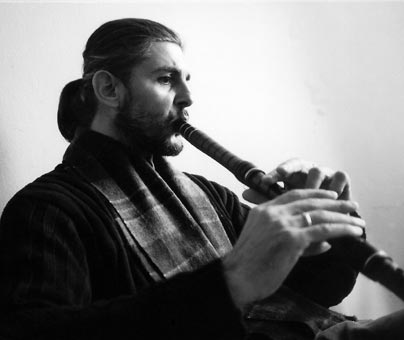
The kaval is a “chromatic, end-blown flute” traditionally used by shepherds across Hungary, Turkey, Greece and the present-day Eastern Partnership countries. But it’s safe to assume that none of their hemp-clad herders ever thought to use it quite as Spassov does. The instrument (played more like a clarinet than a contemporary flute) is open at both ends, which comes in handy when you fancy turning it around and blowing it the other way. If that wasn’t enough of a party trick, Spassov also scats (both directly into the kaval and in the more traditional way), sings, and – when doing none of the above – uses it as a percussion instrument.
No gypsy girl could gyrate more skilfully or enthusiastically for our pleasure than Järvi
Spassov has created an entirely new sound and life for this ancient instrument that sits somewhere between folk, film soundtrack and jazz. For anyone who has ever cringed at the try-hard paradox of a jazz flute, the kaval is a revelation – deeper, almost clarinet-like at the bottom, and breathy-flexible at the top. It’s a flute that has enjoyed too many cigarettes and too much sex, whose every colourful wheeze speaks of life lived. In case his credentials for musical cool were still in any doubt however, Spassov (pictured below) brought with him a duo of guitarists. Vlatko Stefanoviski and Miroslav Tadić led the way in the sequence of Spassov’s own orchestral arrangements that were the climax of the evening.
 Ranging from folk-kitsch to syncopated jazz frenzy, with moments of Appalachian barn-dance jostling with muezzin-like calls from Spassov himself, this hotch-potch of miniatures was a dance-suite run wild. Acting more as ringmaster than conductor, Järvi throbbed and stamped with the rhythm, grooving along to guitar improvisations between coaxing the LSO strings into swooning action or deploying grenades of brass and percussion. I’m not sure it was all in the best taste, but it was so utterly unknown, so vehemently excellent, that it was impossible to muster rational thought for long enough to judge.
Billed as an evening of “Balkan Fever” (a designation more approximate than strictly accurate) we had opened with Kodály’s Dances of Galánta – a paprika-infused vision of tourist Hungary, all modal scales and exotic flourishes. No gypsy girl could gyrate more skilfully or enthusiastically for our pleasure than Järvi, nor could hope to entice more passion from the LSO, who were clearly enjoying themselves. No matter that the Kodály Variations on a Hungarian Folksong (“The Peacock”) and Enescu’s Romanian Rhapsody No 1 that followed offered more of the same, giving the impression that we’d strayed into the soundtrack of a 1950s MGM gypsy film, and cried out for a little bit of acerbic Bartók to balance the sooty-eyelashed string portamentos or twinkling-hipped flute sashays. We were all having far too good a time to care.
This wasn’t the kind of concert you’d want every night – altogether too rich, too sugary for everyday consumption. But once in a while a bit of indulgence is exactly what is called for, and last night the LSO were the answer to every craving neglected by a balanced London diet of briskly efficient orchestral standards and bracing contemporary fare.
I’m not sure it was all in the best taste, but it was so vehemently excellent that it was impossible to muster enough rational thought to judge
rating
Explore topics
Share this article
Add comment
The future of Arts Journalism
You can stop theartsdesk.com closing!
We urgently need financing to survive. Our fundraising drive has thus far raised £49,000 but we need to reach £100,000 or we will be forced to close. Please contribute here: https://gofund.me/c3f6033d
And if you can forward this information to anyone who might assist, we’d be grateful.

Subscribe to theartsdesk.com
Thank you for continuing to read our work on theartsdesk.com. For unlimited access to every article in its entirety, including our archive of more than 15,000 pieces, we're asking for £5 per month or £40 per year. We feel it's a very good deal, and hope you do too.
To take a subscription now simply click here.
And if you're looking for that extra gift for a friend or family member, why not treat them to a theartsdesk.com gift subscription?
more Classical music
 Scott, Irish Baroque Orchestra, Whelan, RIAM, Dublin review - towards a Mozart masterpiece
Characteristic joy and enlightenment from this team, but a valveless horn brings problems
Scott, Irish Baroque Orchestra, Whelan, RIAM, Dublin review - towards a Mozart masterpiece
Characteristic joy and enlightenment from this team, but a valveless horn brings problems
 France, LPO, Gardner, RFH review - the sound of other worlds
From a snowbound contemporary classic to Mahler's folk-tale heaven
France, LPO, Gardner, RFH review - the sound of other worlds
From a snowbound contemporary classic to Mahler's folk-tale heaven
 Classical CDs: Voice flutes, flugelhorns and froth
Baroque sonatas, English orchestral music and an emotionally-charged vocal recital
Classical CDs: Voice flutes, flugelhorns and froth
Baroque sonatas, English orchestral music and an emotionally-charged vocal recital
 Kanneh-Mason, Britten Sinfonia, Shave, Milton Court - a grin and a big beaming smile
A pair of striking contemporary pieces alongside two old favourites
Kanneh-Mason, Britten Sinfonia, Shave, Milton Court - a grin and a big beaming smile
A pair of striking contemporary pieces alongside two old favourites
 Lapwood, Hallé, Wong, Bridgewater Hall, Manchester review - journeys into space
Star of the console takes us on a cosmic dance , while Elgar brings us back to earth
Lapwood, Hallé, Wong, Bridgewater Hall, Manchester review - journeys into space
Star of the console takes us on a cosmic dance , while Elgar brings us back to earth
 theartsdesk at the New Ross Piano Festival - Finghin Collins’ musical rainbow
From revelatory Bach played with astounding maturity by a 22 year old to four-hand jazz
theartsdesk at the New Ross Piano Festival - Finghin Collins’ musical rainbow
From revelatory Bach played with astounding maturity by a 22 year old to four-hand jazz
 First Person: Manchester Camerata's Head of Artistic Planning Clara Marshall Cawley on questioning the status quo
Five days of free events with all sorts of audiences around Manchester starts tomorrow
First Person: Manchester Camerata's Head of Artistic Planning Clara Marshall Cawley on questioning the status quo
Five days of free events with all sorts of audiences around Manchester starts tomorrow
 Goldscheider, Brother Tree Sound, Kings Place review - music of hope from a young composer
Unusual combination of horn, strings and electronics makes for some intriguing listening
Goldscheider, Brother Tree Sound, Kings Place review - music of hope from a young composer
Unusual combination of horn, strings and electronics makes for some intriguing listening
 theartsdesk Q&A: composer Donghoon Shin on his new concerto for pianist Seong-Jin Cho
Classical music makes its debut at London's K-Music Festival
theartsdesk Q&A: composer Donghoon Shin on his new concerto for pianist Seong-Jin Cho
Classical music makes its debut at London's K-Music Festival
 Helleur-Simcock, Hallé, Wong, Bridgewater Hall, Manchester review - moving lyricism in Elgar’s concerto
Season opener brings lyrical beauty, crisp confidence and a proper Romantic wallow
Helleur-Simcock, Hallé, Wong, Bridgewater Hall, Manchester review - moving lyricism in Elgar’s concerto
Season opener brings lyrical beauty, crisp confidence and a proper Romantic wallow
 Kohout, Spence, Braun, Manchester Camerata, Huth, RNCM, Manchester review - joy, insight, imagination and unanimity
Celebration of the past with stars of the future at the Royal Northern College
Kohout, Spence, Braun, Manchester Camerata, Huth, RNCM, Manchester review - joy, insight, imagination and unanimity
Celebration of the past with stars of the future at the Royal Northern College
 Jansen, LSO, Pappano, Barbican review - profound and bracing emotional workouts
Great soloist, conductor and orchestra take Britten and Shostakovich to the edge
Jansen, LSO, Pappano, Barbican review - profound and bracing emotional workouts
Great soloist, conductor and orchestra take Britten and Shostakovich to the edge
Comments
Just a clarification on