

How do you solve a problem like Prokofiev? Not with a TV talent hunt promoted by Andrew Lloyd Webber. Not even, I’m beginning to think, with the current London Philharmonic concert series, Prokofiev: Man of the People?, devised by Vladimir Jurowski. Prokofiev’s uneven output; his parade of masks, making it hard to decipher what the composer is thinking and feeling: these form the principal difficulties, especially when the popular works are put to one side in the programmes and the gargoyles and dead dogs march in.
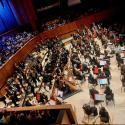
We had a couple of those in last Wednesday’s London Philharmonic concert, principally the Symphonic Song of 1933 (neither symphonic, nor a song), though the night had still ended the right way up thanks to a blistering account of the Sixth Symphony. Last night, decamped to the Amaryllis Fleming Concert Hall at the Royal College of Music, the series’ dedicated followers faced Prokofiev’s Second Symphony: rowdy 1920s modernism at its most belligerent. At the Paris premiere in 1925 the audience, we’re told, scuttled fast for the exit, few surviving to the end. No one at the RCM bailed out early. The gusto of Jurowski’s players, the Royal College of Music Symphony Orchestra, helped make it bracing listening even in the auditorium’s disordered, unforgiving acoustic, comparable with too many Victorian town halls.
In the second half the battle temporarily eased with a thoughtful tune and cosseting harmonies before modernistic grimaces returned
The first of the symphony’s two chunky movements was a battlefield: brasses braying, winds close to piercing the eardrums, contrapuntal layers getting entangled in different keys, Stravinsky getting mimicked and mocked, the Machine Age bedlam unceasing. Virile music, though, hurtling forward with a purpose. Then, in the second half, the battle temporarily eased with a thoughtful tune and cosseting harmonies before modernistic grimaces returned. Under his resolute beat, Jurowski's student forces showed tremendous stamina and, when needed, finesse. Gargoyle or not, this was still a worthwhile revival.
I’m not so sure about the 15-minute orchestral patchwork from 1945 called Ode to the End of the War, a preposterous mixture of patriotic thumb-twiddling, chatty good spirits, and mindless racket:a Stalinist gargoyle if ever there was one. But when did you last see eight harps on stage in a semi-circle, cradling four Steinway pianos, backed by excitable brass and winds at the back and a timpanist ready to thump us to hell? Novelty value alone made this revival memorable; but little about the music stuck in the mind for more than two seconds.
Prokofiev’s creative spirit seemed no peppier in the Cello Concertino, left unfinished at his death and filled out from sketches by the ailing composer’s friend, the young Mstislav Rostropovich. Gruffly eloquent, Kristina Blaumane, principal cello of the London Philharmonic, didn’t look as though she was enjoying playing it. Can’t say I blame her: this is Prokofiev going through the motions, panting and pained, with ruminant melodies of little character and ponderous attempts at the jocular. The poor little work wasn’t helped by Dmitri Kabalevsky’s inappropriate, unbalancing, strident orchestration. No-one could turn this pig’s ear into a purse, but Kabalevsky made it an elephant’s.
One more novelty was squeezed in: two settings of poems by Konstantin Balmont, a fragrant student work from 1910, when Prokofiev was 19. Lined up under the concert hall’s organ, the ladies of the Royal College of Music Chorus floated mellifluously over the orchestra in a mix of simple harmonies and unison lines. An interesting antique, the piece didn’t solve the Prokofiev problem, but it was easy, dreamlike listening – the calm before the storm.




Add comment