

Works of art are usually quite easily recognisable: they’re in a frame, or on a pedestal, or (if it’s a particularly expensive one) there’s a security guard nearby. You’ll probably be in an art gallery or a smart private house too. But what about when the art is in the land? And moreover, when that art is almost too subtle to be noticed?
This is what confronts the viewer of Ana Mendieta’s work, on show at Alison Jacques Gallery in London. Cuban-born Mendieta (1948-85) made interventions in the landscape based around her own silhouette, such as pressing her hand into grass or arranging stones around her outline, and then took photographs. She also made videos of herself, lying naked underneath stones, hardly visible, in what looks like a quarry, or submerged in a Mexican creek.
Drawing on Mesoamerican traditions of the spirituality of the land, an anthropomorphised land, Mendieta affects nature by putting herself in it, almost as if she is willing that spirituality to enter her, or her to enter it. Her photos and videos, which seem almost bland at first, are thus quiet examinations of the relationship of man (and woman) and nature. She alters nature without doing so in an obvious or permanent or destructive way, and thus maintains an ancestral respect; contrast the “art” of Mount Rushmore and you’ll see what I mean.
By inserting herself into the landscape, and indeed with several photos of vaginal slashes in the earth, Mendieta is asserting the importance of the feminine in the natural world. Whereas most interventions are grand masculine statements, Mendieta’s play on her own womanhood makes her work that much more modest and affecting.
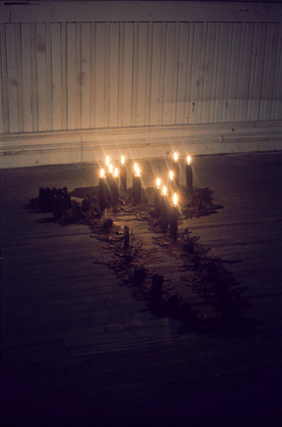 Another important aspect of Mesoamerican culture is ritual, which motivates Mendieta’s performances. One of these was recreated at the private view last night, where guests lit black candles arranged around Mendieta’s silhouette and the candles were left to melt down. (Picture right is the original performance.) This echoes a Cuban ritual from which Mendieta was excluded both by being a woman and an exile, her family thrown out of Cuba for opposing Castro. By being invited to light one of these candles, that is, become a participant in Mendieta’s ritual, it became a meditative experience, poignant and inclusive.
Thus far most famous for her death (her husband, artist Carl Andre, known best in England for Tate Modern’s arrangement of bricks called Equivalent VIII, was acquitted of her murder after she fell out of their 34th-floor apartment window), Mendieta is difficult because of how she draws on unfamiliar non-Western traditions of art and because of the low voice in which her art speaks. However, her conception of nature, and specifically woman’s place within it, is ultimately compelling and beautiful.
Ana Mendieta: Silueta and Silence is on at Alison Jacques Gallery, 16-18 Berners St, from 19 February to 20 March



Add comment