

This blistering account of Brecht’s classic – which he wrote in a white heat of fury as news reached him of Hitler’s invasion of Poland – pitches us headlong into the cynicism and casual obscenity of war. Elle While’s uncompromising production is like a Mad Max cabaret at the end of time, a post-apocalyptic vision of a world corrupted by violence and greed.
The impact is heightened by a punchy, expletive-stacked translation from Anna Jordan that vividly demonstrates the corrosive impact of conflict on language. Eight years ago, her acclaimed play The Unreturning – written for Frantic Assembly – chronicled the stories of three young men coming home from experiences of war. To research the script, Jordan interviewed soldiers from Afghanistan and immersed herself in the stories of Syrians returning to a bombed-out Aleppo. The aftershock of that research is clear in her translation of Mother Courage – which she wrote around the same time – a portrait of a woman scavenging for survival in a world that doesn’t know what civilisation is any more.
The Globe’s Artistic Director Michelle Terry proves once more how well she understands this theatre’s tricky chemistry as she takes on the central role of Mother Courage. Brecht intended his character to be abhorrent – neither maternal, nor courageous – and was reportedly dismayed each time an actress won the audience’s sympathy. Terry is initially as hard-nosed as she is abrasive, “If you’re looking for shame, you’ll find it in the ditch between shag and shite,” she bellows, but her skill is to convey how that brashness comes from years of disappointment and suffering. As she and her three children yank her cart around, filled with wares to sell to the desperate, you see how her jauntiness has become a mode of survival, devised to deflate tragedies that would otherwise crush her.
takis’ beaten-up set shows a world on the brink of collapse, with ragged grey and brown drapes, discarded tyres and oil-drums, and sofas and chairs upholstered with cardboard. The stage has been extended into a wooden-O shape, and as Mother Courage’s cart does its weary circuits of war zones we get regular updates of how many hundreds of kilometres she has travelled in her relentless search for profit. Brecht’s original play was set during the Thirty Years’ War in the first half of the 17th century, but here the different armies are named according to colours rather than nations. References to drones as well as guns heighten the sense that this is a warped allegory about every war everywhere all at once.
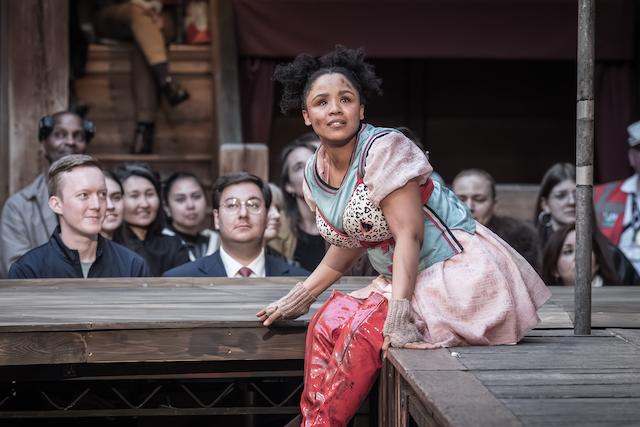
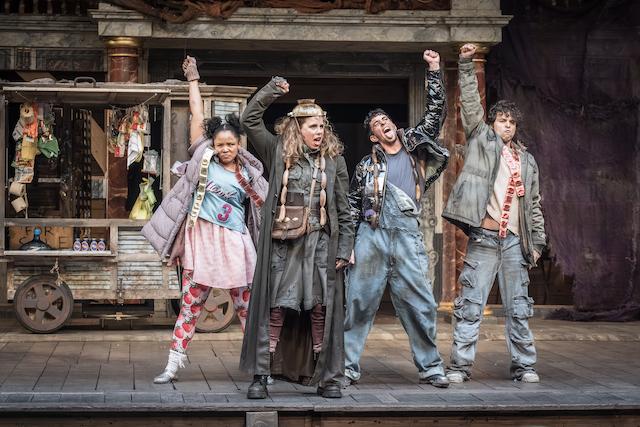
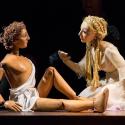
In this harrowing epic tale, her three children Eilif (Vinnie Heaven, pictured below, centre right), Swiss Cheese (Rawaed Asde, pictured below, far right) and Kattrin (Rachelle Diedericks, pictured above and below, left) represent bravery, honesty, and compassion – qualities which will all be obliterated as the evening progresses. Heaven certainly captures Eilif’s swagger, and we keenly feel his dismay after he kills peasants to steal their pigs – an act he has been praised for in wartime – only to be told that in peace time he will be punished by firing squad. Asde displays a naivety that heightens the pathos of Swiss Cheese’s fate when he conceals his regiment’s money from enemy soldiers and is shot as his mother takes too long to haggle for funds to release him.
Yet both sons’ performances are let down by underpowered singing, in contrast to Terry, whose plaintive tones can clearly be heard, even when she’s competing with passing planes. Though the knockout musical performance of the evening comes from Nadine Higgin’s prostitute, Yvette, as she sings James Maloney’s jazzily-composed version of The Fraternisation Song with smoky devil-may-care vibrancy.
Overall it’s Diedericks who really breaks Brecht’s philosophy of alienating the audience (Verfremdungseffekt) to ensure that they stay analytical rather than losing themselves in emotion. As Courage's mute daughter Kattrin – who we discover has been abused by a soldier as a child – she tugs repeatedly at the heartstrings. Though she cannot express herself verbally, her sense of vulnerability and compassion are palpable, whether she’s covetous of Yvette’s sexy red boots, or furiously trying to protect her brothers. Through her, we glimpse the last remaining specks of Mother Courage’s humanity as she puts Kattrin’s future above her own. The moment when Kattrin sacrifices herself to stop the inhabitants of a refugee camp from being destroyed, stands out as the one genuine moment of heroism in this nihilistic landscape.
Some might argue that there’s little need for us to digest Mother Courage’s brutal messages any more. Unlike when the play was written, most of us take it as read that wars are conducted for profit rather than for any moral agenda – so what does it have to teach us? Though what’s most sobering is that this realisation has done nothing to stop global conflict – instead we find ourselves watching leaders like Trump revel in the rhetoric of brute force and capitalist opportunism. Where Mother Courage still manages to hit home is in forcing us to confront the shattering bleakness of how war will always play out for the poor, reflecting situations that we know from the news are a daily reality in places ranging from Ukraine to Sudan.
This is not an easy piece of theatre to watch – I took an 81-year-old aunt and two teenagers, and we were all reeling at the interval. Yet the teens relished it, and my aunt was fascinated by what it added to her insights on war from reading everything from The Diary of Anne Frank to the memoir of Alexei Navalny. It’s a bold, brave piece of programming that reaffirms Terry’s inspired leadership as an actor and artistic director. Trivial though it may sound to observe, if only the singing had been uniformly strong, this production would have been astonishing. As it is, it’s a robustly provocative piece that sends you back to the foreign news with gritted teeth and a broken heart.







Comments
Thoroughly enjoyed
American tourists, who love theatre, ist time at the globe. Powerful acting by mother courage. She lifted all the cast to a higher level
Add comment