A glamorous black woman sits in a Forties bar under a Vichy cop’s gaze, cigarette tilted at an angle, till two male companions join her in clandestine conversation. The woman is Suzanne Césaire (Zita Hanrot), an influential Martinican journalist and essayist on Surrealism, feminism, Négritude (Francophone black consciousness) and an anti-colonial philosophy honed to a dangerous edge by the Fascist-aligned authorities. More intriguingly for director Madeleine Hunt-Ehrlich, following this feverishly productive period, Césaire never published another word.
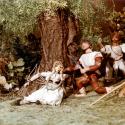
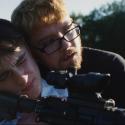
That conventional biopic scenario, with its poised heroine engaged in Caribbean intrigue like a black feminist Casablanca, is just one element of Hunt-Erlich’s response. You would need to conduct your own research to glean that its men are French Surrealist poet André Breton (Josué Gutierrez) and Césaire’s husband Aimé (Motell Foster), whose long political career eclipsed hers, or discover the joint expedition deep into the Martinican forest which would become a minor myth in the Surrealist canon.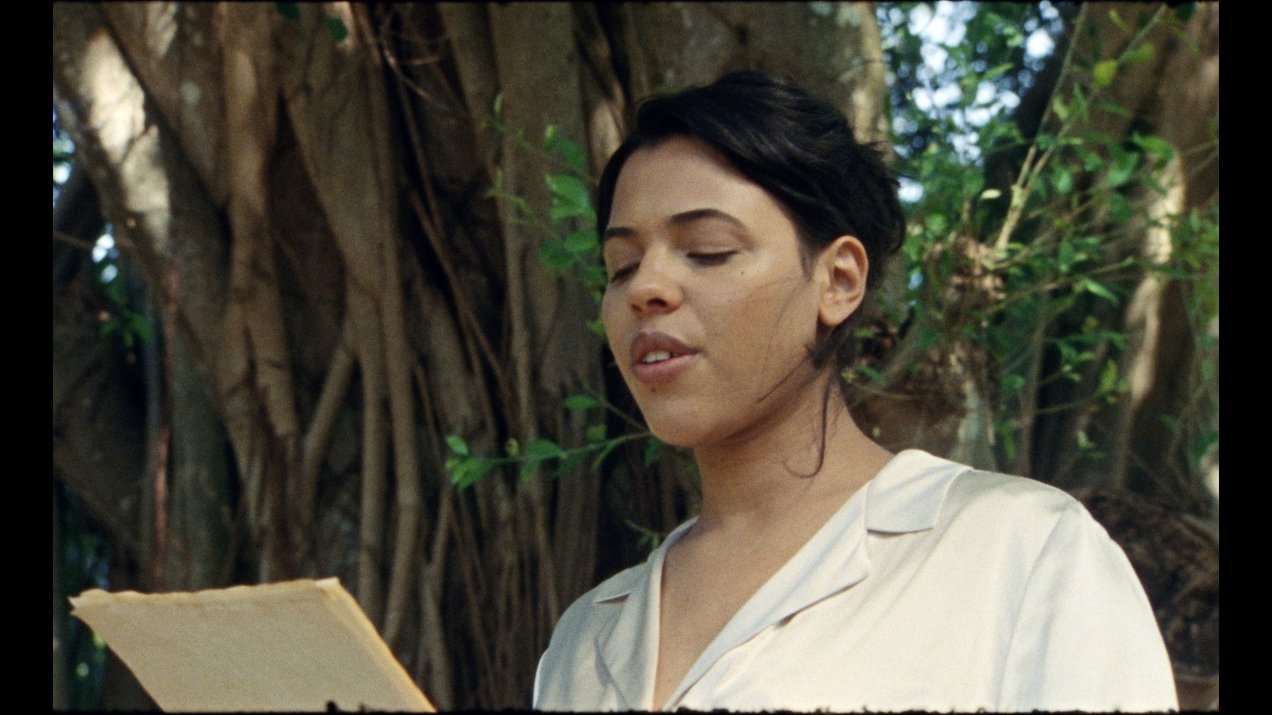 Hunt-Erlich’s pursuit of her heroine involved interviewing Césaire’s biographers and surviving children and reading her extant output, but factual understanding sinks into the mulch of a film also incorporating the concerns of an actress playing Césaire (Hanrot again), a film set’s colonial structure, dance’s defiant intimacy and the pram in the hall’s punishing effect on black female art - Césaire’s six children are the simplest solution to her literary vanishing.
Scant dialogue is perhaps deliberately unconvincing, with Suzanne and Aimé’s bodies’ ballet-like, shadowy moves more emotionally substantive. Voiceovers convey ideas, confusingly drawing on Terese Svoboda’s secondary source Surrealist Refugees in the Tropics alongside Césaire’s own writing. Whatever the source, these are vivid thoughts, whether on the cosmology of the Caribbean’s hurricanes (“At the centre of the cyclone there is a crack…the ripping sound of great manifestations”), pregnancy (“I felt my body become a portal between worlds…black matter”), or literature (“Martinican poetry will be cannibal. Or it will not be”).
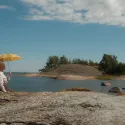
On set meanwhile, the alienated actress fears her role, must hand her own baby to a maid and leaves script pages scattered on the ground. Budget constraints meant the pristine, palm-fronded lawn was filmed in Miami, not lush Martinique, and preclude more phantasmagorical jungle visions. Hunt-Erlich anyway conveys forest stillness, and something of the intellectual and ecological atmosphere of Césaire’s life, the landscape in which she moved. Saturated 16mm film adds to this tangibility even as, largely by formal choice, the director’s subject stays elusive.