For a play about silence – its uncanny ability to tell the truth, to “persuade when speaking fails” – The Winter’s Tale is remarkably wordy. Of the sequence of late romances only Cymbeline comes close to the dense and elliptical verbal patterning we find ourselves tangled in here. But Michael Longhurst’s new production for the Sam Wanamaker Playhouse is so richly cast, its verse-speaking so expressive that we see straight through the often opaque text to the humanity and the humour beneath.
After a riotous Pericles and troubled Cymbeline, this third play in Dominic Dromgoole’s farewell quartet of late Shakespeare sees dramatic energy build, setting us up for the finale of Dromgoole’s own Tempest later this month. It helps that by now we’re getting a sense of the actors as a company – the same figures returning in each show as echoes, opposites and variations of their former characters. It’s a delight to see Jessica Baglow’s poised Marina give way here to a lusty, grubby Mopsa, and it’s quite the sea-change that transforms James Garnon’s Pericles into his incorrigibly villainous, relentlessly charming Autolycus.
Cusack is the charge that ignites a deliberately static first half
But before we’re allowed to escape to Bohemia’s songs and sex, Longhurst gives us a Sicilia of rare violence. The imprisonment of Rachael Stirling’s Hermione and her subsequent courtroom judgement are no mere formalities. Chained and bloodied, streaked with dirt, she struggles to stand, yet still delivers her defence with all the authority of a crowned and gowned monarch. Her warmth, even in anger, reflects off the hard surfaces and sharp corners of John Light’s Leontes, softening the brutality of this unsympathetic figure even as his destructive jealousy is written on her in wounds. In the context of such an opening, Stirling's unquestioning affection at the close (her physical actions chafing against her refusal to address her husband directly) strikes an awkwardly unresolved chord.
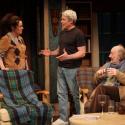
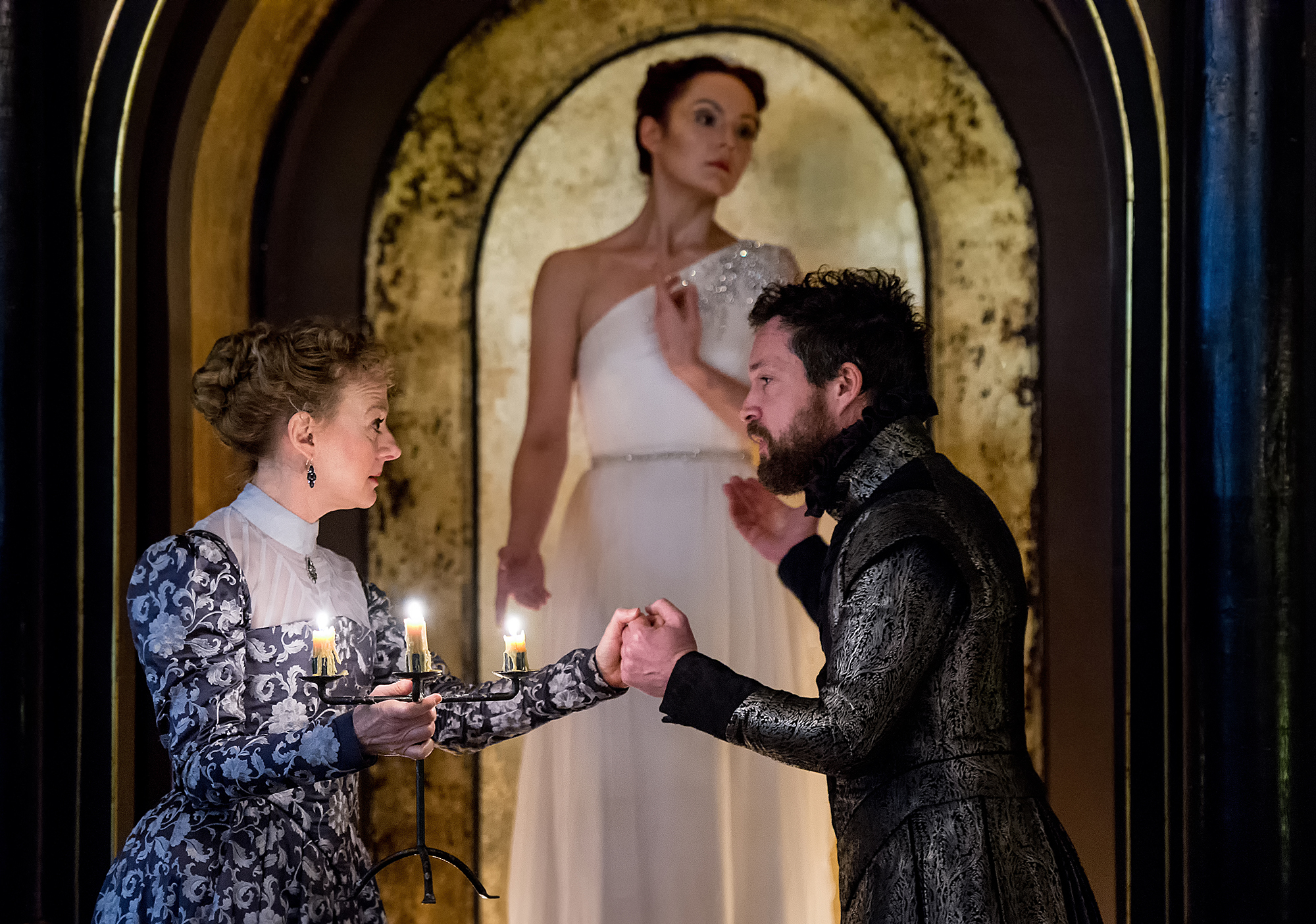 Even Niamh Cusack’s Paulina (pictured right with Light) is waspish, destroying with words what Hermione must later restore in silence. Nervy and energetic, Cusack is the charge that ignites a deliberately static first half, her restless movement finding release and expression in the frankly erotic dances of the sheep-shearing festival. But even these celebrations aren’t without their darkness; in Longhurst’s vision Bohemia and Sicilia share more than they differ, and the power abuses of courtly marriage find sinister echo in the thrusting, violating masculinity of the three peasant rams.
Which isn’t to say this is a Tale without charm. Miscast as Pericles, Garnon is back at his best as Autolycus, the roguish pedlar. Singing and strumming with throwaway skill, Garnon’s is a one-man-band of a performance, whether laying out his range of accents for our delectation, seducing or stealing sips of beer from the audience, or distracting them with laughter while, unnoticed, picking pathos from their emotional pocket. It’s bravura stuff, but it speaks to the strength of the ensemble cast around him that it never once threatens to overbalance the play.
 Fergal McElherron’s Camillo, David Yelland’s gloriously-spoken Antigonus (pursued by an exceptionally fine bear) and Sam Cox’s wry Old Shepherd each make their mark, their wry wisdom framing the innocence of Tia Bannon and Steffan Donnelly’s central romance. If Donnelly’s Florizel seems to have come by way of Eton, it doesn’t spoil his impetuous directness, which sparks nicely off Bannon’s rather more matter-of-fact Perdita.
Richard Kent’s designs do a lot with very little, letting the Wanamaker’s space and its unique rhetoric of light do most of the talking, often amplified by Simon Slater’s attractive score. Longhurst and his collaborators here share a lightness of touch, a generosity that is content to display the text to its best advantage, clear and clean. Pericles may need all the help it can get, but, given the right environment, The Winter’s Tale tells itself – all the more captivating for its simplicity, all the more persuasive for a director’s refusal to speak too loudly.