

Iliad is the third collaboration between National Theatre Wales and “the two Mikes”, directorial duo Pearson and Brookes. The pair have been responsible for two previous highlights of the still young company’s back catalogue, The Persians (2010) and Coriolan/us (2012). Aeschylus was re-imagined on a Brecon Beacons military range and Shakespeare recast in an RAF aircraft hangar, so it is perhaps surprising that the ultimate epic drama of war is staged in an actual theatre, the compact and modern Ffwrnes in Llanelli.
“War Music” is the generic title of Christopher Logue’s Homer, five full-length volumes of poetry published between 1981 and 2005, but also the specific name given to this production, the final instalment of NTW’s four-part series, which introduces “box-set theatre” to south-west Wales. Audience members have the choice to attend one stand-alone production or to see all four parts, either on consecutive nights or at one of two “marathon” performances (all day or all night).
The polyphony of voices works particularly well in a Welsh context
Logue’s opening line, “Now hear this”, is a reminder of the Iliad’s oral origins, and despite the constant presence of black text on white screens all around the space, War Music is primarily an assault on our auditory faculties. The polyphony of voices works particularly well in a Welsh context; this is a culture that loves the sound of voices, be they singing or speaking. Dylan Thomas’ “play for voices” Under Milk Wood was written just across the estuary, and Logue’s cinematic rendering of Homer is a reminder that this epic poem, too, is primarily about spoken delivery.
Performance levels are, however, somewhat uneven; for me the piece only really took full flight in the interactions between Richard Lynch and Llion Williams, both of whom consistently enunciated with a richness of timbre that was sometimes lacking elsewhere.
The mid-sized auditorium is stripped back to monochrome minimalism: the only “props” are piles of black tyres and stacks of white plastic chairs, some of which are transmogrified into makeshift trees during the course of the evening. A gargantuan projection screen accents the cinematic styling of the poetry, but its widescreen landscapes are unobtrusive. Microphones hang on long wires suspended from the ceiling. Occasionally the “Gods” – impressively played by local teenagers – make an appearance, but in this final part of the saga it is Fate rather than the Gods which muscles in once Patroclus reaches the wall of the besieged city.
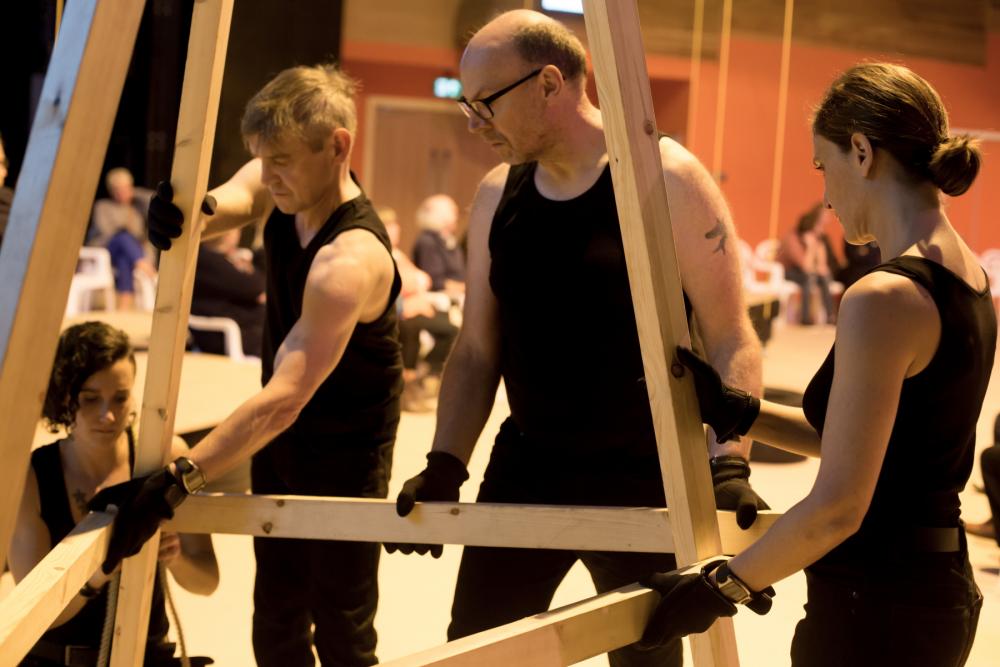 The unfussy set, unobtrusive visuals and cinematic surround-sound combine to create a world that feels, at times, like you are inside an audiobook. There are the lulls inevitable in any longform listening exercise and the fourth episode was not a great advert for the 11-and-a-half-hour version, but on its own terms of rendering Logue’s Homer as theatrical vision, Iliad is a triumph.
The poetry veers, sometimes violently, between evocations of war and peace, apprehension, brutal violence, aftermath and regret. It is, like Homer’s original, a full and moving account of the pity of war. There is light and shade: armour “the colour of moonlight” and “noises the like of which you and I never hear,” screeches, battle cries and haunting laments. Logue’s text is the star, and Pearson and Brookes’ design innovation might also have inadvertently created the next generation of open-mike nights. At the end, famously, “there is no end”; nevertheless, “the two Mikes” have created yet another production that will stick in the memory like a spear in the sand on a Trojan beach.






Add comment