Talking to Dave Stewart is like being on a psychedelic roller-coaster. He’ll start with one thought, spin it round and turn it upside down a few times, and just at the point when you’re feeling completely disorientated, whirl you to its conclusion. His is a mind in constant motion – you don’t have to spend long in his company to understand how he has emerged as one of the great musical chameleons of our time. Though most people know him from his partnership with Annie Lennox in The Eurythmics, the whistle-inducing rollcall of his collaborators includes Bob Dylan, Aretha Franklin, Mick Jagger, Gwen Stefani, Stevie Nicks, George Harrison and Nelson Mandela.
Anyone who knows anything about Stewart is aware that his prolific career started unpromisingly when – aged 13, and confined to his house with a broken knee – he taught himself to play on his brother’s out of tune guitar with one string missing. Up till that point he had dreamed of being a footballer, but his new love for the guitar became an obsession when he received a parcel in the post containing two blues records. Stewart talks a lot about things “just happening”, yet it was his round-the-clock determination to learn everything he could about the blues and beyond that allowed him to blaze a path from Sunderland to the Bahamas, where he now spends six months of each year. (He also has homes in Nashville and Los Angeles.) Aged 15 he ran away with the lute-toting prog-folk band Amazing Blondel, and by the time he was 18 he had signed a contract with Elton John’s Rocket Records for his own band, Longdancer. “I was suddenly part of a scene,” he wrote in his autobiography Sweet Dreams Are Made of This, “and, without realising it, becoming a bit of a ringleader”.
It says a lot about the creative labyrinth of Stewart’s mind that The Eurythmics sounds utterly unlike anything else he’s done, even in his first band with Annie Lennox, The Tourists. An encounter with the visionary German record producer, Conny Plank – who worked with Kraftwerk, Brian Eno and Karlheinz Stockhausen – introduced him and Lennox to a rich vein of avant-garde experimentation. Though their first album as The Eurythmics, The Garden (made with Plank) failed they knew they were on the right track. Returning to England they set up their own studio in Chalk Farm where they were to make musical history with the release of their second album, Sweet Dreams (Are Made of This).
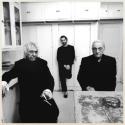
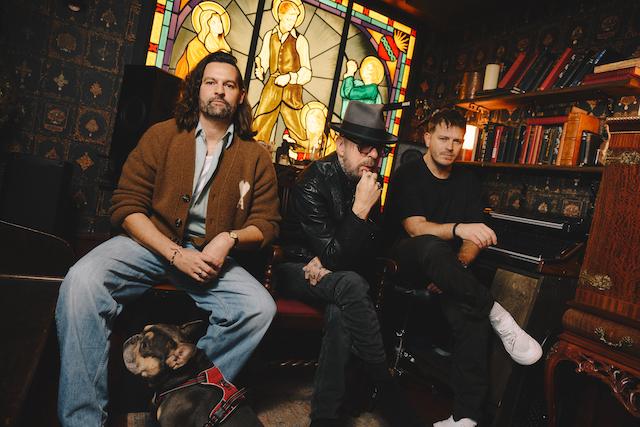
Stewart is well aware that his break relied in no small part on a bank manager in Crouch End who agreed to loan Stewart and Lennox £5K so they could buy second-hand recording equipment. Now – together with entrepreneurs Dominic Joseph (pictured below right) and Rich Britton (pictured below left) – he has set up a venture-building company, Rare Entity, which aims to provide artists both with crucial financial support and with advice on how to protect their intellectual property. We meet in Rare Entity’s Mayfair office, an open-plan oasis of punchy colours, designer chairs, ironic artworks, and a gleaming kitchen which you suspect is used primarily to deliver caffeine shots from its state-of-the-art coffee machine. Though there’s an unmistakable aura of rock star royalty when Stewart enters in his trademark fedora hat, designer sunglasses, and a life story’s-worth of tattoos snaking across his skin, he quickly makes it clear there’s no standing on ceremony. When asked what he wants for lunch, he requests a no-frills bacon sandwich, before embarking on the story of his idiosyncratic rock odyssey.
RACHEL HALLIBURTON: I’m interested that your musical life began when you learnt the guitar the wrong way. It was your brother’s guitar, it only had five strings and it was out of tune. You taught yourself to make notes on the out of tune strings. Then somebody pointed out to you that it needed to be tuned, and you had to start all over again.
DAVE STEWART: It was a double “mislearning”. After picking up my brother's guitar, I realised the chap who lived next door but one – Mr Gibson – had a guitar, but he played it almost like a banjo. He’d been in a Japanese prisoner of war camp for almost four years and saw most of his friends killed and tortured. Even so, he was a sweet and gentle man and when he saw I wanted to play the guitar, he tried to show me how. But it was tuned differently to a proper guitar, so I learnt the wrong way twice. Then my brother’s friend, John Graham, came back from college and said, “What’s going on?” It was only after he tuned it properly that I really started to learn.
To me that shows ingenuity, originality and grit. Since that tricky start, the list of people who’ve wanted to collaborate with you has been extraordinary. Mick Jagger, Joss Stone, Bob Dylan, George Harrison, Gwen Stefani, and Nelson Mandela. I have to confess, the last one is the name that surprised me most. How did Nelson Mandela come about?
I knew there was a big charity concert being organised. [This was a concert set up by the Nelson Mandela Foundation for the fight against AIDS, in 2002. Stewart and Lennox had first sung at the Nelson Mandela 70th Birthday Concert in 1988.] Roger Taylor from Queen had a farm up the road from where I lived, and we started to talk about it. Then their manager and Brian May got involved. Then we flew to Cape Town. The next thing I knew I was sat in a room and being told that “Mr Mandela’s on the phone for Dave Stewart”. I’d had an idea about making his prison number – 46664, the most negative number in his life – into something positive by turning it into a phone number that people could ring. [They would get the greeting] “Hello, Nelson Mandela here”, and then hear new songs that I’d created with Paul McCartney, Bono, and many other people.
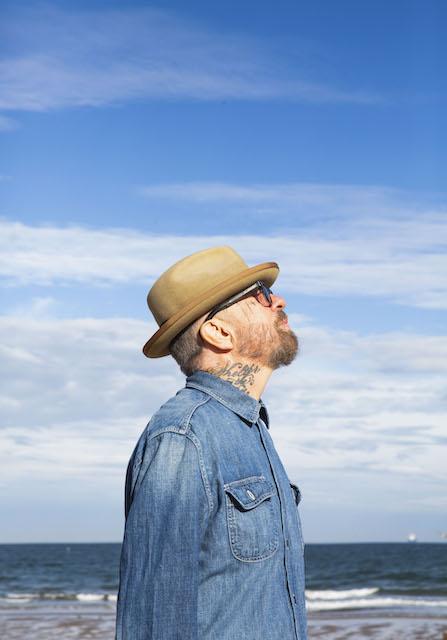
One thing that’s striking – given how much it’s defined you is how different your Eurythmics sound is from any other of your collaborations. You came up with your distinctive, era-defining style after going to Germany to work with record producer Conny Plank. Can you tell me what happened? (Pictured above: Dave Stewart by Tyler Lee Aubrey).
We’d met Conny Plank before because me and Annie had been out to Germany to help another musician make a record with him. Conny worked in a farmhouse near Neunkirchen-Seelscheid, not far from Cologne, but basically in the middle of nowhere. He was a really brilliant, eccentric producer, a genius who had made his own mixing desk. We made a very strange album [In The Garden] and the label wanted to drop us. But [the important lesson] I’d learnt from Conny Plank was “There are no rules”. So we can mike a drum kit up from six feet away, or have one microphone or 26, or put a mike down a well. Suddenly recording became an amazing adventure. Where before you had a record producer and engineer at the back, and if you didn’t like something you couldn’t really say anything, now I knew I could do anything – put my hands on the faders or turn the gain up on the soundboard. I was just absorbing it all. Annie and I could actually do something ourselves without anybody telling us what to do. It was a portal into a huge part of my life.
How did that impact on how you created the Eurythmics’ second album? As part of it didn’t you teach yourself the keyboards from scratch?
Annie and I were living in a squat above a record shop that sold a lot of reggae and dub music. I realised that one of the reasons why a lot of the music was amazing was because of the strong bass line. So though I didn’t really learn to play keyboards, I learnt how to create bass lines that were memorable. I’d got this idea that the space between everything [the notes] is as important as the notes themselves. I wanted to make music where there was space that allowed Annie’s voice to come through crystal clear. But we needed equipment. So I went to this bank manager and explained to him what I wanted to do, and I thought he was going to kick us out. But he lent us £5K and with the equipment we bought from that we made Sweet Dreams – the album, and put millions back into his bank, and he was the hero of the banking world in Crouch End.
In your autobiography, Sweet Dreams, you say that writing songs together is like falling in love again and again. Apart from Annie Lennox, what has been your greatest love affair, musically?
I’ve had amazing songwriting experiences with Mick Jagger, just the two of us. We're both obsessed with the blues, early blues, the same as Bob Dylan, and we're both very knowledgeable about it. If I think about it, there's usually some sort of musical thread that has led to me meeting most of the people in my life. I remember there was one point when I looked out into my garden and there was Roy Orbison, George Harrison and Bob Dylan there. [George Harrison was living in Stewart’s home in Encino, California, when he formed the British-American supergroup the Traveling Wilburys. Though Stewart was crucial to the group as a host and “virtual member”, he was mainly touring with the Eurythmics at the time]. If I think about it now, it’s insane. How did that happen? It all just happened through these weird musical threads.
It seems completely characteristic of who you are, that you're you decided to tell the story of your life and musical journey in an ambitious project [a triple album and a movie] called Ebony McQueen? Can you explain who Ebony McQueen is and why you decided to use her to talk about your life?
She’s inspired a bit by [blues electric guitarist] Jessie Mae Hemphill, who I filmed in the documentary Deep Blues: A Musical Pilgrimage to the Crossroads [directed by Robert Mugge and written by Robert Palmer in collaboration with Stewart and his brother John]. Ebony McQueen is a wise soothsayer who can see everything and understand everything that's going on. Just like blues music did for me when I was younger – it saved my life. When those two records of blues music arrived in the post from my cousin it was almost like a gift out of nowhere. I was in Sunderland under a slate grey sky with a broken leg, and my mum had left my dad. Blues came from a lot of hardship and pain. When I first heard it I went into a trance, it just seemed to describe what I was feeling so well. I decided that Ebony McQueen’s character would appear in the movie, but only the young person playing me would be able to see or hear her.
How far advanced is the movie at this point?
Shekhar Kapur [director of Elizabeth and What’s Love Got To Do With It] is going to direct it. [Elizabeth and Slumdog Millionaire composer A R Rahman will be collaborating with Stewart on the soundtrack]. He really understood the character Ebony McQueen and the way that she was a guiding light, so he flew to meet me, and we spent a couple of weeks going on long walks and talking about it. He’s already been up to Sunderland looking at locations. We don’t know exactly when filming’s going to start yet – obviously everything has to fall into place.
Rather than fearing AI as a phenomenon that will make artists lose control, you see it – potentially – as a moment when giant corporations will be taken apart, and that rights will be returned to artists. Reinforcing rights for artists is one of the things you’re aiming to do with your new venture-building company Rare Entity. Can you explain exactly what it’s going to do?
I wanted to create a kind of upside-down company with the creativity as the top layer – the people creating keep ownership of their IP all the way – and underneath that, there's an engine [involving money and a team of people] to make it work. [In return the artist sells Rare Entity a minority stake in their project – a far more favourable deal than can normally be accessed]. A lot of it is about bringing the right people together. For instance Dom and Rich are working with Ben [Lovett] from Mumford and Sons on Planet Fans. The problem for artists was often that the big companies were keeping information about their fans, so the artist themselves didn’t really understand who they were. Planet Fans allows a more direct relationship, so artists can give fans things like recordings of rehearsals for a new single, or priority booking, or discounted merchandise.
What do you think the greatest threat is to creativity?
Creativity needs to be constantly enforced. If AI makes people stop, what’s the point? You should be able to do something like I did, when I just went to Finsbury Park station with an acoustic guitar and played to people going by. It’s not easy but you can have an adventure. Typing a prompt into AI to make a song is not the same as me meeting Annie and going through all these adventures. You miss out on life. So be an artist and live life.