African Scream Contest 2 opens with a burst of distorted guitar suggesting a parallel-world response to The Chambers Brothers’ “Time Has Come Today”. Then, the song beds in and a James Brown groove plays off against spindly lead-guitar lines also evoking California in the psychedelic era: the extemporisation of Jefferson Airplane. At 3.06, the vocalist and percussionist are left to get on with it for 30 seconds. Next, a wheezy organ comes to the fore and injects some “Light my Fire” vamps.
The track is “A Min We Vo Nou” by Les Sympathics de Porto-Novo. Recorded in 1973 or 1974 in Lagos, Nigeria it was, until now, unreleased. Despite the nods to America, “A Min We Vo Nou” is clearly a West African recording. It is not by a Nigerian band, however, but by one from its western neighbour Benin who had named themselves after its capital city Porto-Novo.
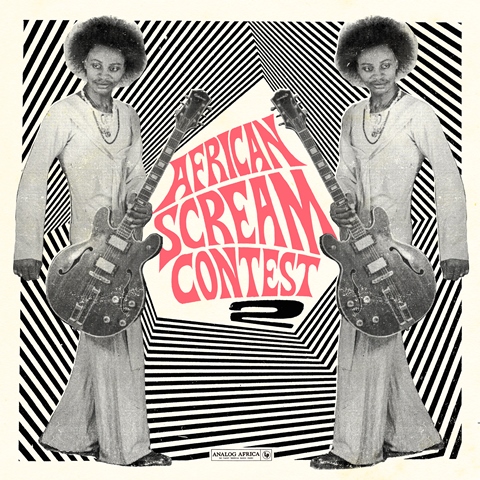 African Scream Contest 2’s other 13 cuts are equally intriguing. Black Santiago’s “Paulina” (1975) kicks off with a squall of brass and quickly sets its stall with a reductive, circular groove. Distant-sounding and hypnotic, it is the compilation’s most enigmatic track. The band featured musicians from Benin, Togo and Ghana, and “Paulina” was also recorded in Nigeria.
It’s clear from African Scream Contest 2 that Benin lacked Nigeria’s musical infrastructure. In the Seventies, there were no professional recording studios or pressing plants. Today, Benin’s population is 11 million while Nigeria’s is 186 million. Musicians were forced to look to across the border. Although the Fon are dominant in Benin, otherwise, there is no majority ethnic group. Around half the population are Christian, a quarter Muslim and a significant minority practice the local Vodoun faith. Such diversity makes it hard to get a handle on Benin’s music.
This compilation is not a primer on Benin’s music overall but instead looks towards the dance floor with cuts exemplifying what the PR material dubs “Afro-funk”. Excepting two outliers recorded in 1963 and 1967, everything is from 1970 to 1980. Orchestre Poly-Rythmo de Cotonou, now Benin’s most famous band, feature twice on what is a follow-up to 2008’s African Scream Contest, a collection of tracks from Benin and Togo
There are no clunkers or filler. Lokonon André et L’Orchestre Les Volcans “Glenon Ho Akue” (1976) is sparse yet drives. Antoine Dougbé’s “Nounignon Ma Kpon Midji” (1976) plays with Fela Kuti’s corkscrew dynamic but is defined by the compilation’s trademark reductiveness. The spiralling “Glenon Ho Akue” (1976) is by Les Volcans de la Capital, a band formed from serving police. At that point, Benin was controlled by The Marxist Military Council of the Revolution and named (in 1975) The People’s Republic of Benin. The police were integral to state control of the population. Nonetheless, the track swings like the best of them.
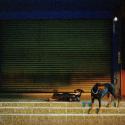
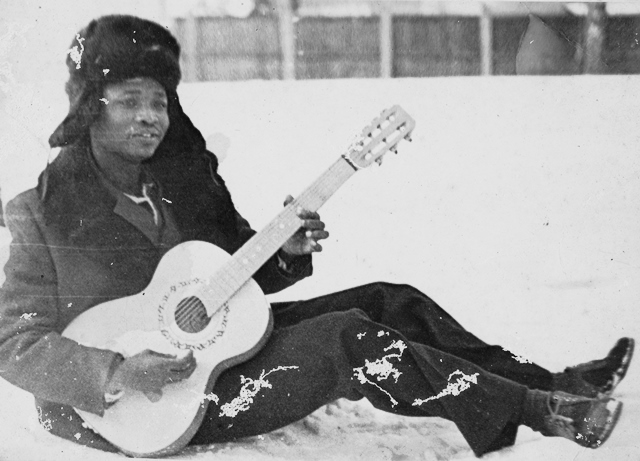 Bizarrely, Les Volcans de la Capital’s Lokonon André (pictured left in Russia, 1974) was instrumental in bringing African Scream Contest 2 together by making connections with bands and songwriters. But back then he was a policeman; one trained by the KGB in Russia. At home, he was charged with sniffing out dissidents.
In the liner notes, André says “The republic was governed with an iron fist by President Kerekou, a man who didn’t tolerate nonsense. Due to his strict socialist doctrine, Kerekou had lots of enemies, in and outside of Benin. He sensed the pressure mounting and to secure his safety decided to send some members of the police force to be trained by the Russian KGB, in Moscow. I was one of them and so I know how to find people”.
Unfortunately, the liner notes do not record how any of the bands heard on African Scream Contest 2 reacted when Lokonon André found them.
- Next week: Double-CD package of the first two Nirvana albums – the original Nirvana, that is
- Read more reissue reviews on theartsdesk