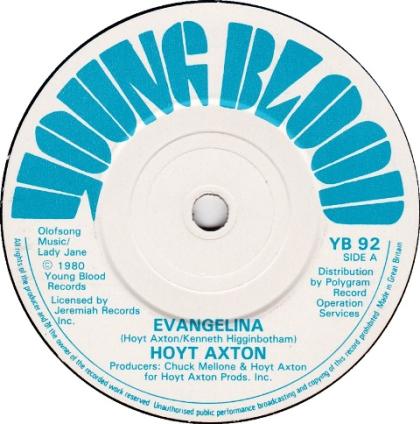
The opening track is Hoyt Axton’s “Evangelina.” After first appearing on the 1976 album Fearless it was re-recorded and issued as a flop UK single in July 1980. The new version had also been an OK-selling US single in 1980. The reason this deeply atmospheric, velvety, yearning country marvel had UK sales potential after it came out on minor-league British imprint Young Blood was due to radio play: radio play on the BBC’s Radio 2.
“Evangelina” illustrates exactly what Wednesday Morning 6AM - Radio Hits From The Small Hours 1970-1983 is about: the musical continuum defined by a maverick aspect of the BBC’s sister radio station to the (generally) chart-focussed Radio 1. Without the strictures of a playlist, Radio 2’s DJs and producers had leeway to follow their own tastes, and to play – as it's put in this collection’s liner notes – records which were not hits but through airtime were “as familiar anything by The Jam or Soft Cell.”
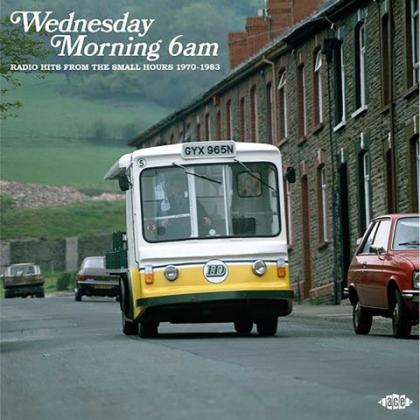
Wednesday Morning 6AM is, in the words of compiler, author and former Saint Etienne band member Bob Stanley, about when “In the late 70s and early 80s, there was a parallel world of [figurative] hits that people only heard when their clock radio went off. BBC Radio 2 had little time for the Top 40 music played by Radio 1 and beamed into living rooms by Top Of The Pops. Radio 2 effectively created a chart of its own playing singles or album tracks that their DJ’s enjoyed and wanted to share with their listeners. These tracks were given multiple plays on rotation and became earworms to millions of listeners.” All which springs to mind as a parallel in radio station terms is London’s Capital Radio, which championed The Alessi Brothers, The Eagles and Christopher Rainbow.
After “Evangelina” Wednesday Morning 6AM next features Lou Rawls’ silky “Lady Love,” a November 1977 single issued in the US by Philadelphia International. Like “Evangelina,” a corresponding UK release (in January 1978) did not, despite Radio 2 exposure, burn up Britain’s charts. It seems these listeners were not record buyers. However, in the US, “Lady Love” went Top 20 on Billboard’s Hot 100 and peaked at number five on the Adult Contemporary chart; the measure of Adult-Oriented Rock (AOR).
To a large degree, with its mix of country, singer-songwriter fare, suave soul and what’d later be tarred as yacht rock this collection traces elements of the US mainstream which weren’t represented in the UK (viz: the hoo-hah when, in 1981, Elvis Costello issued his country album Almost Blue). There was no British Adult Contemporary chart. There was no UK Country chart. Radio 2, again to a degree, was carving its own path.
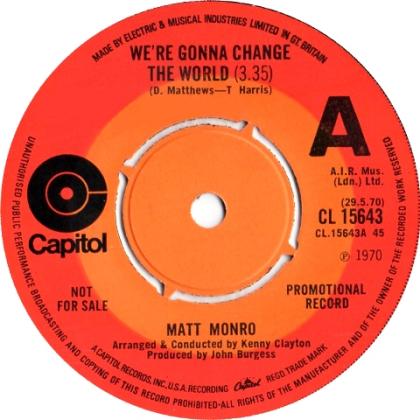
The collection isn’t all about the US though: Matt Monro’s extraordinary “We're Gonna Change the World” is here. Also present are Barbara Dickson, Lindisfarne, Gilbert O'Sullivan and Clifford T Ward. On the face of it, Wednesday Morning 6AM could come across as a Smooth Radio-style exercise in gentle aural massage. However, it is not. An important release, it is a ground-breaking consideration of a previously overlooked facet of British musical culture.
Wednesday Morning 6AM is a concept compilation. Rather than delineating a genre – baroque pop, harmony pop, say – it seeks to evoke a particular characteristic from a specific period. Bob Stanley has done this before: with Three Day Week: When the Lights Went Out 1972–1975, Incident At A Free Festival and more. His Tribal Rites Of The New Saturday Night collection bridged the gap between the two approaches by drawing from what was known about what was played in US East Coast discos c. 1975, and by striving to educe the feel of the milieu and the period.
This time though, instead of being born from a self-generated conception of a theme which is then soundtracked, Wednesday Morning 6AM centres around – and pursues the recreation of – an experience which is empirically measurable: what was on a chunk of British radio at a specific time of day. However, here, that ability to quantify draws from memory rather than chart rundowns or playlists.
If the UK’d had AOR and country charts, the framework would by less intangible, less, indeed, conceptual. There would be a materially measurable baseline; one which wasn’t about experience or memory.
Is it necessary to consider all this while listening to, assimilating, the elegant Wednesday Morning 6AM - Radio Hits From The Small Hours 1970-1983? Maybe not. But it is worth acknowledging that this is about more than revisionism, about more than the fantastic tracks gathered under this umbrella. Get this. It’s a real eye-opener.
- Next Week: The seven CDs of The Lovin' Spoonful's What A Day For A Daydream - The Complete Recordings 1965-1969
- More reissue reviews on theartsdesk
- Kieron Tyler’s website