

Can you go home again? That's the question that will be hanging over the Royal Shakespeare Company's first residency at the Roundhouse since their "History Play" cycle stormed north London over two years ago, reminding those lucky enough to catch it of the loss to the capital ever since the RSC opted out of a London base of operations.
theatre reviews
alexandra.coghlan

“You’ve never heard a fairy tale before unless you’ve heard it told by a real fairy. And I am a real fairy.” Festooned with magic, colour and humour, the National Theatre’s Christmas production of Beauty and the Beast is solid-oak tradition gift-wrapped with just enough shiny, iconoclastic naughtiness to sneak it past the children. Wooing with conjuring tricks, slick visual effects and wit, its soft-centred sincerity comes as a surprise, a sugar-coated stiletto aimed at those with a weakness for festive sentimentality.
Joe Muggs

There's a kitchen-sink feel to this children's play by David Almond – indeed, nine-tenths of it takes place in a Newcastle kitchen – which adds a certain edge to it. Even though the broad, cartoonish comedy is signalled from the off, there's an initial hint of real-life grimness in the scenario of a little girl trying to care for her unkempt father who won't eat properly, emits abrupt shrieks and is convinced he is a bird. There's an engagement with loss that runs through the play too, a bittersweetness that makes it completely unsurprising that the Pet Shop Boys, those masters of putting a sting in the tail of a simple pop song, should have chosen to provide music for this production.
Veronica Lee

This is the final production in the Donmar Warehouse’s 12-week season at Trafalgar Studios (which showcases the work of its resident assistant directors) and is a revival of Jeremy Sams’s translation of Jean Cocteau’s play - first seen in Sean Mathias’s acclaimed production at the National Theatre in 1994, with a cast that included Jude Law, Alan Howard and Sheila Gish.
Matt Wolf

Few theatrical collaborations have been as successful as that achieved over five plays, two films, several decades, and numerous awards by the playwright Alan Bennett and the director Nicholas Hytner, who had jointly made a habit of art well before Bennett decided to write a play of that very name, premiered in November 2009 at the National Theatre. Now, More4 has come along with a documentary chronicling the two men's collaboration on a work that is itself about a collaboration. And if Adam Low's behind-the-scenes take on an essentially private meeting of minds leaves you wanting more, well, even some of Bennett and Hytner in action is better than no glimpse of them at all.
I'm not sure that Alan Bennett and The Habit of Art will prove all that revealing for those already interested in and admiring of a playwright who, intriguingly, tends to resist being put under the spotlight himself, even as his own plays offer often deeply intimate, sometimes scabrous views of people no longer around to answer back. (Those who saw The Habit of Art during its extended run on the South Bank and then on tour will have learned more than they could ever have anticipated about the poet W H Auden's sexual, um, habits.) How open was Bennett willing to be, then, about a process - writing - that is itself notoriously tricky to dramatise? Enough to satisfy up to a point. And yet it was left to Hytner briefly to play the analyst, making clear that the play's original title, A/B, referred not just to its putative subjects, Auden and the composer Benjamin Britten (pictured below), but, of course, to the initials of its author. (This script's intermediary title, Caliban's Day, reported previously, went unmentioned.)
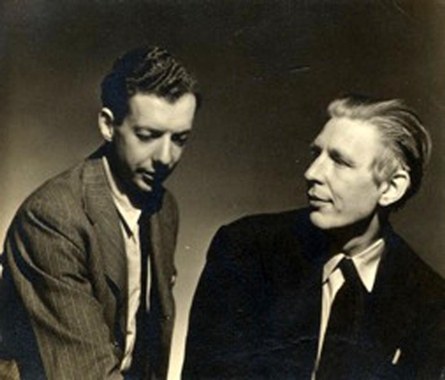 Instead, we got footage of Bennett and Hytner reflecting both jointly, and individually, on the play's birth pangs, along with snippets of commentary from its enormously talented leading men, Alex Jennings (Britten) and Richard Griffiths (Auden), the latter of whom stepped in during rehearsals following the departure due to illness of original co-star Michael Gambon. (The full impact of Gambon's exit on the rest of the company was not explored.) This recent material was interspersed with a version of, presumably, much the same enquiry into Auden and Britten's own professional and personal dovetailing and eventual separation that Bennett must have engaged in himself, though Bennett's own preface to the published script of the play is, in fact, more complete on this front than the documentary manages to be.
That said, it was fascinating to be reminded of the extraordinary ravines of Auden's face and how aptly evocative they are of Gambon, next to whom the smooth-cheeked Griffiths was about as far-removed physically from the poet he was asked at the 11th hour to play as it was possible to be. (Hytner's finished stage production made a wry joke out of that very fact.) And one might have liked an even greater investigation into the process whereby an apparently straightforward bioplay morphed over successive drafts into a far more complex and moving look at the relationship between play and playwright as Bennett decided to encase his Auden/Britten face-off within a show that just happens to take place within the very rehearsal room that Bennett can by now call a second home - a play, in other words, first intended to lay bare the lives of others turned into a meditation in some way on its creator.
With musical scoring including Britten's always welcome Sea Interludes, Low's film hinted at a creative reckoning in Bennett that finds rough equivalents to Auden and Bennett in his play, images of Britten walking the Suffolk beach paralleled by shots of Jennings making his way down one or another backstage corridor at the National. I waited in vain for a recapitulation of that delicious final speech in Bennett's play in which Frances de la Tour's inimitable stage manager, Kay, spoke the author's title. But to see Bennett visibly worrying his latest creation at this point in a career spanning a half-century of kudos was to be reminded that the habit of art can be as hard as, with luck, it is glorious. Let's hope it's one habit Bennett doesn't kick any time soon.
Overleaf: more Alan Bennett
David Nice

Events surrounding the birth of the unrepentantly "un-American" Marc Blitzstein's early (1936-7) shot at socially aware music-theatre prove much more interesting than the show itself. Heck, I got more out of reading the programme than I did sitting through the whole darned thing. Let's face it, Blitzstein's mostly foursquare marriage of words and music sucks. Not that the dynamic Mehmet Ergen's latest Arcola team didn't give it their best shot.
Sam Marlowe

“It’s this ghost they’re talkin’ about. I’m feelin’ an emanation meself. Unless I ‘ad too many pickled eggs last night.” If that’s the sort of crack that tickles your fancy, you’ll find plenty to make you chuckle in Ken Hill’s spoofish take on H G Wells’s novella, first presented at Theatre Royal Stratford East in 1991. Should you also have a taste for rather well-worn magic tricks, you might find Ian Talbot’s new production positively transporting.
Aleks Sierz

Middle-class family angst continues to be this season’s theme at the Royal Court Theatre, but this time it is seen through the eyes of 10-year-old girls at a 1990s boarding school. But don’t expect this to be an episode of Malory Towers or even the rather good-natured naughtiness of St Trinian’s. No, this is a bleak institution where the girls are foulmouthed and vicious in their rivalry. As Mrs B, who supervises the dorms, says to the headmistress: “They are small dogs doing what small dogs do.”
alexandra.coghlan

“Suicide, parricide and salivation!” Not the ecstasies of a masochist, but the mangled verbal fanfare announcing that The Rivals – Richard Brinsley Sheridan’s classic comedy of manners – is once again a fixture in London’s West End. When it comes to powerhouse comedic casting, the National Theatre has long had the laurels for 2010 sewn up in Simon Russell Beale’s voluminous britches. Partnered by Fiona Shaw in Dion Boucicault’s London Assurance, the pair were mighty indeed. Now, in the dying breaths of the year, we have Penelope Keith and Peter Bowles reunited in two much-beloved comedy roles. So does their Rivals live up to its name and challenge for comedic supremacy?
David Nice

"Can't go on, ev'ry thing I had is gone". Hear Judy Garland deliver those lines from Arlen's "Stormy Weather" live at Carnegie Hall in 1961 and you'll know that no singer, not even Callas, could go further turning heartbreak into art and serving up the naked truth. I wasn't expecting this production of Peter Quilter's play, previously seen in Northampton, to do much more than echo your average queen's "such a tragic life" line, nor Tracie Bennett to go beyond a Star Impersonation.