

“There’s no situation in the world that can’t be passed off with small talk,” claims hostess extraordinaire Olivia Brown in Terence Rattigan’s Less Than Kind. It’s a maxim that could well serve as Rattigan’s theatrical epitaph, the philosophy that allows him to smuggle desperation, frustration and steel-capped social critique in amongst the silk peignoirs and smoking jackets of his drama. In celebration of the centenary of this newly fashionable playwright’s birth, the London stage is to be crowded with his work.
theatre reviews
David Nice

Tradition has often bedded down very comfortably in the Russian performing arts, which ought to be an asset in the current vortex but brings mixed blessings. Detailed ensemble work, the Moscow Sovremennik Theatre's strongest asset, takes time to develop, yet actors with roles for life may be slow to yield to fresh blood. So does theatre legend Galina Volchek's 21-year-old production of a tough literary adaptation about women learning the "new language" of the terrible year 1937 on the way to Siberia merit a standing ovation?
Sam Marlowe

Becky Shaw is lonely, unattractively needy, nervous, hungry for affection, affirmation, security. We are all Becky Shaw. That’s a gross generalisation, of course – but then, generalisation is the language of Gina Gionfriddo’s play, which premiered in Louisville, Kentucky, prior to a 2009 off-Broadway run.
David Nice

Have you ever found onstage nudity sexy? Unlike a friend of mine, for whom the epiphany of the National Theatre's Bent was the giant member in the first five minutes, I honestly haven't. Sensuous, once, in the Maly Theatre's skinny-dipping Platonov, and even sweet, in ATS Theatre's strong adaptation of Forster's Maurice. Since the theatre's Artistic Director Peter Bull, evidently a good guy, was staging this, Jack Heifner's all-male updating of Schnitzler's La Ronde, I'd hoped that some good things would come of it. Unfortunately, for me at any rate, Seduction was neither erotic, very funny nor very dark (until you read the programme note for a reason why).
sheila.johnston

Set at a pivotal point in Shakespeare's canon, Twelfth Night is a glass-half-full kind of play. Is it a joyous, clear-eyed, compassionate comedy of human foibles by a writer reaching maturity, a wild and crazy ride through a season of carnival misrule and role reversal? Or, on the other hand, an ominous harbinger of the troubling, darkening work still to come?
Aleks Sierz

Playwright Nina Raine has a gift for evocative play titles. Her 2006 debut was called Rabbit, and her sellout success at the Royal Court last year was Tribes. This time, we seem to be on safari with Tiger Country, but appearances can be deceptive.
alexandra.coghlan

“Now go we in content. To liberty and not to banishment.” A touchstone to productions of As You Like It, Celia’s wishful recasting of the Forest of Arden can rarely pass unchallenged by directors. In 2009 we saw Michael Boyd’s RSC production go head to head with Thea Sharrock’s unexpected and beguilingly sunny interpretation at the Globe – a contest in which Sharrock proved a comfortable victor. Returning once again with his conventionally darker-hued take on Shakespeare’s comedy, the question was always going to be whether Boyd could grasp the authority that so slimly eluded him last time.
Aleks Sierz

As the debate about educational standards and Free Schools rumbles on, the Bush Theatre in west London has had the good idea (gold star guys) of beginning the year with a mini-season of two plays on the subject of education. The first play, by John Donnelly, opened tonight and looks at what happens when a young teacher, Zoe, bites off more than she can chew. It's a thrilling start to the playwriting new year.
sheila.johnston

Joseph Mallord William Turner - Billy to his intimates, such as he had - is the notional centre of The Painter, a snapshot of the great British landscape artist as a young iceberg. Toby Jones is the main draw in this world premiere of Rebecca Lenkiewicz's new play, and he emanates quiet charisma and sardonic wit. But it's the women in his life who get the better scenes and who steal the show.
Success came early to Turner. In 1799, when the play begins, he was still in his mid-twenties but had been exhibiting watercolours at the Royal Academy for nearly a decade – possibly buying his paints from the Colourworks Reeves factory in Dalston, north-east London, a building which, in a very neat marketing manoeuvre, is also the Arcola Theatre's brand-new premises; a high-ceilinged, unfinished but striking bare-brick space.
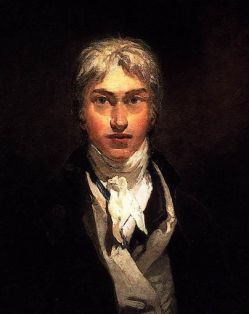 There was more going on that year. Turner had just moved into a new studio with his devoted father whom the play and performances induce you to take for a kindly, devoted manservant until late in the game. His mother, Mary, meanwhile, was drifting into madness. In 1799 she entered Saint Luke's Hospital, but would die in Bedlam.
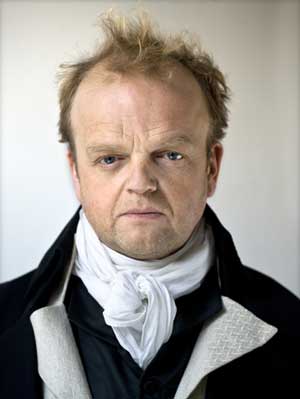 This was also the probable year of Turner's best-known self-portrait (pictured above), deliberately channelled in the publicity shot (pictured left) of Jones for the Arcola's production. But painted Turner is handsome, romantic - intense, to be sure, but also a little suave and patrician. Jones's Turner is unshaven, rumpled, scowling, a bit of rough. When he opens his gob, he's pure East End barrow boy. "I thought Turner was posh!" sighed a woman behind me.
Turner's father, we learn, was from the lower orders: a wig-maker who lost his trade when wigs fell from fashion, one reason no doubt for his devoted support of his son as a new meal ticket. There are also references to a world in turmoil ("Town was mad again") from the Napoleonic Wars, and Turner is cramming Dutch, perhaps on account of his lifelong passion for Holland's art. Rebecca Lenkiewicz's play is full of such elliptical detail. But - with only seven characters - it's very much a chamber piece.
As a rule, Turner didn't do portraits. In the play, he calls it "face painting". He didn't do people much, come to that. "Your heart's a hole, Billy," his mother says. The short, fragmented scenes make it hard to engage with the character, particularly in the first half (under the aegis of the Arcola Theatre's artistic director Mehmet Ergen, the scene changes in this almost-in-the-round production aren't always as swiftly and smoothly managed as they could be).
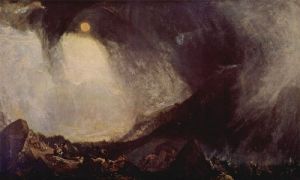 From time to time Turner holds forth to the members of the Royal Academy on his theories of art, full of contempt for the no-talent nobs, his mind never quite on the task in hand. Then, at the end, he turns to address the audience on his breathtakingly ahead-of-its-time Hannibal Crossing the Alps (1810-1812, now in the Tate Britain and pictured right): "The sun is God and it's a battle. Or dark against light... And... the light has to win."
This should be Turner's big, redeeming, barnstorming speech: a transcendent vision of sublimity, the victory of hope over despair. But at first you assume it's just another of his boring lectures. And far from being the intended coup de théâtre, you can barely make out the slide projection of the painting on the back wall.
So look to the women to pick up the slack. The play has three of them. Turner's mother, Mary (Amanda Boxer) lost her wits when she lost her adored daughter; her son treats her ambivalently and she returns the favour. Jenny Cole, an Irish prostitute (Denise Gough), poses for him and they form an intimate, curiously Platonic relationship which he ultimately betrays.
Sarah Danby (Niamh Cusack), a widowed actress clinging onto respectability, tries to domesticate Turner and unsurprisingly finds him a lost cause. They are all - especially the first two - given stonking, emotional scenes. In a production bursting overall with talent and ideas, all that's needed is for Turner's elusive being, as mazey as his explosions of painterly light, to be brought more clearly into focus.
Aleks Sierz

We remember JM Barrie as the creator of Peter Pan, that quintessentially English fairy story which features Neverland, the Boy Who Wouldn’t Grow Up, and where “to die would be an awfully big adventure”. Generations have embraced this mythical tale as an expression of the spirit of upper-class Deep England. Here the Victorians are us. But James Matthew Barrie himself was the child of a Scottish Calvinist working-class family, and is the subject of Alexander Wright’s play — a hit in Edinburgh last year — which aspires to be a kind of anti-myth.