Ariadne auf Naxos, according to its librettist Hugo von Hofmannsthal, is all about fidelity: fidelity in love, fidelity in art, fidelity in spirit. Ariadne on her island, abandoned by Theseus, can give herself to Bacchus only by persuading herself that he’s a god. The actress Zerbinetta gives herself to every man in sight, including the Composer (played, incidentally, by a girl), who for a moment weakens in his lofty contempt for these comic actors who intrude on his high ideals with their vulgar songs and dubious humour.
Hofmannsthal could seldom be parted from his deep meanings. All the same the real interest of Strauss’s chamber opera – composed just after Der Rosenkavalier – lies in its theatrical method, which, pre-Pirandello, pre-Turandot, presents an earnest, heroic drama disrupted by irrelevant characters who offer advice to the heroine and do their best to turn the opera seria into street theatre. It’s an entertaining, suggestive idea, but problematic in performance, partly because Strauss couldn’t bring himself to abandon his epic conclusion, which tends to drag on and in the process rather spoils the irony. The finest music comes in the Prologue, backstage before the show, which has the performers popping in and out of their dressing rooms in the best Feydeau manner while the high-minded young Composer laments the looming wreckage of his magnum opus.
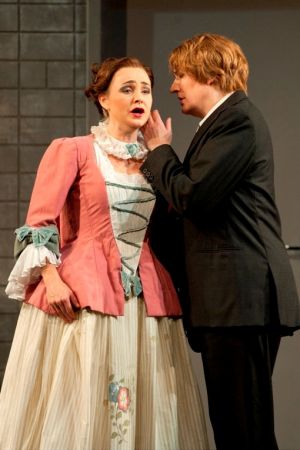 This is also much the most enjoyable part of Neil Armfield’s production in this WNO revival at the Wales Millennium Centre in Cardiff. True, he drops Hofmannstal’s beloved 18th century, and with it the whole idea of the grand Viennese palais (which survives nevertheless in the text). Still, Dale Ferguson’s modern theatre-backstage fizzes and crackles with comic vitality while allowing space for those moments where the music speaks, the comedy retreats, Zerbinetta looks into the Composer’s eyes and for about 30 seconds falls in love. Sarah Connolly, in the travesty role of the Composer, is wonderfully touching in these episodes, and Gillian Keith (pictured right with a suited Connolly) as Zerbinetta subtly colours her flirtatiousness with the sort of profundity that lurks in the eyes and voices of pretty girls but vanishes in an “Augenblick”, as she admits – the flash of a spider’s eye.
There are several other crisp performances in the prologue from singers who, like the Composer, are not required in the “opera” itself. Stephen Rooke’s Dancing Master is outstanding – a fine lyric tenor; but Robert Poulton’s shock-haired Music Master, and the just-not-too-overacted Major Domo of Eric Roberts (another disruptive element, as the part is spoken) are also both excellent. As for those who do reappear on Ariadne’s island, the four commedia masks (Owen Webb, Aled Hall, Julian Close and Wynne Evans) make a sprightly team, but as always they outstay their welcome, a problem that not all Armfield’s skilful management of slapstick cliché can solve. Strauss even made the mistake of continuing Zerbinetta’s great show-stopping aria "Grossmächtige Prinzessin" for some minutes after it’s stopped the show – to my mind a fatal miscalculation. Keith dispatches the whole thing with coquettish brilliance. But one nevertheless tends to sympathise with Ariadne (Orla Boylan), who has had enough long before the end and makes a dignified exit.
After last month’s lamentable Fidelio, Lothar Koenigs and the WNO Orchestra are back on top form. They need to be
Would that she could manage her own music with quite such poise. She is, though, a wooden actress, and her musical phrasing is short-winded; there is bloom – of a silvery kind - on the voice, but rarely on the long musical line. She might take a tip from her three graces, Mary-Jean O’Doherty, Patricia Orr and Joanne Boag, who blend with irresistible sweetness in the march-trio they cheekily base on Harlequin’s “Lieben, Hassen, Hoffen, Zagen”. But Strauss did not make it easy for her, or indeed for her “new god”, Bacchus (Ricardo Tamura), who descends in this production on a superior builder’s cradle and acts, it must be said, like a superior builder. His singing, though, is better than that: sturdy, if one-toned. But the problems of this conclusion are mainly Strauss’s fault. Perhaps we should revert to the work’s earlier ending, which has the masks reappearing and M Jourdain falling asleep in his box.
Finally, I’m happy to report that, after last month’s lamentable Fidelio, Lothar Koenigs and the WNO Orchestra are back on top form. They need to be. Strauss’s chamber textures are exposed and the balance treacherous, but everything here is stylish, athletic and beautiful, in an opera that is almost worth hearing for its orchestration alone.
OVERLEAF: MORE RICHARD STRAUSS ON THEARTSDESK



