


Even for those with only a passing acquaintance with Irish history, the Famine – or the Great Hunger – looms large, when British indifference to the failed potato crop in large parts of Ireland resulted in the deaths or emigration of nearly a quarter of the country’s population in the 1840s and 1850s.

“Let’s get a clip, Long Island.” One New York skateboarder encourages another, who’s from the ‘burbs, to show off ollies, pop shuvits and kick-flips for a YouTube video. But hang on: “There are too many penises in the way.” This is a posse of young women, a rare sighting in the male world of the skate park.

Domnhall Gleeson needs to watch it. In Goodbye Christopher Robin he played AA Milne, the creator of Pooh and co. To achieve the correct level of period English PTSD, it was as if he’d folded himself up into a neat pile of desiccated twigs. And now he’s gone and done it again in The Little Stranger, only more so.

Why is M.I.A. such a problematic pop star? Why can't she just shut up and release a hit? Tellingly, this is the very question the singer poses at the start of Matangi/Maya/M.I.A - a question she's been asked throughout her career, from interviewers to management.

On the eve of her tenth decade, the marvellous Agnès Varda embarked on the enchanted journey that we see in Faces Places. For admirers of the great French director – of whom there are a great many: indeed, it is hard not to be won over by her resolutely independent, profoundly humanistic substance and style – its spirit will recall her two earlier documentary films of the century, The Gleaners & I (2000) and the more autobiographical The Beaches of Agnès (2008), though the mélange between personal and social is here complete. This is a journey that celebrates a life richly lived as well as the human interaction, the delight in the sheer richness of humanity, that has always been inseparable from that existence.
The difference from those previous films is that in Faces Places Varda does not travel alone, her companion here the vivacious photographer JR, a half century her junior: she has seen “88 springtimes”, he is 33. (Quite how they met is shrouded in a whimsical series of opening episodes charting how they didn't meet, including an irresistible disco scene with the veteran Varda gamely bopping the dance floor.) JR’s speciality is large-scale photo portraiture, created in the most democratic style possible: he drives a special photo-camion, designed to resemble a camera, complete with photo booth and equipment which produces, directly out of the side of the truck, huge prints for pasting on walls,. Or any other suitable surface, since his speciality (aided by a team of assistants) is plastering his images – which can be anything up to ten times human scale – on anything, from gasometers to train wagons. Portraits in landscape, as never before.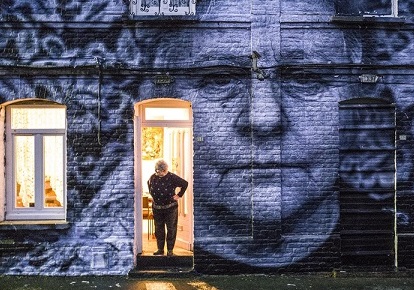 It’s their shared interest in their subjects – hardly the right word, when collaboration is so close – that makes this pairing ideal; these are not artists working on their own, but creators of events. “To meet new faces,” is how Varda expresses the resolve behind their road trip, its destinations better caught by the film’s French title, Visages Villages. No big city monotony here, rather an exploration of rural France, its singularities and personalities relished to the full.
Was there a guiding concept behind their journey, as they travel from the declining mining communities of the North to the villages of the South, where a sense of profound permanence seems to reign? Hard to say, when chance (“We enlist it as an assistant!”) so clearly played a role. In each location, JR and his team create small monuments to individuality, putting the sitters in a spotlight that nevertheless seems a natural part of their environment: they range from Jeanine, the last remaining resident in a whole row of miners’ dwellings (pictured above), through portraits of the wives of three Le Havre dockers that are emblazoned, almost 100 meters in height, across the sides of shipping containers, to the collectif of a Provence chemical factory (pictured below, with Varda and JR).
Change is a recurring motif, a level of dehumanisation noted in working life
That last detail brings home that the Varda-JR tandem does not consciously seek out any sort of rustic idyll; modernity is a natural element in these worlds, even if politics remains distant (notwithstanding any reflections we may have that some of the communities visited would surely have voted for Le Pen). And change is a recurring motif, a level of dehumanisation noted in working life: where once whole communities would have brought in the harvest, now a single farmer attends to 2,000 acres on his own, sitting atop a tractor/harvester that is fully controlled by computer.
“What is the subject, actually?” Varda muses at one point. For her, perhaps, it is in the conviction that whatever activity a human being may engage with, it should not dwarf the humanity of the individual(s) involved. Faces Places teaches us quite a lot on matters caprine, including that today’s goats often have their horns removed (burnt away, or “disbudded”, at an early age). That’s ostensibly to reduce damage when they fight, but Varda is affronted: how she rejoices when she finds a smallholder who resists all that, a place where milking by hand rather than machine is seen as the natural process. To treat someone or something as mere “product” is the worst thing of all.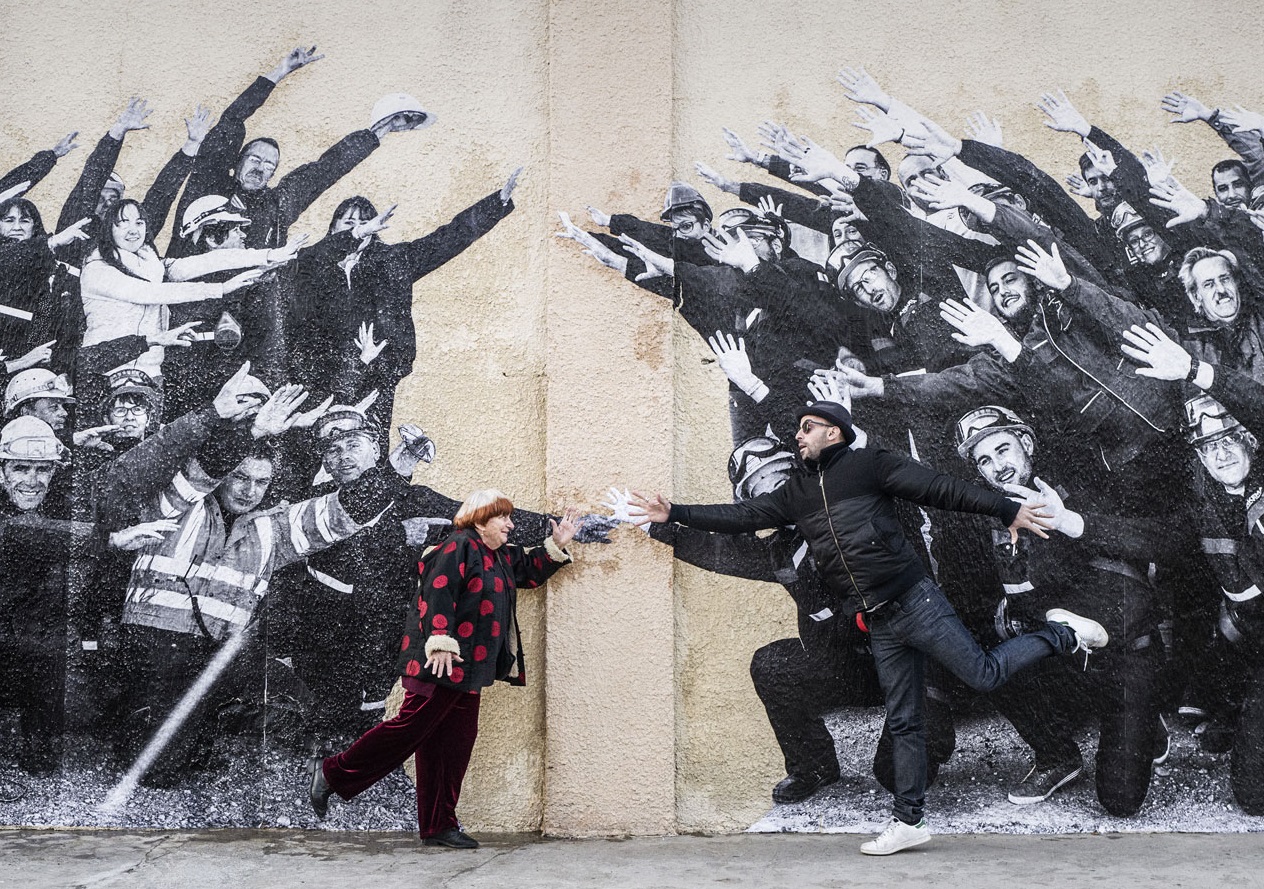 By loose extension, art becomes a catalyst that can transform the everyday. Asked by one railwayman why JR has pasted images of Varda’s eyes (and toes, too) onto the sides of chemical-storage train tankers, she replies that it is to endorse the “power of imagination”. We may perhaps wonder whether there is nevertheless an elitist concept involved somewhere, in this conscious idea that “art is for everyone”, especially when promulgated by France’s generous funding regime. But Varda’s film brings home how that can never be the case when everyone is involved (the film’s crowdfunding element is surely as appropriate here as the concept has ever been).
Faces Places is also a picaresque story of bonding between two individuals, their symbiosis of engagement with those whom they encounter reinforced by the gentlest of teasing. Both look with such curiosity at the world around them, that issue of vision associated both with Agnès’s failing sight and JR’s reluctance to take off his dark glasses. That latter strand harks back naturally to Varda’s 1961 burlesque film-within-a-film, Méfiez-vous des lunettes noires (Beware of dark glasses), in which Jean-Luc Godard, no less, starred with a Keatonesque charm, a quality singularly lacking in his behaviour in the final scene of Faces Places. It proves a rare moment of sadness in a work where these two presences, perfectly accompanied by Matthieu Chedid’s string score, are so entrancingly life-affirming. If ever a film could promise you une bonne journée, it’s Faces Places.
Overleaf: watch the preview for Faces Places

Beware the hidden powers of the cellphone. When in Never Here New York conceptual artist Miranda Fall (Mireille Enos) finds a stranger’s phone, she uses it as the basis for her next art show, tracking down and interviewing the owner’s contacts, listening to his music and using his GPS history to retrace his steps.

Annemarie Jacir’s third feature may have picked up a subtitle, “The Wedding Invitation”, for international distribution, but the key to her intimate portrait of Palestinian life seen through a father-son relationship lies in understanding the full nuance of its title. The word wajib, best translated from Arabic as “social duty”, is spoken only once in the film – an invitation is taken to an old lady whom the hosts know will be unable to attend, but they offer it because that is the accepted, the proper way in their society – but its concept pervades the entire film.
Jacir has located her story within the Palestinian Christian community in the Israeli city of Nazareth, where the tradition remains strong that the father of the bride must hand-deliver wedding invitations to family and friends, and that it’s the duty of his son to accompany him. Even though this is a community that is as geographically contained as it is closely bonded, it’s a task that can take days – not least because every stop brings an almost ritualistic invitation to drink coffee, another aspect of tradition that cannot be disregarded.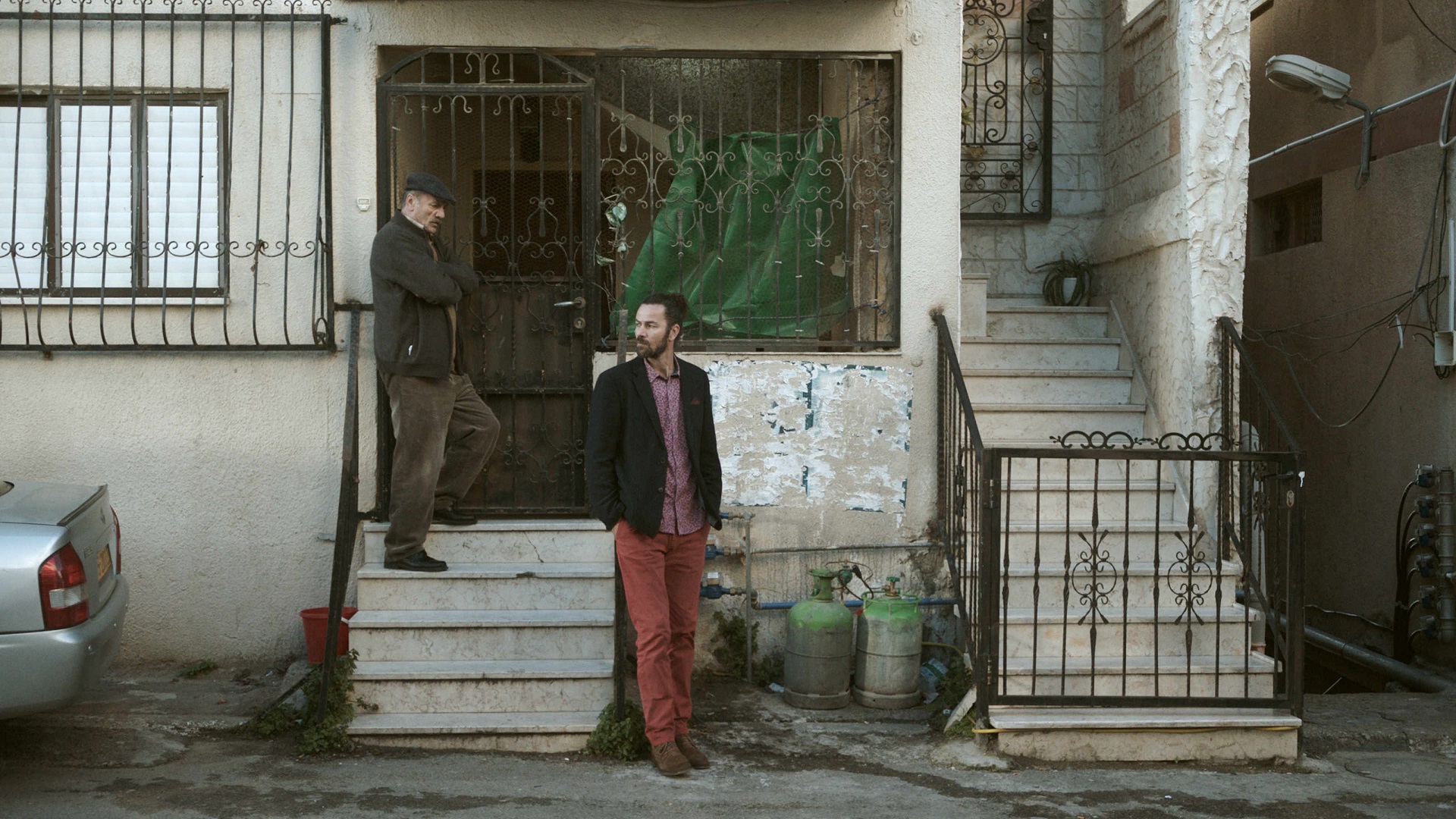 That may sound like a perfect opportunity for some père-et-fils quality time between sixty-something Abu Shadi and his man-bunned son, Shadi (Mohammad Bakri and Saleh Bakri, father and son in real life, pictured above), but in reality the sturdy old Volvo they are driving sometimes appears more resilient than their relationship. Jacir’s beautifully observed script skilfully outlines their wider circumstances and family story, taking in both the very particular realities of their life as Palestinians in a particular environment, as well as the general hazards and frictions of family life that might be found anywhere in the world.
The difference between home and abroad is one central division between them. Shadi was sent abroad to study by his father, and has settled in Italy, where he works as an architect. The reasons for that earlier departure become clearer as the film proceeds, involving the general question of Abu Shadi’s necessary accommodation with the Jewish authorities – “I have to deal with them!”, he explains with the exasperation of the pragmatist – and is crystallised into one particular issue that gives rise to a strong late scene of angry conflict. That Shadi’s girlfriend is the daughter of an exiled PLO high-up only accentuates the distinction, emphasising the restricted reality of occupation against the broader perspectives of the diaspora. It doesn’t help that the younger man is forthright with his criticism of conditions in his erstwhile hometown, directed at everything from its street rubbish and neglect of architecture to the “closed minds" of its people.
The father can certainly be an awkward cuss on occasions, but has a humour that wins us over
The fact that his son has anchored his emotional life abroad clearly saddens his father, who would like nothing better than to marry him off to a local girl. He drops hints to that effect at almost every stop, lamenting that “It's too bad people don't marry their cousins anymore” when a family lunch introduces an independent female relative into the company. The older man’s sensitivity to the issue of marriage is no abstract matter, however: it gradually becomes clear that he himself is separated from his wife, who now lives with another man in New York, her return to the wedding proving complex in every sense. He had been left to look after their two children on his own, a blow that hit hard not only for personal reasons but because it broke with values and tradition, prioritising personal freedom over the kind of obligation that is there in the film’s title.
Bakri senior plays this with a wounded dignity that hits home, his face revealing more through craggy restraint than anything more obvious. He can certainly be an awkward cuss on occasions, but has a humour that wins us over, especially when set against the peremptory remoteness of his son: the experience of age, even when it has had to admit compromise, wins out over the intolerance of youth. “The most beautiful bride!” he exclaims simply to his daughter as she tries on wedding dresses (pictured below), his words spoken with such rich pride that they resound long after we forget all the younger man’s frustrations and anger.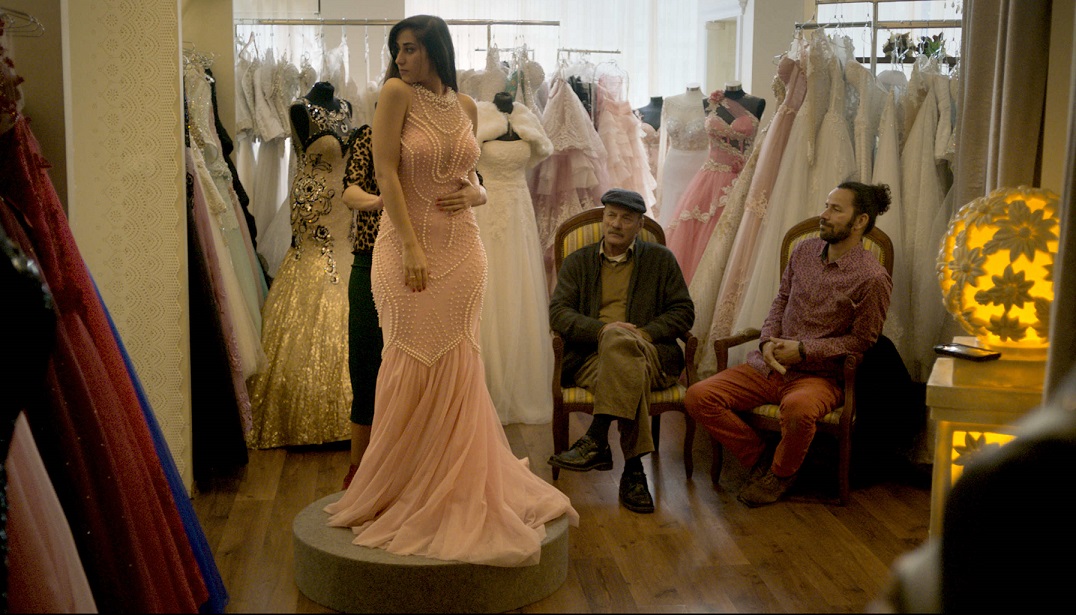 Wajib is a film anchored to its very depths in a particular territory, with Jacir giving us all the particular details of life of her chosen world – its everyday aspects but also a sense of its past, of roots that extend further back than any current politics. The director was born in Bethlehem and, after growing up in Saudi Arabia, education in New York, and some years based in Amman, has now returned to live there: we may wonder whether the profound humanism of her new film somehow reflects that relocation. It’s there in the film’s look, too: there’s little obvious beauty in the Nazareth locations, but they’re caught with real resonance, as well as poised framing by French cinematographer Antoine Héberlé (perhaps an outsider’s eye helps).
Jacir’s previous film, When I Saw You from 2012, overlapped a personal story with the wider circumstances of the history of her people. Wajib may appear to have narrowed its horizons, but in burrowing down to the essentials, allowing detail to speak volumes, she proves, resoundingly, that less can be far, far more.
Overleaf: watch the preview for Wajib

Harry Dean Stanton died in September last year aged 91, and will forever be remembered as the embodiment of the lean, lonely, laconic stranger, a man of few words but imbued with an enigmatic allure. This film, the directorial debut of character actor John Carroll Lynch, has been conceived as both homage to and starring vehicle for the departed Stanton, but doesn’t quite hit the spot on either count.

A starry and mostly American cast does well by The Seagull, Chekhov's eternally moving portrait of egomania run wild and self-abasement turned tragically inward. Combining two major players from the New York theatre world in director Michael Mayer (London's Funny Girl, Broadway's Hedwig and the Angry Inch) with a Tony-winning adapter in The Humans' Stephen Karam, the film suffers only from an occasional literalmindedness that exists at odds with the multi-layered nuance of the source material. Still, Annette Bening in full flow is always worth one's attention, and a distinguished supporting cast for the most part matches her a large part of the way.
Karam's Broadway treatment of The Cherry Orchard (with Diane Lane in the lead) was fairly savagely dispatched last autumn, and his Seagull has similarly come in for some hard knocks that, to this observer at least, aren't altogether deserved. True to the emotional geometry of the play if sometimes inclined to underscore it too intently, this Seagull captures the cat's cradle of crossed affections that animates Chekhov's merciless portrait of vanity and ego and of a mother (Bening's Arkadina) who surely loves her son (Billy Howle's impressive Konstantin) even as she can't help wreaking havoc with both his professional and personal aspirations. 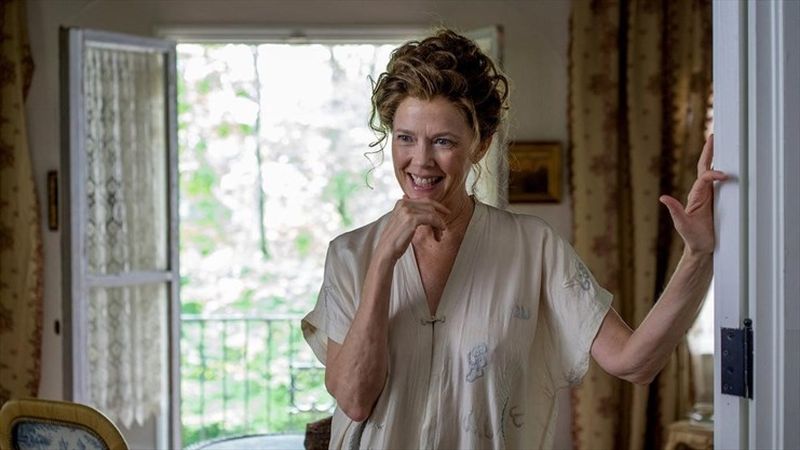 This version provides a prologue for Arkadina that find this vainglorious actress in her natural theatrical habitat, before the narrative of the play itself kicks in with the return to her brother Sorin's rural estate of Arkadina and her retinue, which includes the spineless if charismatic Trigorin. (In that crucial and difficult role, New York theatre regular Corey Stoll manages to be both imposing and weak, as required by the dictates of a plot that spans several years on the way to its tragic finish.) And whether revelling in the applause of her unseen audience or interrupting her son's play to proffer a deflating aspersion or two, Bening (pictured above) is in full command of the ever-mercurial Arkadina, a part this terrific actress should at some point revisit onstage; while we're at it, she'd be an excellent Ranevskaya, as well.
Funny and spiky (Bening gets a laugh proffering a nominal tip to the household help which, she announces, is to be shared three ways), her Arkadina captures better than most this mother's belated awareness of the the full damage being wrought on a hyper-sensitive son whom she both cossets and destroys. You feel at once her essential blindness to the reality of the scenario unfolding around her, alongside a slow-aborning realisation that her recklessness has consequences, for sure. Stoll's Trigorin, by contrast, knows that he is one of life's destroyers but carries on regardless, his psychic evisceration of Konstantin's beloved Nina (Saoirse Ronan) running in tandem with the imploding artistic despair of the young writer, Konstantin, doomed to exist on life's margins.
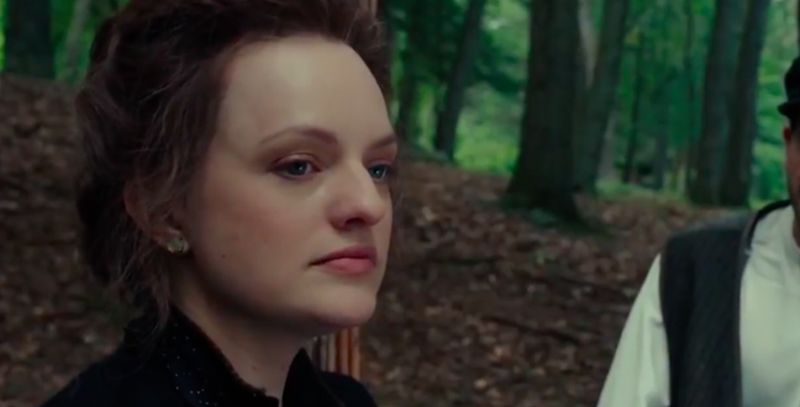 A name-heavy cast (a pragmatic Jon Tenney here, a tearful Mare Winningham there) includes Elisabeth Moss (pictured right) in terrific form as the mordantly funny, black-clad Masha, trapped in a marriage that roils her to the soul, and Brian Dennehy as the ailing Sorin, who at least is allowed to expire in something resembling the natural order of events: a luxury not always available to the younger generation around him. Amongst that blighted lot, I expected rather more from Ronan's Nina, the self-described seagull of the title, who seems hampered by an American accent that never sounds as lived-in as the one this three-time Oscar nominee assumed so well for Lady Bird. That said, this Seagull compels and wounds as it must and ends with the requisite moment of hinted-at recognition as Arkadina and co get on with life, even as they exist forever to be shadowed by death.
Overleaf: watch the preview for The Seagull