

To the rich but faintly melancholy strains of Mozart’s Piano Concerto no 23, the latest release from Korean director Park Chan-wook sets up its protagonists for us, a carefree family enjoying a barbecue in their garden, with a mischievous ironic tone from the outset.
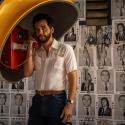
The music suggests refined, portentous emotions, far from the mundane domesticity of the scene before us. The father, Man-su (Lee Byung-hun, pictured below right), is almost blissed out with happiness at his good fortune: he has a sexy wife, two photogenic children, a house that once belonged to his farmer grandparents, a long career in the paper-making industry and bosses who have sent him a congratulatory present of an eel. His son thinks it’s a snake, and in one sense it is. This idyll, lovingly limned by Kim Woo-hyung’s athletic camerawork, which investigates every structure, storey and treetop like a super-nosy estate agent, is what Man-su stands to lose when his world is blown apart by a US corporate takeover. The eel is actually a cushioning of the blow: Man-su’s middle management job will soon be gone and he will, as he sees it, have no other choice than to take desperate measures to safeguard his family.
What follows is a black tragicomedy about human fallibility faced with social upheaval, and a kind of satire that has fallen out of fashion lately, except in South Korea, seemingly, which also produced Parasite. In a recent interview, Park indirectly evoked this sort of movie-making when he described his leading man as “Korea’s Jack Lemmon". Add some typical Park darkness and grotesquerie to the plot, and you might have a Billy Wilder film such as The Apartment. Wilder diagnosed the deadening office culture of 1960s corporate America; Park is targeting the latest legacy of those same capitalist forces, the invasion of the workplace by robotics and AI.
He has been working on No Other Choice for 20 years, adapted from Donald Westlake’s novel The Ax: a period in which Korean culture’s soft power has become a world leader. But there are signs that its K-pop mop-tops and leggy cartoon demon-hunters cannot be relied on to sustain this success. It's not a rerun of the 1998 financial crisis, with its mass layoffs, but Park’s film seems a timely reminder that no country's traditional industries are ever safe. (He has dedicated it to a previous adapter of The Ax, Costa-Gavras.)
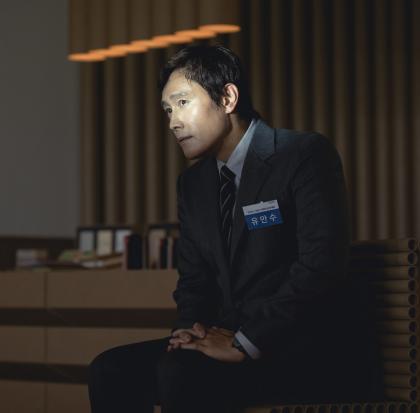
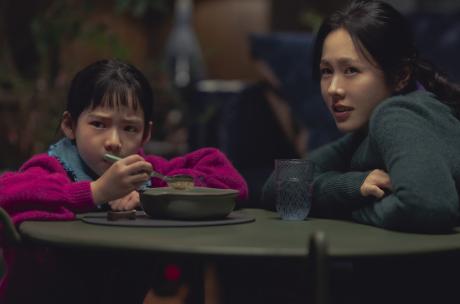
The perils of unemployment are distilled primarily in Man-su, an everyman figure, though he’s unusual in having married a divorced single parent, Mi-ri (Son Ye-jin), still a social no-no in more conservative circles in Korea. His loss of job equals loss of status and loss of identity as a patriarchal — and sexual — force. His son is already a budding delinquent; his 10-year-old daughter, Ri-one (Choi So-yul, pictured below with Son Ye-jin), is firmly on the spectrum and can only express herself via echolalia and her exceptional cello-playing. Man-su’s joblessness means her cello lessons — and future independence — are in jeopardy, as are his wife’s tennis coaching, their dance classes and the family Netflix subscription.
But when Man-su decides he has no other choice than to eliminate the top three rivals for any paper job he goes up for, he discovers other souls in similar trouble, who have turned to drink or found work in a job they are seriously unsuited to. HIs attempts at despatching them are fast-paced, darkly comic, with big helpings of expert slapstick. Park makes sure we are secretly rooting for him, a jittery man who can’t help sympathising with his fellow sufferers. Mi-ri, too, is a character we don’t entirely trust, yet she's similarly appealing in her stout defence of her family and her dislike of social snobs. Son Ye-jin can take her from bubbly to frosty on a dime. Will she become Man-su's accomplice? Does she have a choice? Her means of disarming the boorish businessman aiming to prosecute her son for theft is wickedly funny, and subversive.
The tone of the piece is underpinned by Park’s regular composer, Cho Young-wuk, whose soundtrack is as vital to the film’s success as Nicholas Britell’s for Succession, for some of the same reasons. From the highs of Mozart it descends to 1980s soul and cheesy pop, via crisp snatches of mock-baroque harpsichord, and back again, all of it dripping with irony. Young-wuk also writes a loud, galumphing piece, dominated by mocking wind and brass solos, to accompany a morbid sequence in Man-su’s greenhouse, a Little Shop of Horrors for bonsais — as well as managing at one point to incorporate the metallic clang of the Netflix ident. To end with there is a bouncy Vivaldi cello sonata played by little Ri-one, the closest she has come to communicating directly with her family; then a reprise of the Mozart, now discordantly playing over footage of savage machines ripping trees down in their metal maws.
The warmth of the piece inevitably comes from the humans, even little Ri-one, whose every move (and recital) is attended by the two family dogs, Ri-Two and Si-Two (Park’s subtitlers have worked wonders with the script’s opaque punning jokes). She and her family may be immensely flawed, but their will to survive raises them far above the snakes and noisy tree-destroying chomping ladybirds.

Lee is a wonder as Man-su (watch him in Squid Game if you must, but his finest hour on TV for me is in Our Blues on Netflix, as a lonely ice-seller on Jeju Island). Here he shows his subtle comedic gifts when he arrives late at the fancy-dress dance-party his wife was so looking forward to, to find her slinking around the floor with her dentist boss, both bizarrely dressed as Native Americans. Man-su, in a costume of Mi-ri’s choosing, is kitted out as a British sea captain, a look of sexy intent on his face as he sidles in his bicorn hat through the dancers. Just a rose between the teeth would have made it a Jack Lemmon moment.






Add comment