The Hail Mary pass is a desperate act of sporting faith when regular tactics fail, and the world’s end is faced here by constitutional optimists on both sides of the camera: The Martian novelist Andy Weir and its film’s writer Drew Goddard, Lego Movie directors Christopher Miller and Phil Lord and Ryan Gosling as Ryland Grace, waking alone in a spaceship unreachable light years from home, beard and brain mangled as he remembers his suicide mission. Gosling’s cool charm, a blank slate which flips from Drive’s smooth killer to La La Land’s mild lover, here converts into raw film star fuel for what is often a one-man show. He’s executive producer too, and Project Hail Mary mirrors his personality in the most Gosling-esque movie to date.
“I’m going to have to science the shit out of this,” Matt Damon’s astronaut realised when stranded on the Red Planet in The Martian, an essential Weir message which becomes global policy now in response to the apocalyptic qualities of Astrophage, a microorganism which is eating the Sun, with fatal consequences for humanity. Grace is a once brilliant molecular biologist whose maverick theories have reduced him to schoolteacher obscurity, only to be pressganged by elite government operative Eva Stratt (Sandra Hüller, pictured below right) into a last-ditch effort to save the world.
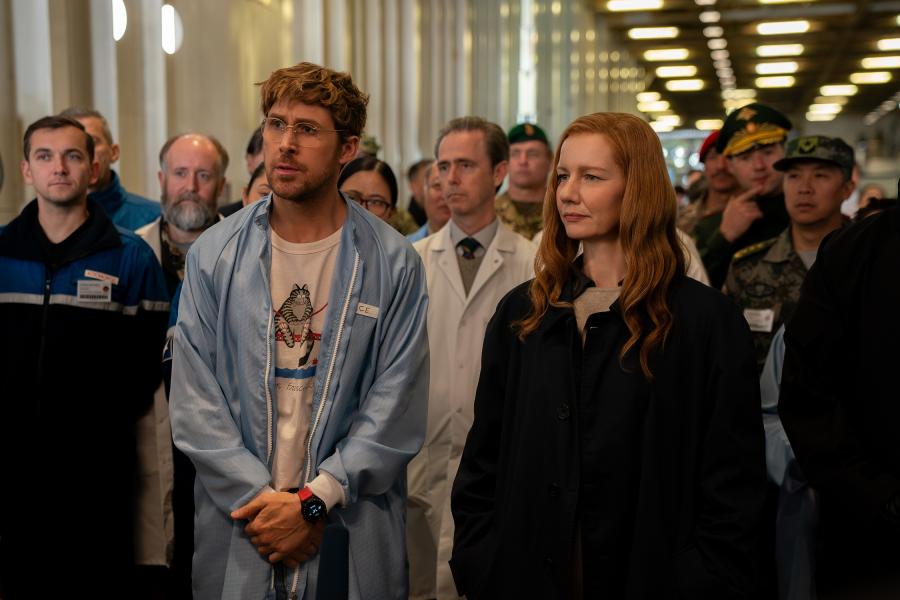
The methodical refinement of scientific solutions in a spirit of necessary unity recalls Covid days from which we apparently learned nothing, and acts as a rebuke to current divisions. Astrophage proves a galactic plague, and a journey is envisaged across cosmic wastes to examine a rare immune star. Daniel Pemberton’s score emphasises both looming threat and camaraderie, climaxing when Hüller’s rational bureaucrat lets rip with blowsy karaoke. She then dragoons Grace onto the good ship Hail Mary, where his memories intersperse with his current predicament, after the rest of the specialist crew died in transit.
The poignancy of sacrificial space-travel recalls Christopher Nolan’s Interstellar and Dennis Villeneuve’s Arrival, with added wisecracks, as the nominally determined Grace shaves and sets to work on a solution which will outlive him. The arrival of a similar dying planet’s mission and its surviving crew-member, a truly alien ambulatory mineral he dubs Rocky, turns his vigil into a genial double-act, pooling interplanetary knowledge and inter-species friendship. Hard sf now serves a soft family film. Older audience-members may think of Bruce Dern’s friendship with cute robots Huey, Dewey and Louie as the last man on a space eco-ark in Silent Running (1972). Grace’s red-lit spacesuit later riffs on 2001, in a film not shy of spare sci-fi parts.
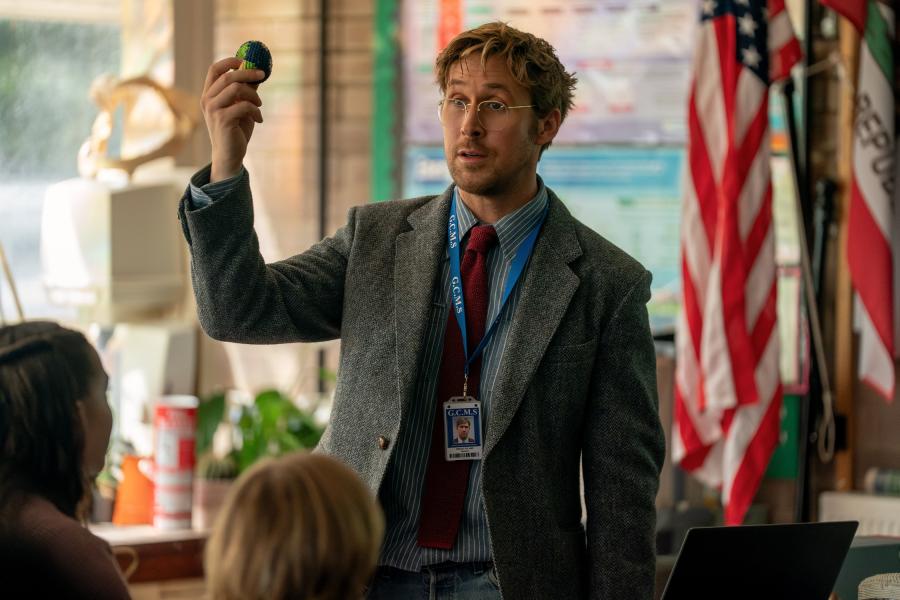
It gains enormously from IMAX, as practical sets’ scientific clutter, Rocky’s giant needle-ship, swirling water-colour cumulus and crystalline light-storms gain vivid intensity. Gosling carries this long, light film as it favours science theses over action till, as with The Martian, that science becomes so batshit crazy you just hail Mary and hold on.
The filmmakers’ sunny-side DNA finally overrides the poignancy which sharpened their wit, risking inconsequence. They join Greta Gerwig in suggesting cinema can be ambitious and happy, major minus the minor-key. This makes a huge financial bet on an original if derivative film which seeks to inspire a deflated and fractious world. For Gosling and its IMAX immersion too, bon voyage.