Take a bitter-sweet homage to Swinging Sixties London, then add a psychological horror story, and a murder mystery, with a dash of Mean Girls and a commentary on misogyny and sexual violence, all told through the prism of a young woman’s gift for seeing the dead. Edgar Wright has apparently been thinking about Last Night in Soho for more than a decade, which may explain why the final film feels so very over-cooked.
Wright is a creative, effervescent, engaging filmmaker. It would be impossible for him to make a film that isn’t entertaining, and this latest venture certainly has its dazzling moments. But overall it’s a messy melange that makes his break-out zombie comedy Shaun of the Dead seem positively subtle.
The complicated scenario starts in the present, with young Eloise (Thomasin McKenzie, pictured below) leaving her Cornish home for college in London and her dream of becoming a fashion designer. Eloise has a psychic ability that allows her to see her dead mother, who committed suicide when she was a child. For this, and other unstated reasons, her grandmother (Rita Tushingham) is concerned about the trip. “London was too much for your mum,” she says, ominously.
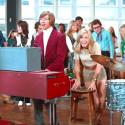
At college the only thing Eloise has to worry about is a bitchy and pretentious roommate and being a fish out of water, both quickly solved by abandoning the dorm for independence in a dusty old bedsit in the heart of Soho. It’s here that her passion for the Sixties is triggered to such a powerful degree that, at night, she’s transported back to the period – unseen to all, but with the powerful sense that she is there, for real.  At first, it’s a rush, as Eloise lands in the Café de Paris nightclub and the life of beautiful, stylish, wannabe singer Sandie (Anya Taylor-Joy), on the verge of her big break courtesy of shifty manager Jack (Matt Smith). Sandie’s confidence is contagious, the sense of possibility around her exhilarating; Eloise takes some of that into her own life in the present – emulating Sandie’s blonde bombshell styling and finding her creative voice.
But it can be no coincidence that the James Bond film playing in the Sixties is Thunderball, the one cited by No Time to Die director Cary Fugunaga when condemning the Connery Bond as a rapist. Both Sandie and her acolyte are to discover the darkness beneath Soho’s glitzy veneer; as Sandie’s life becomes horrific, so does Eloise’s, her romantic dreams now waking nightmares, the present and past frighteningly entwined.
The film itself brims with echoes from the past: Roman Polanski’s genuinely chilling Sixties horror film Repulsion, the presence of Sixties icons Tushingham and Terence Stamp; a terrific juke box of songs. In fact, it’s with the musical set pieces that Wright is at his best: paring back the visual distraction to showcase Taylor-Joy’s terrific rendition of Petula Clark’s "Downtown"; a kinetically staged and scary version of Sandie Shaw’s "Puppet on a String" (the moment of Eloise’s rude awakening, the only woman in an audience of leering men); a contemporary nightclub scene, on Halloween, with Eloise’s disintegrating mental health accompanied by Siouxsie and the Banshees’ "Happy House".
There’s also a smart horror steal when Wright simply capitalises on the opening screech of Black’s "You’re my World" sounding very like a Bernard Hermann moment from Psycho.
The problem is that there’s very little respite – from cinematic showmanship (swooning cranes, silky tracks, eye-catching effects), the soundtrack, the horror clichés – and as the film becomes wearing, it also loses its potential to be genuinely disturbing.
McKenzie (Leave No Trace, Jojo Rabbit) has a touching vulnerability, and Taylor-Joy is ineffably charismatic, but neither is well-served by Wright’s script (with 1917’s Krysty Wilson-Cairns), particularly McKenzie, who ends up doing a lot of frantic running around, while dealing with a soaking wet love interest and working her way through buckets of mascara.
The late Diana Rigg is fun as Eloise’s landlady with a twist, though her role too will undermine the serious themes and add to the sense that less could have been so much more.