

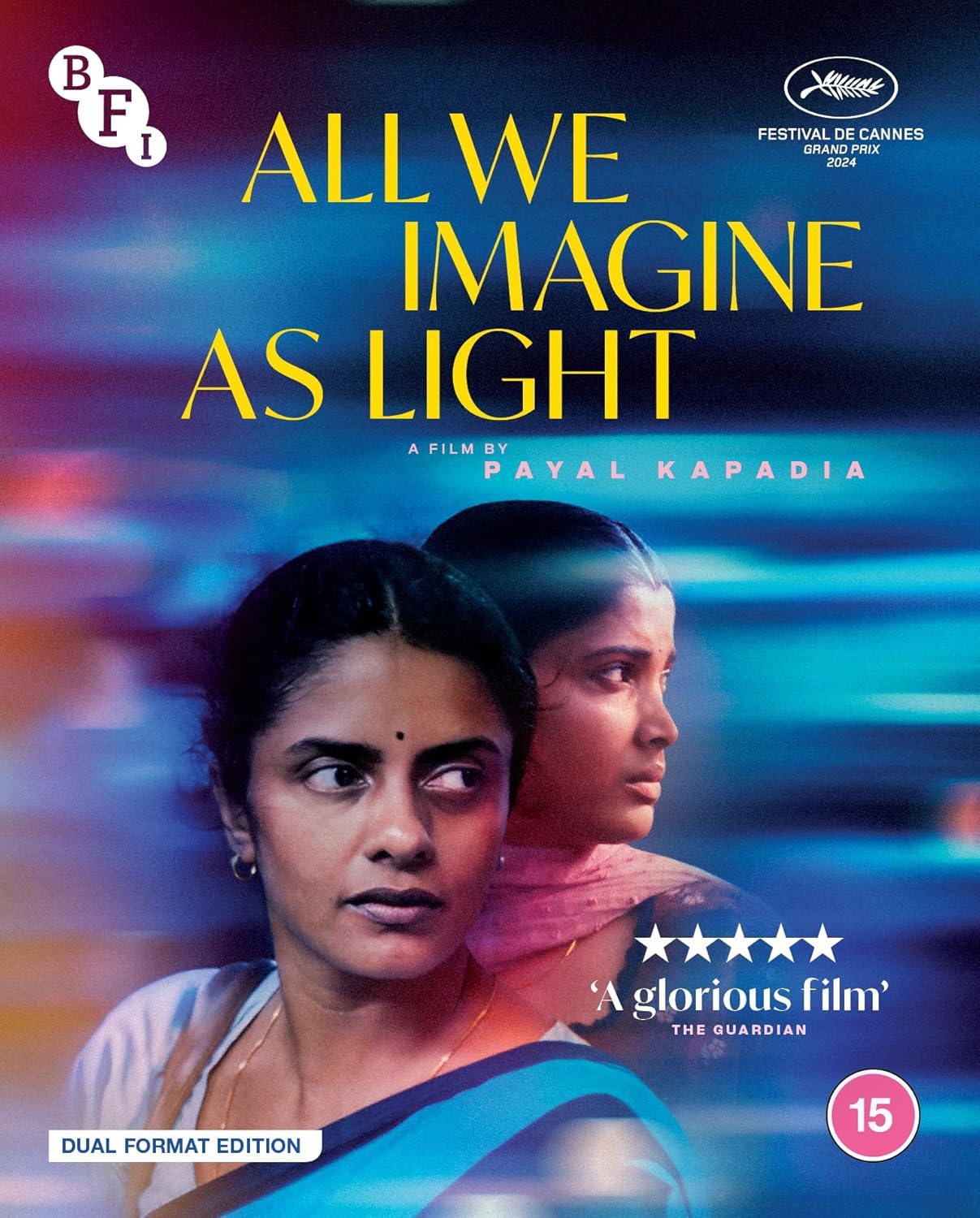
All We Imagine as Light focuses on the lives of three women in contemporary Mumbai; as shown by director Payal Kapadia, the city is arguably the film’s fourth major character. Kapadia eschews convention, her metropolis painted in muted colours with dark skies and heavy rain a constant.
We first see Prabha (Kani Kusruti) on the long journey home to the cramped flat she shares with her younger colleague Anu (Divya Prabhu); as in many western cities, their key worker salaries aren’t sufficient to allow them to live a reasonable distance to their city centre hospital.
Kusruti is an extraordinary screen presence, her deep-set eyes giving just a hint of the burdens which Prabha is carrying. Chief among them being the absence of her husband, now living in Germany after the pair’s arranged marriage, a man who hasn’t spoken to her in over a year but who has, possibly, sent her a rice cooker as a gift. Prabha is stuck in limbo, looking on as the flirtier, bolder Anu falls in love with Shiaz (Hridhu Haroon), a young Muslim who she can only meet in secret. Hospital cook Parvaty (Chhaya Kadam) is fighting eviction, but widowhood and her lack of the requisite paperwork mean that not even an experienced property lawyer can offer any real help.
 Kapadia balances quiet domestic sequences with flurries of activity and moments of real humour: Prabha’s exchange with an elderly patient who believes she’s being harassed by the ghost of her later husband is very funny, as is a scene where Anu and Shiaz comment on the photos of potential husbands sent to her by her parents. A shy young doctor at the hospital shows interest in Prabha, presenting her with poetry and home-made sweets, but she brushes him off. When Parvarty learns that she has no choice but to move back to the coast, she and Prabha throw stones at the sign advertising the luxury flats due to be constructed on the site of Parvaty’s home, the text reading “Reserved for the Privileged”.
Prabha and Anu‘s decision to visit Parvarty in her beachside village signals a striking tonal and geographical shift. Anu uses the trip to hook up with Shiaz, and Prabha saves the life of an older man who's washed ashore entangled in a fishing net, the cue for a magical realist twist made utterly convincing by Kusruti’s performance. The film’s nocturnal coda is blissful, a beach shack attendant dancing in the background while the main characters chat late into the night.
That All We Imagine as Light addresses a raft of weighty issues – globalisation, inequality, female friendships, gender roles – with such ease is nothing short of miraculous, Kapadia securing superb performances from her three leads. This is an unassuming, unshowy masterpiece; watching it is like immersing oneself in a rich, engrossing novel. It certainly stands up to repeated viewings and the BFI’s release contains some enticing extras: namely extended interviews with Kapadia and Kusruti plus two early short films by the director, both enchanting.


