

With Cardiff’s St David’s Hall continuing under wraps while it gets a new roof, the BBC NOW is still having to be tyre-levered into the much smaller Hoddinott Hall for its public concerts. It refuses to be restricted by this minor inconvenience. Strauss’s Tod und Verklärung, in Thursday’s concert conducted by Alexandre Bloch (pictured above), was done with the usual army of strings and duly pinned us all metaphorically to the back wall with the sheer blast of sound in one of its composer’s noisiest tone poems.
They even named the concert after the piece: "Death and Transfiguration", even though the other works on the programme, Beethoven’s Violin Concerto and George Benjamin’s Concerto for Orchestra, express life, not death, transfiguring it without that dread intermediary. Veronika Eberle (pictured below) played the Beethoven exquisitely, with a beautiful lightness of touch, superb filigree on the E and A strings and a lovely warm tone in what is, in the end, an essentially lyrical masterpiece.
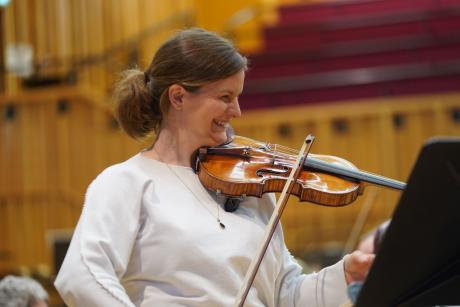
The performance nevertheless raised an issue of both historical and contemporary significance. Beethoven wrote no cadenzas for the concerto but marked in the score where they were to occur, and this has proved a terrible provocation to both violinists and, particularly, composers. It’s one thing, after all, for a versatile fiddler to improvise briefly and more or less spontaneously on the themes he or she has just been playing, quite another for composers - creative musicians with strong voices of their own - to get hold of that material and knock up a five or even ten minute insert in whatever style takes their fancy.
The gifted German composer, Jörg Widmann, has done precisely that for Veronika Eberle for all three of Beethoven’s movements, and on Thursday we had to endure (the right word in my case) what felt like a good ten or twelve minutes of ostentatiously alien digressions, interesting enough in themselves (and studiously relevant, even involving the timpanist and his first movement taps, and in the slow movement a double-stopping duet with the orchestra’s leader), but effectively telling Beethoven to mind his own business.
Well, who knows what went on in Vienna in 1805? Franz Clement, who gave the first performance, is said to have played a set of variations of his own on an upside-down violin between Beethoven’s first two movements. Maybe he stood on his head for the cadenzas. Beethoven dedicated the concerto to him “par Clemenza” - a plea for mercy, perhaps. What would he have said to Widmann?
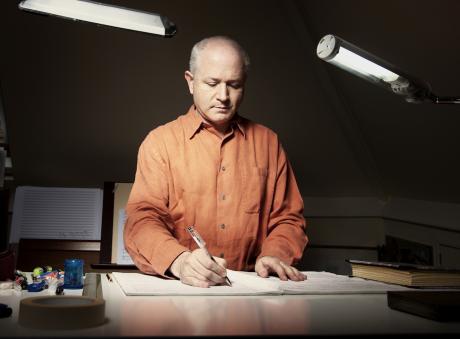
Benjamin’s fascinating Concerto for Orchestra raises no such problems, only the usual ones of intricacy and coordination (Benjamin pictured below by Matthew Lloyd). Composed for the Mahler Chamber Orchestra in 2021 and played here with the exact forces specified, it fitted the Hoddinott Hall to perfection, the detail lucid and balanced, the spacing marvellously effective because visual as well as acoustical, and the rhythmic polyphony greatly enhanced by watching the conductor, whose admirably clear beat became part of the score, since the eye registered it and transmitted it to the ear.
Bloch is a fine conductor of the whole-body type, definitely not of the Boulez eye-and-finger school. But his corybantics, never excessive, always had their effect, sometimes dramatically so (one subito piano in the Beethoven hangs in the memory). In the Benjamin he seemed in complete control, and the orchestra responded.
The sixteen-minute score itself is yet another tribute to the precision of Benjamin’s inner ear and his sensitivity to the spectrum and topography of orchestral sound. In one single movement but with near silences that articulate a slowly evolving form, the music scrolls past like a rolling tapestry where the ear (like the eye) is constantly drawn to the conversation between instrumental colours and figuration. There is a lot to take in, but at the same time a surface that carries you along, thanks to a certain harmonic coherence, hard to describe, heard instinctively. It should have, and will repay, many performances.

Add comment