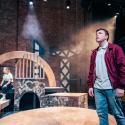
Conor McPherson has set his latest play at an interesting point in Irish – and European – history. It is 1822, post-Napoleonic wars, and Ireland is in an economic mess, with impoverished peasants facing the failure of their crops for the second year in a row, unable to pay the rent to the Ascendancy landlords living in the “Big House”. Lady Madeleine Lambroke (Fenella Woolgar), mistress of the slowly decaying Mount Prospect, is about to marry off her teenage daughter, Hannah, to an English marquis, who will pay off her debts and thereby save the estate.
Hannah (Emily Taaffe), who saw her father commit suicide 10 years before in the drawing room where the play is entirely set, has been hearing voices. Her mother, with whom she appears to have a fractious relationship, dismisses it as nonsense - but could the big old house be haunted, or is she mentally unstable? When their cousin - the defrocked and comically overenthusiastic Reverend Berkeley (Jim Norton) - arrives to escort Hannah to England for her marriage, he is accompanied by philosopher Charles Audelle (Adrian Schiller), a rather creepy cove who introduces Hannah to the laudanum he is addicted to.
The two men, both transcendentalists (if rather ahead of their time in being so), are keen to have a séance with Hannah – or a rite, as they call it – in which the Reverend prays while trying to invoke the spirit that plagues her.
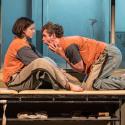
Meanwhile love - unrequited - is all around. Lady Lambroke's estate manager Mr Fingal (the superb Peter McDonald, pictured below with Ursula Jones and Brid Brennan), a drunken gambler who is in love with her, can't contain his feelings any more, while her grandmother (Ursula Jones), a surprisingly sprightly dementia sufferer, reminisces about the one who got away. The young maid Clare (Caoilfhionn Dunne) is lovelorn too, for Mr Fingal, and the only one who isn't a hopeless romantic is housekeeper Mrs Goulding (Brennan in fine form).
 There's a deep sense of foreboding (indeed the Big House setting lends undertones of Chekhov and Ibsen to the proceedings) and as lightning strikes and knocks come at the door late at night we know it will be darkest before dawn. And the first rule of melodrama – that if there's a gun on stage it will surely go off at some point – is adhered to.
The Veil has been much anticipated (it's McPherson's first new play in five years) and sadly it's a disappointment. At two and a half hours, it needs to be much pacier, but McPherson, who also directs, takes a long time to set up the story while throwing too much into the mix. It's not frightening enough to be a proper ghost story, not emotionally engaging enough to be a melodrama and not funny enough to be a comedy, and the beautiful language we have come to expect from the writer of The Weir, St Nicholas and Dublin Carol is only occasionally deployed here.
The play's central argument, between the rational and supernatural, appears anachronistic – that's surely a Victorian motif – while the relationships between toffs and servants, who spend their evenings drinking together in the drawing room, are difficult to believe.
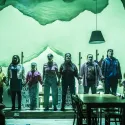
The cast, however, are terrific, and Rae Smith's high-ceilinged set and Neil Austin's atmospheric lighting are a continual delight. But despite the occasional good line and a very clever twist on the ghost element, McPherson has written an unconvincing play that falls between too many stools; as Lady Lambroke says at one point, “This is preposterous!” Quite so.
- The Veil at the Lyttelton Theatre until 11 December