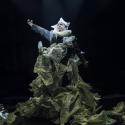
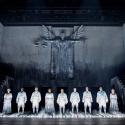
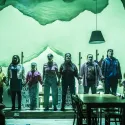
Hot on the heels of the latest English uncle over at the Vaudeville comes Dyadya Vanya from Moscow, bringing with it no samovar or old lace. Rimas Tuminas, the Vakhtangov Theatre's artistic director since 2007, has chucked out the Stanislavsky tradition of Chekhovian naturalism and in his own singular attempt to render what he thinks the characters feel as well as say serves up a stylised ritual that nearly suffocates the humanity of the drama.
There's no problem in daring a radical re-think: Benedict Andrews's contemporary take on Three Sisters at the Young Vic mostly made sense on its own terms. Yet whereas Andrews started out by imposing a physical distance between his sisters but slowly brought them together in team spirit, the Vakhtangov actors have little room to reveal their characters' complex inner lives. The open stage, with Adomas Yatsovskis's severe designs leaving space for some puzzling woodwork and the odd bit of dusty furniture (I couldn't see the "Petersburg lion" mentioned in the programme), isn't at fault. The main culprit is a hardworking score by Faustas Latenas that imposes its varied rhythms on nearly every scene; it only stops for a couple of minutes - why isn't quite clear - in one of the beautiful, married Yelena's encounters with her adoring Vanya.
Mannerism smothers many of the one-to-ones
This is nothing like the subtle soundscape of evocative Three Sisters master Paul Arditti. Satirical waltzes and jog-trots insist. Lugubrious organ tones dog tortured Doctor Astrov's second-act monologue of despair, overegging the anguish just when we wondered, like Astrov himself, whether he could ever be taken seriously; the earlier speech about deforestation is played out as a frenetic music-hall turn with mannered participation from the lovesick Sonya. Vanya's wasted life is sentimentally plastered over by a doleful trumpet tune and solemn wordless voices with all the subtlety of an Ennio Morricone film score.
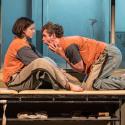
One thing you do have to admire: the ensemble's sense of timing to a score that cramps their style. That style seems to me to be further compromised by the tricks and manners of the often contradictory movements they're asked to execute. A couple of the extended mime scenes do work: I like, for instance, the unnerving way bored, married Yelena wields a steel hoop and bowls it tantalisingly between her two furtive suitors, Vanya and Astrov. Others fail to read, and mannerism smothers many of the one-to-ones. Curiously the one truly absurd moment in Chekhov's play, when Vanya breaks out against Professor Serebryakov's plans for the future and attempts to shoot him, is rather low-key beside what's gone before. But there's offbeat humour in the far from repressed parting scene of Yelena and Astrov, and other scenes in the second half verge on the naturalistic, which rather compromises Tuminas's vision.
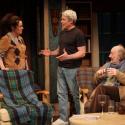
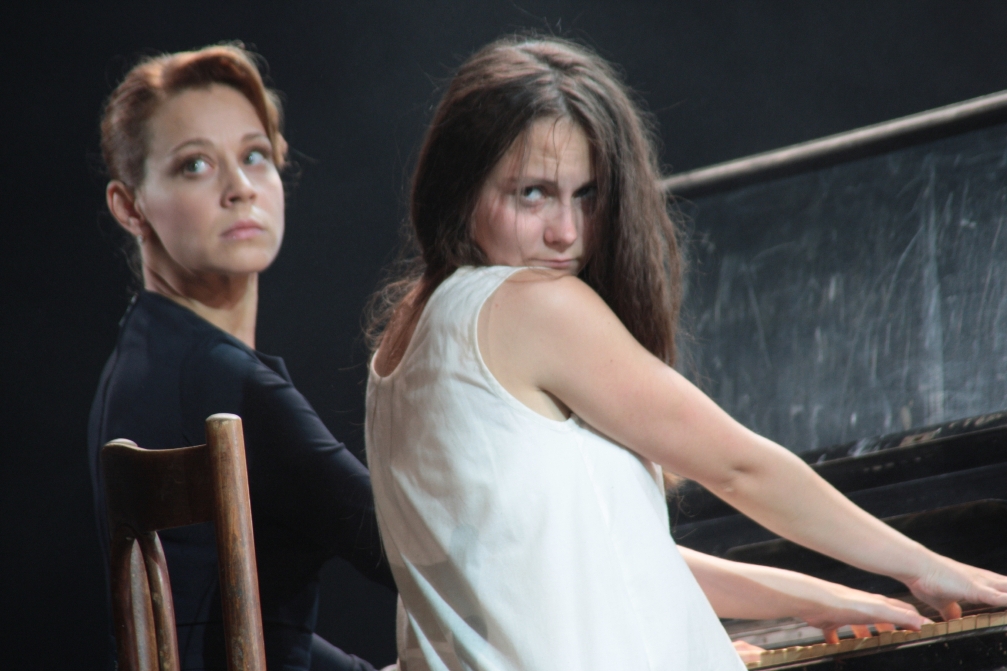 One senses in Sergey Makovetsky's Vanya and Vladimir Vdovichenkov's Astrov nuanced performances trying to break loose from the uncertain changes of tone Tuminas demands of them, though Makovetsky's clown face and gestures are apt, while Vdovichenkov settles to more realistic gravitas in the second half (if only the music would go away). Anna Dubrovskaya's Yelena (pictured above with Maria Berdinskikh's Sonya) is a compelling beauty who conveys the intended strangeness and carries out her physical stylisations well, but her vocal delivery is too low-key to project to the middle of the auditorium: a problem with the Sovremennik Company's Three Sisters last year in the same theatre, not confined to Dubrovskaya here. Vocally the most assured of the cast is Vladimir Simonov's rather too attractive Serebryakov. It's comic to think of 95-year-old Galina Konovalova as the programme's advertised "baby sister"; she is, of course, nyanya Marina, though as offbeat a nurse as you'll ever see in a Chekhov production.
Maria Berdinskikh, a young actress of promise, seems miscast as a not so long-suffering Sonya (the role is shared throughout the short run), surely too girlish for the mature heartache which is here anything but stoically voiced. She starts out as a hyperactive infant phenomenon and ends up delivering the big final speech about endurance rewarded with a scratchy-larynxed, angry militancy. Wrong or a plausible alternative? A standing audience clearly believed in it; I'm afraid I didn't for a moment. Three stars for endeavour and craft, then, but one for the concept.
MORE CHEKHOV ON THEARTSDESK
The Cherry Orchard, National Theatre (2011). Zoë Wanamaker (pictured below) shines in Howard Davies's murky production of Chekhov
The Cherry Orchard, Sovremennik, Noël Coward Theatre (2011). Russians soar in third, and final, offering of their first-ever London season
Uncle Vanya, The Print Room (2012). Iain Glen stars in a version of Chekhov at his most tenderly intimate
A Provincial Life, National Theatre Wales (2012). Moments of visual beauty punctuate a Chekhov adaptation that struggles to find its focus
Three Sisters, Young Vic (2012) Benedict Andrews' energetic update is stronger on ensemble work than individual performances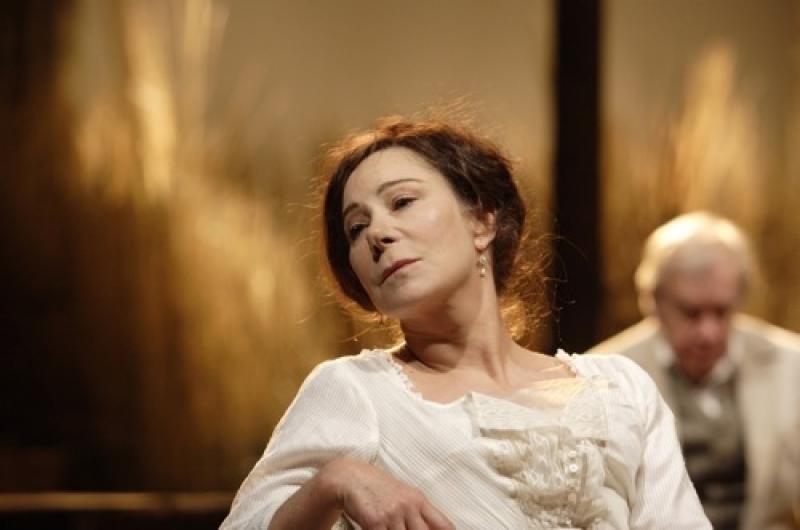
Uncle Vanya, Vaudeville Theatre. Anna Friel, Laura Carmichael and Ken Stott shine bright in Lindsay Posner's production of Chekhov's drama
Longing, Hampstead Theatre (2013). William Boyd's dramatisation of two Chekhov stories with Iain Glen and Tamsin Greig is more pleasant than towering
The Cherry Orchard, Young Vic (2014). Katie Mitchell delivers Chekhov's masterpiece with devastating power
Uncle Vanya/Three Sisters, Wyndham's Theatre (2014). Quiet truth in finely observed ensemble Chekhov from the Mossovet State Academic Theatre
Winter Sleep. Turkish master Nuri Bilge Ceylan’s Cannes Palme d'Or winner, based on Chekhov short stories, is huge in every sense
The Seagull, Regent's Park Open Air Theatre (2015). Strikingly staged Chekhov continues a strong season in the park
Uncle Vanya, Almeida Theatre (2016). Robert Icke's lengthy Chekhov revival/reappraisal is largely a knockout
Young Chekhov, National Theatre (2016). Jonathan Kent's three-play Chekhovathon builds to a shattering climax
Wild Honey, Hampstead Theatre (2016). Early Chekhov begins strongly then falls away