

The show’s subtitle – “Songs banned by the Nazis” – is a catchy one, and somewhere under the confetti, the stilettos, the extravagant nudity, the sequins and even shinier repartee that are wrapped around Effigies of Wickedness like a mink coat on the shoulders of an SS officer’s mistress is the bruised and grubby story of one of history’s foulest episodes. As the evening progresses and the glossy fur slips lower and lower we see a reveal more shocking than any burlesque club or Weimar cabaret could offer.
Effigies of Wickedness (a phrase borrowed from an official description of the Nazis’ famous 1938 exhibition of Degenerate Art) gives voices back to those composers and artists silenced under the regime, those deemed “too political”, “too black”, “too Jewish”, “too subversive”, or simply “too experimental” by the Reich. Brecht and Weill are of course here, as well as Hanns Eisler, Friedrich Hollaender and Misha Spoliansky, with Schoenberg adding his uniquely degenerate brand of avant-garde experimentalism to the mix. The laughs come quickly and often, but are reliably followed by the stab of satire, honed stiletto-sharp by numbers like Spoliansky’s gleeful homage to lesbian love “Best Girlfriends”, Weill’s “Petroleum Song” (a cautionary tale about simple seaside pleasure turned to corporate greed) and Brecht and Eisler’s shattering “Paragraph 218 (Abortion Is Illegal)”. Arranged in far-from-artless chronological order, the songs take us from 1920 to 1939, ramping up the intensity as they go, before dispatching us out into the night and into WWII with a final kick of a coda that is as devastating as it is beautifully judged, both by dramaturg Christopher Green and director Ellen McDougal.
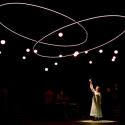
But it’s the show’s superb central quartet (with a little help from Seiriol Davies’s English translations and Corin Buckeridge’s deft arrangements) that power this delicious evening along by sheer force of musical personality. Two theatrical performers – cabaret and drag artist Le Gateau Chocolat, all creamy bass and curled eyelashes, and actress Lucy McCormick (whose rendition of Hollaender’s “Sex Appeal”, main picture, is unexpectedly devastating) – and two opera singers –baritone Peter Brathwaite, who also devised the show, and mezzo Katie Bray (pictured above) – meet somewhere at the junction of their art forms to give us an evening that is part historical homage and part frighteningly current satirical revue, where vaselined smiles slip imperceptibly into screams.
The show is at its best when it dares to go dark. The simple horror of Hollaender’s “Munchhausen”, in which optimistic hopes for social justice are repeatedly stamped back by the chorus “Liar, liar, liar…”, and the dignified desolation of Brecht and Eisler’s “The Ballad of Marie Sanders” (powerfully performed by Bray) cuts through the noise of improvised comic interludes and endless, perhaps extraneous, costume changes. This is a piece whose punky, counter-cultural defiance and mongrel charm would crumble under the weight of a larger or more mainstream venue than Notting Hill’s tiny Gate Theatre, and it seems a misstep to trick it out with so many gaudy trappings, cluttering up the outline of its sleekly silhouetted form.
But from its brilliant four-strong band to its lightly-worn rage Effigies of Wickedness is still a class act – a serious show that doesn’t take itself too seriously, whose horrors are all the more haunting for being hidden behind a grin and a soft-shoe shuffle.
- Effigies of Wickedness is at the Gate Theatre until 9 June, 2018
- Read more theatre reviews on theartsdesk



Add comment