John Bunyan’s Christian, hero of The Pilgrim’s Progress, may have been putting his feet up in the Celestial City for the better part of 350 years, but for Ralph Vaughan Williams’s Pilgrim it has been a rather different story. Languishing in the Slough of Despond after an unsuccessful first run at the Royal Opera in the 1950s, the composer’s lavish “Morality” The Pilgrim’s Progress, with its patchwork biblical libretto, vast forces and uniquely blended combination of opera and oratorio, has never since established a secure place in the repertoire.
A new production at English National Opera – the company’s first, and indeed the first fully-staged production since the work’s 1951 premiere – provides an opportunity to reassess a piece whose score has long been a quiet favourite among musicians, but whose dramatic viability has never yet been successfully proved.
Oida’s production may just be the operatic (Shawshank) redemption this work has been waiting for
At the head of this rehabilitating mission is director Yoshi Oida. A long-time collaborator of Peter Brook’s, Oida combines a ritualised Japanese quality of gesture with a western frame of reference, and has described his work as “a theatre of service”, likening it to “a bus transporting the audience to a realm of their own imagination which they would not reach otherwise". It’s a philosophy that chimes with Bunyan’s own dream vision tale, written to carry its readers through the challenging journey of Christian living, and one that also finds resonance in Vaughan Williams’ contemplative score – written to evoke and suggest rather than to enact.
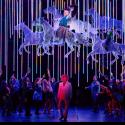
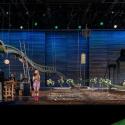
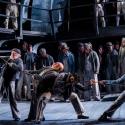
Oida frames The Pilgrim’s dream in a prison. Enclosed in a metal cage, an endlessly flexible sequence of walkways, doors and structures create a shifting stage space to accommodate the changing landscape of the journey. All changes happen in plain sight, as everyday prison objects and locations becomes repurposed in the story (most fantastically in an oversized scrap-puppet Apollyon) with the prisoners themselves taking the roles of Pilgrim’s fellow travellers.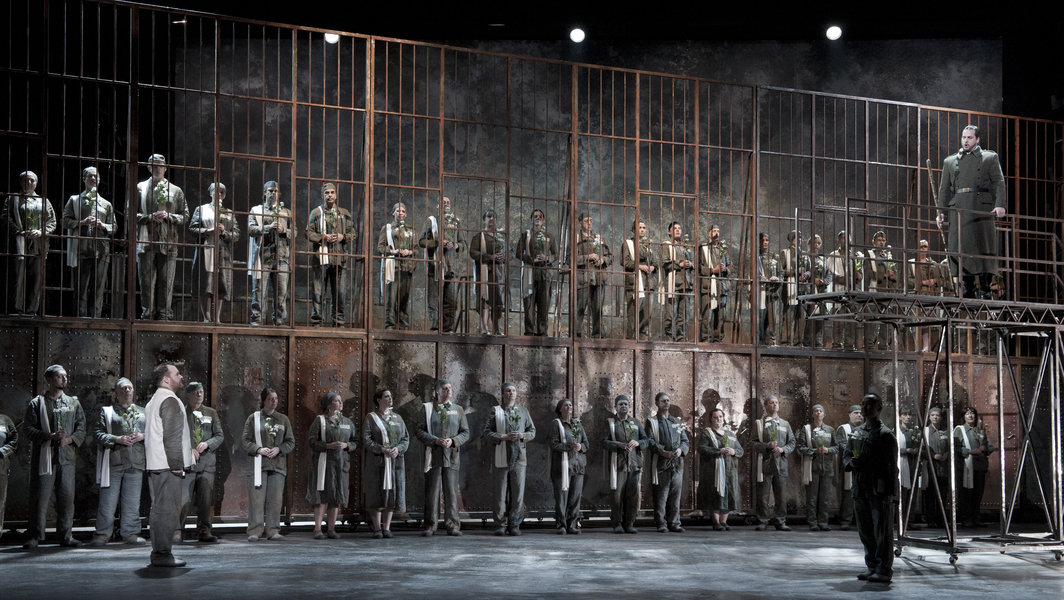 Described by a contemporary as "summarizing in three hours virtually the whole creative output of a great composer", Vaughan Williams’ score is a collage that avoids self-pastiching smugness by its sheer radiance. Here we find the lofty melody-writing of the Five Mystical Songs, the string sheen of the Fantasia on a Theme of Thomas Tallis, blazing brass fanfares of A Sea Symphony and the folk-simplicity of the a capella choral motets co-existing in a generous muddle of spiritual contemplation.
Martyn Brabbins directs the ENO orchestra in a superb performance, keeping the textural surge and swell poised rather than succumbing to the too-easy abandon Vaughan Williams’ music invites. But the orchestra are if anything outdone by the chorus – delighting in some of the finest ensemble-writing they’ll get to sing all season, their blend and painfully-precise tuning transforming the Coliseum into a vast, resonating bell.
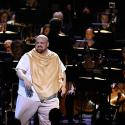
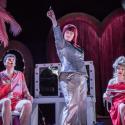
Roland Wood leads a strikingly young cast as The Pilgrim. A secure but unspectacular start initially disarms, but he warms to a lyrical pitch in the post-interval aria, revealing his dramatic understatement as a long and carefully-calibrated game. Among the visual chaos of the supporting characters, whose allegories riot colourfully all over the stage (the cross-dressing, phallus-wielding Vanity Fair sequence their climax), Wood is a quiet constant, finding support from Eleonor Dennis, Aoife O’Sullivan and Kitty Whately in their various celestial guises. Dennis in particular makes a memorable ENO debut. Showcased over the past few years in Royal College of Music productions, here the powerful young soprano comes of age, showing just how far she has outgrown the chamber space of the Britten Theatre. Surely we will be seeing much more of her in future.
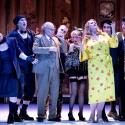
Benedict Nelson’s warm legato was made to sing this music, and despite fighting what sounded like some vocal tiredness on opening night, his was the most memorable of the many cameos, though yielding to Timothy Robinson and Ann Murray’s Mr and Mrs By-Ends for comedic precision.
The prison-play may be an old operatic conceit, but feels unusually fresh here thanks to the evocative simplicity of Tom Schenk’s designs. Yet conceptually there are some questions. Some rather intrusive video footage in the later scenes makes clear that this is no civilian prison, but rather a prisoner-of-war camp. Black and white images of trench-warfare and combat do their allusive bit to complicate a context that was working beautifully beforehand, seemingly determined to stress The Pilgrim’s innocence.
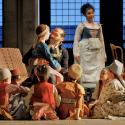
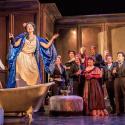
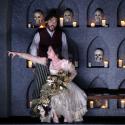
 The result is that we lose some of the very necessary friction between Bunyan’s unquestioning (and frankly rather heavy-handed) statement of faith and a more pitted contemporary approach. We lose some of the shivery adrenaline-hit of a coup-de-theatre that sees the Delectable Mountains revealed as an electric chair, shrouded in a sheet of allegorical euphemism, but when Roland Wood’s Pilgrim (pictured right with Dennis as Madam Wanton) asks “Whose Delectable Mountains are these?” the irony is still heavy and horrible.
In offering us a closing execution whose horrors dissolve into a euphemising flash of lights and a heavenly chorus, Oida seems to betray his own reading of the work. Vaughan Williams’ morality may be closely aligned to Bunyan’s own, but the inherent simplicity of his drama leaves space for doubts and tensions to colour Pilgrim’s redemption. Performed by the mighty ENO chorus and orchestra, the score offers all the affirmation we could need, and the director’s role is surely to cut against this certitude, to take the edge off the complacency of a straight morality play.
Yet with such performing forces, such expansive visuals, and so keen an eye for symbolism, Oida’s production may just be the operatic (Shawshank) redemption this work has been waiting for. Immersive and unconventionally dramatic, this is ENO back at their best.