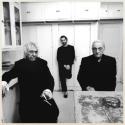
What do we do when our heroes become incapable of doing what made them our heroes in the first place? Who are we to say when an artist is too old and broken to be on stage, if that’s where they want to be? Where is the line between thrilling avant-punk chaos and an unrehearsed shambles? When does an enthused audience willing a band to succeed, whatever the evidence to the contrary, slip into the realms of self-delusion? These were a few of the questions that ran through my mind as I watched the disheartening mess that was Suicide: A Punk Mass, part of Californian multi-disciplinary artist Doug Aitken’s Station to Station “30 Day happening” at the Barbican.
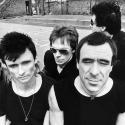
Suicide were one of the very first to coin the term “punk” to describe what they were up to, back in 1971. The famously abrasive duo of Alan Vega and Martin Rev, vocals and synths, respectively, created a definitive visual template for post-punk electro-pop groups while, at the same time (and most especially on their debut album) making some of the most exciting music of the Seventies. Rev's looping drones battered, like Phil Spector, the Stooges and Faust moulded into a relentless assault, while Vega intoned echoing lyrics in the fashion of a man terminally spooked. Tonight, then, was to be a celebration – in the form of a tongue-in-cheek ecclesiastical “service” – of a band who rarely appear live in the UK.
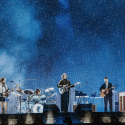
It was an evening of two parts with an interval, in front of a capacity crowd despite the tube strikes. Both halves opened with The Feral Singers, a 12-person choir making deranged noises, hooting, grunting and shrieking. They were an apt opener. Part one was introduced by punk raconteur Henry Rollins who gave affectionate tribute to his heroes, gushing and warmer than his dour reputation might suggest. Then it was into the music. The set-up throughout the night saw collaborator Finlay Shakespeare working a massive bank of analogue kit at the back of the stage while Rev hammered a Korg synth at the front. He didn’t really play it, just banged his hands at the keys creating wooshing washes of white noise, with the actual tunes mostly on pre-sets. He and Vega both started with mini-solo sets entitled, respectively, Stigmata and It.
Rev fired out backing tracks at the press of a button, but most of it wasn't recognizable material
Rev, clad in skin-tight black spandex trousers and waistcoat with trademark space-shades in place, revelled in a messy electronic simulacrum of pre-Beatles pop styles, with three female backing singers. Vega, looking extremely frail from the start, with a silver ball-topped walking stick and a throne-like chair to perch in when he felt knackered, shouted threateningly through a set of industrial techno-noise, accompanied by his wife Liz Lamere and son Dante. It was all a bit haphazard but aggressively so and appeared to be setting the stage for a killer main course.
Unfortunately such hopes were not to be fulfilled. The second half saw Vega, a 77-year-old man who had a heart attack and a stroke in 2012, barely perform at all. He tottered about the stage like someone who should be tucked up in bed, hardly contributing, mumbling and grunting the odd word here and there.
Rev fired out backing tracks at the press of a button, but most of it wasn't recognizable material. At one point, he told us we were listening to the terrifying psychopathic drama of "Frankie Treadrop”, but there was no sonic clue that this was the case. Meanwhile Vega, kept disappearing, looking like a bemused soul who’d prefer to be anywhere else but here. When Henry Rollins walked on to sing along on the classic “Ghost Rider”, Vega seemed to be staring him down, or into space, or who knows what was going on. Rev kept coaxing him and suggesting, “Come on, Alan, sing it,” but it was beyond the frontman. The audience was up and dancing, a mass of hope, but still Vega kept vanishing and by the time a grey-suited, stick insect thin Bobby Gillespie popped up for an encore of “Dream Baby Dream”, no-one seemed to know what was going on. The whole thing fizzled out half an hour before it’s intended finishing time.
When Rollins introduced them he emphasised how Suicide revelled in unrehearsed, living-in-the-moment performance and, certainly, when I saw them years ago, while they weren’t very enjoyable, they seemed a wilfully perverse art experience. It was their choice to be the way they were. Not anymore. I am assured that as recently as 2011, this band were doing white hot shows upon occasion. Tonight, however, seemed like the end of the road. It was, it gives me no pleasure to say, a sad shambles. Go and listen to that first (or second) album and forget all about this evening. There, in amber forever, are songs whose raw power is timeless.