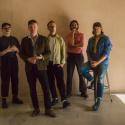
San Fermin have enough brass to rock Mardi Gras and the vocal range to stretch an opera chorus, but they are, still, a pop group. The Brooklyn indie octet’s straight-through rendition of their second album Jackrabbit, released last week, inspired the Jazz Café on Monday night, their obliquely hyperactive compositions, by Yale graduate and Nico Muhly associate Ellis Ludwig-Leone, decked in the gaudy distractions of the carnival.
With eight musicians, all with a relentless dance routine, on a modestly-proportioned stage, the energy is tangible. Even Ludwig-Leone, playing keys, squirms like a belly-dancer. It can be both exhausting and exhilarating to watch, depending on your mood, and the listening experience is similarly intense. Such a rich mix of operatic vocals, rutting parps of the baritone sax, expansive synth melody, allusive lyric-writing and silky strings needs to be balanced with delicacy and wit to avoid overwhelming. It’s an artful concoction, of course, which can be compelling. But there were moments in which there was just too much happening, and the dramatic shape of the song was lost.
Second album Jackrabbit was received politely rather than ecstatically. After the surprising freshness of the 2013 self-titled debut album, in which the sonic palette and energetic performances both had the edge of novelty, more of the same – Ludwig-Leone has included material written both before and after the debut, so there’s no substantial stylistic shift – inevitably loses some momentum. Occasionally, too, a sense of parody, even self-parody, creeps in, where the coquettishness of the melodic writing meets a particularly arch lyric or piece of instrumentation.
Their songs sound like exactly what they are: the clever, self-aware amalgam of a gifted composer, which vary between the gloriously entertaining to the clunkily mismatched
“Parasite”, for example, seems to hint at a dark story about bloodsucking without really having the space to flesh out its hints, while Tate’s vocal lines, usually a gravelly, avuncular legato, are unpleasantly staccato and sinister, his “Uhs” positively cloacal. “Reckoning” has hints of a confessional story, but it doesn’t go anywhere, while “Philosopher” simply offers a vignette of assertion, again with no contextual narrative. Here you sense the band has given up taking pop’s demands for narrative satisfaction seriously.
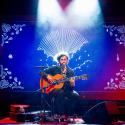
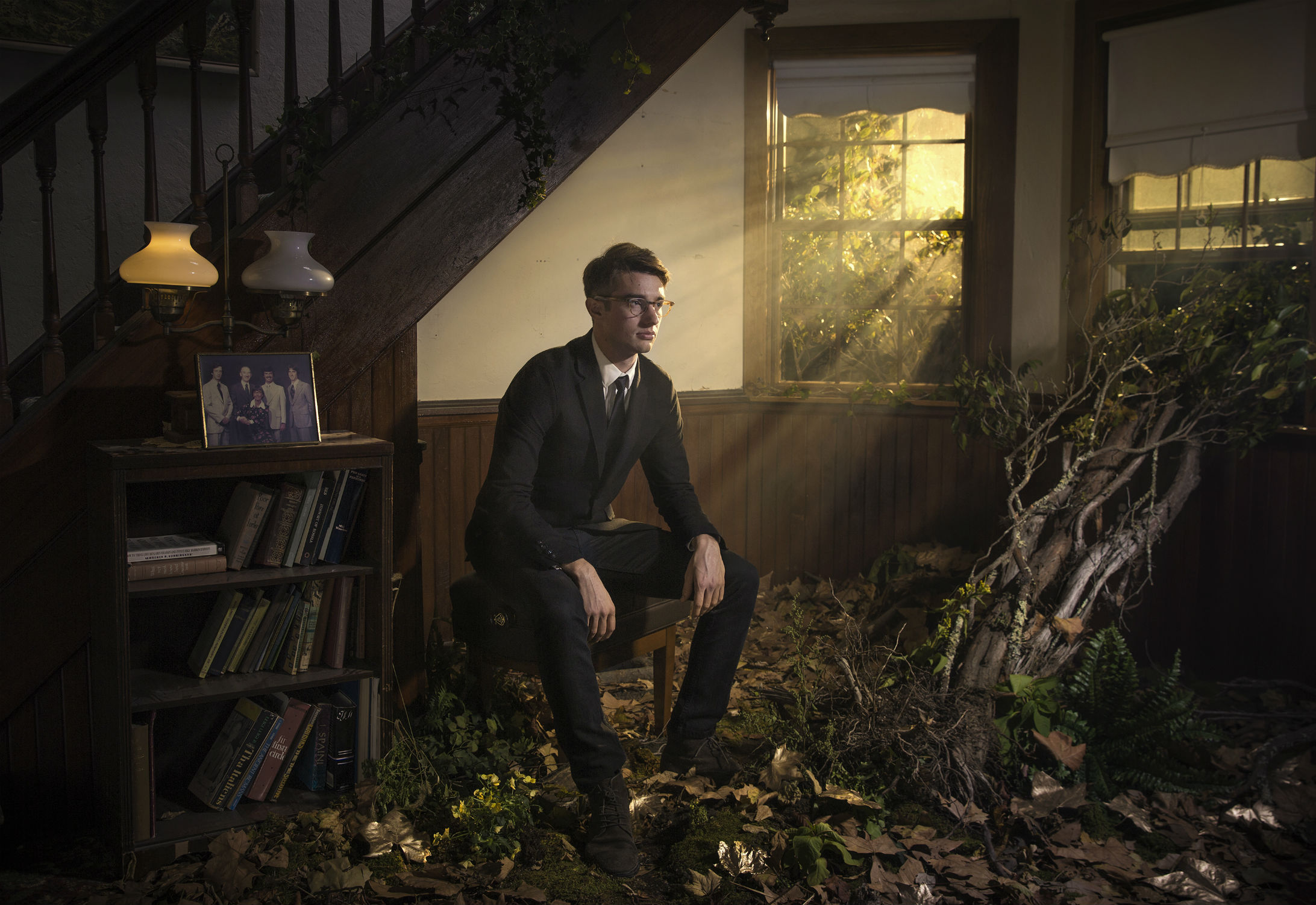
Billed by the free encyclopaedia as baroque pop, the absence of typically baroque harpsichord (composer Ludwig-Leone, pictured below, plays mostly synth) leaves them in fact sounding like a humorously psychedelic collage. (There’s even a hoe-down on “Parasites”.) There are touches of gothic in “The Woods”, with its “witches”, and “pulling legs off salamanders”, and elements of off-Broadway theatrical writing in some of the longer narrative songs, but altogether, their songs sound like exactly what they are: the clever, self-aware amalgam of a gifted composer, which vary between the gloriously entertaining to the clunkily mismatched.
 Some American critics have found the band derivative, too similar to Brooklyn icons The National, especially Allen Tate’s rumbling vocal resemblance to Matt Berninger. Aside from the fact that Tate can enunciate his lyrics clearly, while Berninger mumbles, The National has a much rockier, guitar-led musical profile. An overdose of Brooklyn musicians is therefore unlikely to deter British fans, who will also be pleasantly surprised by the absence of shoegazing in a new indie band. Even on this second, more hesitant album, they’re well worth the experiment if you like fresh, witty palettes in music that doesn’t take itself too seriously.
Having completed Jackrabbit, there was a performance of “Daedalus (What We Have)” from their 2013 debut album, followed by a version of Weezer’s “Buddy Holly”. While the concept of San Fermin covers is a tantalising one, and something as gifted a musician as Ludwig-Leone could carry off with aplomb, this felt incongruous, bolted on as an encore, when most of the audience were checking their phones and fumbling for their Oyster cards. Sometimes the restlessness feels more like a fitbit ad than a cultural event, and the subtlety of the writing is lost in the maelstrom. Though the players of Jackrabbit hopped with abandon, the quietness of a burrow – with hifi – is probably where this art can best be enjoyed.