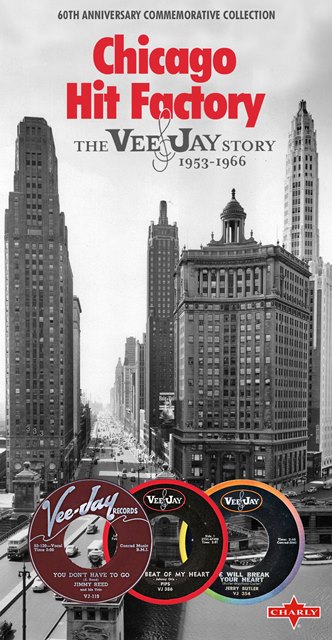
 Various Artists: Chicago Hit Factory – The Vee-Jay Story 1953-1966
According to the book accompanying this 10-disc tribute to the Chicago independent label, “in one month alone in 1964 Vee-Jay records sold 2.6 million records. Two years later the company was bankrupt.” The reason for it flying so high in 1964 was a deal made in 1962 when the label began licensing material from Britain’s EMI. The prize then was yodelling popster Frank Ifield, whose “I Remember You” Vee-Jay got into the US Top 10. Along with Ifield, they got an unknown quantity called The Beatles. When 1964 arrived, Vee-Jay found it had a licence to print money.
But bills weren’t paid. A move from Chicago to Los Angeles in 1963 took Vee-Jay away from its core market and the pool from which it drew talent. The label began falling apart in 1965, filed for bankruptcy in May 1966 with 64 lawsuits in the air and was wound up in August 1966.
It was a long way from the Chicago record store where the label was founded in July 1953. Vivian’s Record Shop was owned and run by DJ Vivian Carter and Smilin’ Jimmy Bracken – their names were lent to the new label. Carter had an outlet to sell her releases, and an outlet to air them on the radio. Such interweaving strands were common with American independent labels, but Vee-Jay stood out as it was black-owned. Chess, Chicago’s other big indie, was white-owned. The lengthy in-depth essay in this package’s book draws a parallel with Detroit’s Motown (as do the words "hit factory" in its title), but that’s overstating things a tad. Vee-Jay did not have one hit-making, constantly evolving sound or a visionary like Berry Gordy.
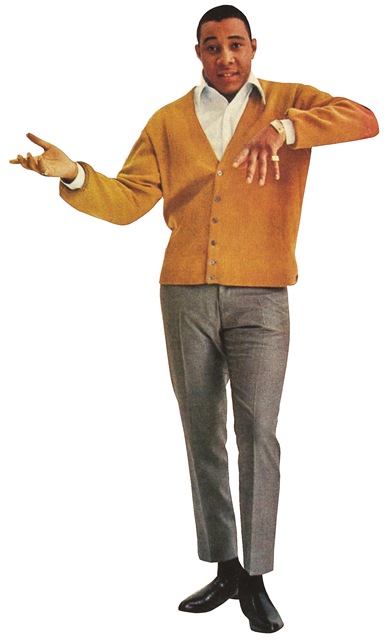 Before looking outside Chicago, Vee-Jay was the sound of the city: the roster had none of the acoustic blues, rockabilly and rock‘n’roll heard on the labels of America’s south. Street-corner doo wop, metropolitan gospel, the electric blues of Chicago’s South Side and urban soul were Vee-Jay’s meat and potatoes. In time, girl groups and country were also issued. Apart from their almost accidental snaring of the early Beatles catalogue, their biggest white chartbusters were The Four Seasons. Their prime black names were bluesman Jimmy Reed (their biggest long-term seller), soul stylist Jerry Butler and musical chameleon Gene Chandler (pictured left). National hits included The Spaniels’ evergreen “Goodnight, Sweetheart, Goodnight” (1953), Jerry Butler & the Impressions' “For Your Precious Love” (1958), Gene Chandler’s “Duke of Earl” (1961) and The Four Seasons’ “Sherry” (1962).
All these names and songs are amongst the whopping 269 tracks collected on Chicago Hit Factory. An impressive and keenly priced set, it’s a proper box with an old-fashioned lift-off lid and a stand-alone, well-illustrated floppy covered book. The pithily-told story doesn’t shy away from Vee-Jay’s lows but it does set the label in the context of the world it was operating in and the competition it faced.
The only possible conclusion to draw about Vee-Jay and its fate is that it had too few bankable artists and, as it developed, was too scattershot and did not focus on what it was best at. Releases by short-stay artists who had more success with other labels, like John Lee Hooker, Elmore James and Little Richard, were not going to ensure Vee-Jay’s longevity. Hopping on the Phil Spector-girl group bandwagon, no matter how wonderful the results, was for the moment, not the future.
Nonetheless, it did issue amazing music from all the genres it dipped into. All strands of Vee-Jay’s output are covered by the themed discs. The mid-Fifties Jimmy Reed and Billy Boy Arnold sides set the template for Britain’s more questing early-Sixties R&B bands. The doo wop tracks on disc four are spectral, swooning delights. The early soul of disc seven is often rough, but always infectious. Before losing its way as a result of the Beatles liaison, Vee-Jay was one of America’s most vital labels. In telling it as it was, this box is a delight.
Overleaf: listen to greats from the Vee-Jay catalogue collected on Chicago Hit Factory, including a northern soul curio by Groucho’s daughter, Melinda Marx
Listen to The Spaniels’ “Goodnight, Sweetheart, Goodnight”
Listen to Billy Boy Arnold’s “I Wish you Would”
Listen to Jerry Butler’s “Make it Easy on Yourself”
Listen to Noreen Corcoran's "Love Kitten"
Listen to marie Gladness's "Cops and Robbers"
Listen to Melinda Marx’s “How I Wish you Came”