Michael Haneke’s Amour was the big winner last night in the European Film Awards’ silver jubilee year. As well as Best Film, Haneke won Best Director, as he did for his previous two films The White Ribbon (2009) and Hidden (2005), while his veteran stars Emmanuelle Riva and Jean-Louis Trintignant were named Best Actress and Actor. It showed both the Oscars-style pack mentality of the European Film Academy voters for their favourite auteurs (shown most alarmingly with Polanski’s blanket wins for his mediocre The Ghost in 2010), and a genuine conviction that Haneke is a master European director, a clear step ahead of the rest now.
Steve McQueen’s Shame (Best Cinematography for Sean Bobbitt, Editor for Joe Walker) and Tomas Alfredson’s Tinker Tailor Soldier Spy (Production Designer, Maria Djurkovic and Composer, Alberto Iglesias) were left with the less high-profile technical awards, and the unfeasibly glamorous Danish writer-director Thomas Vinterberg picked up Best Screenwriter for his work with Tobias Lindholm on The Hunt.
 Dame Helen Mirren, receiving the honorary European Achievement in World Cinema prize, was the nominee most alive to the occasion. “Thank you for recognising that I too am a fucking whore. And proud of it,” she memorably declared, referencing a line in a clip earlier in the night. Introduced as ancestrally Russian by that country’s director Alexei Popogrebsky (“she likes to say her lower half is Russian,” he conceded), and by Sir Michael Gambon as his co-star in The Cook, The Thief, His Wife and Her Lover (“a children’s film,” he purred), her heartfelt speech placed her in the European tradition the EFA is so desperate to foster. She recalled being a 16-year-old waitress in Brighton, stepping into a seedy cinema smelling of piss, cigarettes and beer “to get out of the rain”, and finding it was offering not its regular pornographic fare, but Antonioni’s L’Avventura: her first glimpse of European cinema, and why she might want to be a film actress. Warming to her theme, she listed the other “fucking whores” she revered: Jeanne Moreau, Claudia Cardinale, Anna Magnani above all: “I wanted to be an actor like them...I wanted to be a woman like them.”
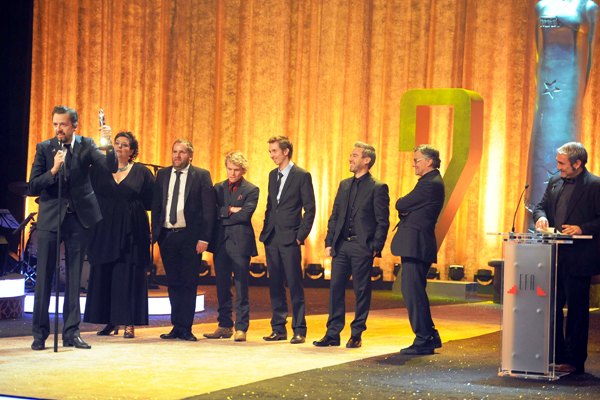
Mirren was red-eyed as she spoke, genuinely moved at her award’s implication that she now belonged in that company. She at least seemed to value it like an Oscar. Come As You Are (Hasta La Vista), a Belgian comedy about three disabled virgins’ trip to a Spanish brothel, startlingly beat candidates including The Artist in the People’s Choice public vote. Producer Mariano Vanhoof (pictured below right) made you keen to see his film as he yelled, “God bless the European audience – sex for everyone!” then proposed to his gobsmacked girlfriend. The long kiss they shared, impervious to cameras and crowd, suggested Vanhoof had won again. A Polish actor later preceded presenting the Best Actor award by proposing to Mads Mikkelsen. The Danish star’s ambiguous smirk kept his options open.
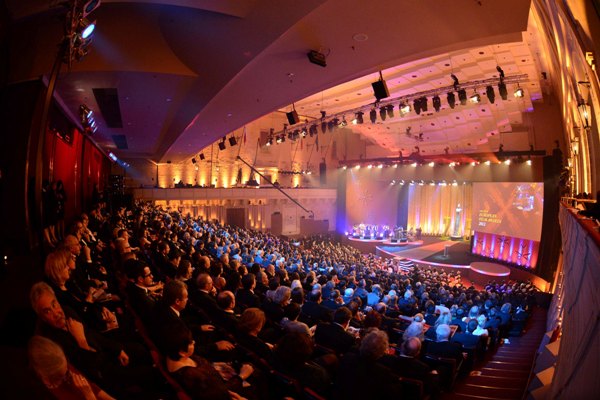
 The mood in the Maltese capital Valletta’s Mediterranean Conference Centre, a cavernous 16th-century building formerly a hospice for the Knights of St John, was elsewhere sombre verging on panicked at the state of the serious European cinema Haneke embodies. The ceremony was interspersed with filmed reflections by EFA members, who saw their work almost fatally embattled by plummeting box-office figures, short-term cinema bookings destroying the possibility of word-of-mouth success, and what Ken Loach called Hollywood’s “monopoly”. “European film is low-budget,” was Stellan Skarsgård’s dry definition, with themes far from Hollywood populism: “You can’t hide the darkness...we’re all going to fucking die, and it’s not much fun.” As the great Hungarian director István Szabó said still more pithily, it’s cinema about “losers, losers, losers!” The bleak reality the European Film Awards attempts to fight is that such films reach audiences in decreasing numbers. The regular cries from the stage of “Long live European cinema!” sounded like desperate whistling in the dark.
Accepting this awful current truth during an awards ceremony distinguishes the EFA from the Oscars (and the BAFTAs) just as the films it favours differ from Hollywood. The regular host, German comedian Anke Engelke, continued her patchily effective mission to deconstruct the very nature of such ceremonies, and especially the EFA (“Or as some people in America call it – ‘The what?’”). “If there’s one thing the EFA’s got a lot of, it’s money,” she said with withering irony, during a weekend when, like some old blues song, guests at functions were sometimes served water when they asked for champagne. Wildly promising Paris’s Crazy Horse strippers and Bengal tigers would soon combine in a lavish routine, she was filmed dashing to the backstage banquet, where a director from impoverished Spain, Sergi Lopez, feigned filching food. His compatriot Alberto Iglesias’s thanks for his award ominously began: “I write to you from Spain. We are alive!”
Engelke formed a too brief double-act with frock-coated, floppy-haired EFA president Wim Wenders, who was filmed giving her a jaunty tip of the sailor’s hat she’d just tossed at him as she refused to host the ceremony as Popeye (the hero in one of the many movies filmed amidst Malta’s remarkable scenery). Wenders, like Herzog, is becoming his own most memorable character.
“When I’m off shooting a film and the EFA calls, I drop everything and come running” was Engelke’s most cutting satirical line. While there was no repeat of the embarrassment of last year’s awards in Berlin, skipped by most of the main winners, Shame editor Joe Walker’s acceptance text from a New Orleans set claiming his award “means a lot to me” walked right into Engelke’s jibe. Trintignant, on a theatre tour aged 81, had filmed a gracious speech, and as with his 85-year-old co-star Riva, at home with a high fever, the spirit at least was willing.
 “Life is too short...and my mouth is too dry for a long speech,” Bernardo Bertolucci (pictured centre, with Wim Wenders, right) said, accepting his Lifetime Achievement Award. The montage of his career – Brando’s beautiful middle-aged face in Last Tango in Paris filling the screen, the awful moment before a woman’s murder in the woods in The Conformist – had sensuality and glamour, a vital aspect of cinema the ceremony, with all its hand-wringing, otherwise forgot. Bertolucci, a big man in a wheelchair with a wide-brimmed gangster’s trilby, didn’t give the impression Mirren had that his award mattered very much. He did, though, fondly recall seeing Ingmar Bergman win the same award at the first EFA in 1988. “The most beautiful-looking man I ever met,” he said fondly. “He was so good-looking, I almost cried.” The sense of crisis for Europe and its cinema agonised over so endlessly here could have done with more mention of such enduring glories, which are its best defence.
One of the EFA’s virtues is its biannual excursion from its Berlin base to spotlight unexpected corners of Europe. Enduring glory could sum up the heart of Valletta. Smaller than the Isle of Wight and a fly-speck below Sicily on the map, it’s a crucial cultural crossroads, with a language close to Arabic, and remnants of its century-and-a-half of British rule (taking over from Napoleon, who finally forced the surrender of the fortress island’s Knights of St John in 1798; independence returned in 1964). The faded green velvet-lined, chipped carriage owned by the Knights’ last ruling Grand Master sits in a courtyard, by a tree-lined square planted by a Victorian British knight surely descended from one of William the Conqueror’s, Sir Gaspard Le Marchant, in 1858. A statue in Republic Street of hungry but unbowed people looking skyward is one memorial to the greatest shared moment of British rule, when the whole Maltese people were awarded the George Cross for withstanding Mussolini and Hitler’s siege for three years of World War Two.
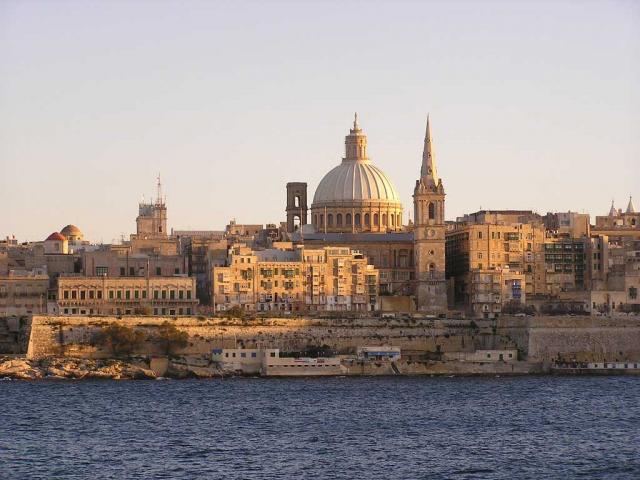 Old shop signs for HMV (at a shop boasting it has sold music since 1885) and Playtex (“Sarong-sters, Girdles and Bras – Sole Maltese agents”), painted green wooden balconies and billowing, drying laundry overhead lead down a side-street to Valletta’s wide, startlingly beautiful bay, limestone fortresses still standing guard for enemies which have rarely overwhelmed it (400 years before the Nazis, the Ottomans were also held off). There are pictorial tributes to young, recent dead set in walls in this Catholic, Arabesque island, and a canoodling young couple lying on the rocks. The big sky is as clear blue as the sea, on what could be a particularly lovely early spring day in England. Whatever crises are besetting Malta behind this tourist facade, its deep-rooted beauty, like that of a Bergman or Fellini film, endures.
Back at the Awards, the party afterwards under the high limestone ceilings of the old hospice finds German director Volker Schlondorff (Das Boot) leaning in to talk with keen pleasure to Haneke, who is visibly enjoying the lavish spread laid on by the EFA at the last (the austere auteur fits both kinds of pasta on his plate). Mads Mikkelsen, the kind of tough, humorous rebel character cinema always needs, juggles a tomato on his back as he heads out for a smoke at 2.45 am. And Wim Wenders, whose dream the European Film Academy and its awards has been for all of its 25 years, has yanked his bowtie open, and is dancing like a teenager to The Doors’ “Break On Through”, all his passions, for a minute, in one place. Crises pass. Alice in the Cities will last.