

Thirty years ago the British were coming. So cried Colin Welland rallyingly from the stage of the Academy Awards, having just accepted an Oscar for best screenplay. And now Chariots of Fire is coming again, twice. An energetic stage reincarnation has sprinted round the block at Hampstead Theatre and now jogs along to the Gielgud, where it will continue to leave barely a dry eye in the house. And then there is the film itself, out shortly for another turn on the red carpet in this Olympic season.
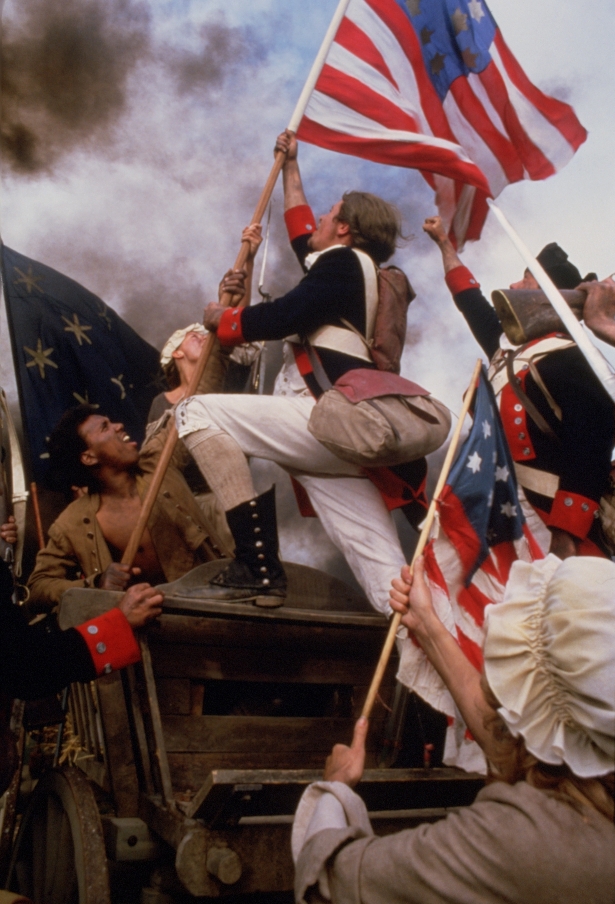
Hugh Hudson (b 1936), debut director of the film, wizened producer of the play, has another offspring he’d like to present for your consideration. In many ways, Revolution was the third in a trilogy of epics in which Hudson pitched himself against the Establishment. Chariots, set in the build-up to the 1924 Olympic Games in Paris, told of Eric Liddell, a devout Christian who ran for God, and Harold Abrahams, the son of a Jewish immigrant who ran to fit in. In Greystoke (1984), his thrilling Darwinian reinvention of the Tarzan story, an aristocratic scion chooses the jungle over his inheritance. Then in 1987 came Revolution, a portrait of the American War of Independence seen from the ground up. Al Pacino played a fur trapper whose boat is requisitioned and his son pressganged, thus forcing him to sign up for a war in which he has no interest. Although the battle scenes were magnificently choreographed, the idea of telling the story from the grunt’s eye view, which worked in sundry Vietnam films of the period, proved too nihilistic a choice for a chronicle of America’s creation myth. Indeed, a film about an iconic moment in history made history of its own, helping to sink Goldcrest and going down as one of the art forms’s great hubristic box office flops.
What does it matter where you shoot? Americans are weird like that
Criticisms were many. First it was the casting. Pacino felt just too modern for 1776, while the Canadian Donald Sutherland played a brutish British sergeant and the very unEnglish Nastassja Kinski was a member of the ruling class who rebels against her family to take up the American cause and fall in love with Pacino. To American consternation, the film was shot in King’s Lynn and Dartmoor. To British consternation, the colonists were portrayed as unremittingly cruel. At the height of Reagan-era confidence, with Thatcher’s Britain still aglow from the post-imperial adventure in the Falklands, this was a story without heroes. Plus it didn’t cohere. Hudson made a film about the senselessness of war which, criminally in the eyes of critics hunting in a unanimous transatlantic pack, made no sense. When Goldcrest went bust, Hudson took the rap, even though the company was overextended thanks also to Absolute Beginners and The Mission.
 His career as a director has never quite recovered. Yes, there was the so-called Kinnock the Movie, his glossy party political broadcast on behalf of the Labour leader, plus several successors, and the ad for British Airways which at the time was the most expensive ever made. His last two movies to see the light of day were I Dreamed of Africa (1999), about a middle-class woman writer in Kenya, and My Life So Far (2000), based Dennis Forman’s memoir of a Scottish childhood before the Great War.
It’s possible that Revolution has been a bad-luck charm. Hudson has always contended that the film was rushed out long before it was ready to meet the Academy Award deadline and ease Goldcrest's cashflow. In 2008 he finally made good his determination to add a gravelly, introspective voiceover with Al Pacino to join the dots of the narrative, while also snipping out 10 minutes he never wanted in there in the first place. Now the director’s cut is being released on DVD by the BFI. Meanwhile, a new work with Hudson’s name on it is to be broadcast on BBC Four next month. A more intimate director is at work in Rupture: Living with My Broken Brain. Made with his wife Maryam d’Abo, it movingly tells of the aneurysm which nearly killed her in 2007.
Hudson’s dry, spiky wit is beautifully captured in Charlotte Macmillan’s portrait, taken in his home in Chelsea, and comes across loud and clear as he talks to theartsdesk about his own ancient wound.
JASPER REES: When did the possibility of being able to do this reboot of Revolution first come up?
HUGH HUDSON: The idea of wanting to do it came up a long time ago. Almost when it came out. For 20 years we’ve been talking about it and trying to get somebody to put some money up for it and we finally persuaded Warner Bros to do it. Al Pacino helped. He doesn’t like doing stuff on films that have been made but this one he wanted to do very much because he felt he’d been really badly treated by the critics who think they know everything always. And often they don’t, albeit the film had problems in structure and narrative. It’s a broken narrative film and that’s why we needed narration and always wanted to do one and were forced to bring the film out before we’d completed the narration. Narration is quite difficult to do. It doesn’t happen overnight. You have to try it and retry and work it and then come back at it. You have to have two or three goes at it and they wanted the film out. It was so obvious it needed a narrative. It’s like Barry Lyndon. You take the narration out of Barry Lyndon, you can’t follow it. It’s a mesmerising piece of work and the narrative just holds it together. It was essential in Revolution to have it.
 Why did Goldcrest want to expedite its release?
They needed income. They were overextended in three very big films which all had gone over budget and had difficulties. We were the one that took the rap. None of the films did very well. The Mission won a Cannes award but it didn’t do very well financially and all three films brought the company to its knees and I got the blame. I think if the film had come out now and done the festivals in Europe it would have been received differently. So Warner’s gave us money and the BFI have been very supportive and many people are coming back to look at it and see that it’s not as bad as it was always trumped up to be.
Where did the original idea for Revolution spring from?
It came from a script I read and I liked the script very much. It was a very interesting bit of British history. We were accused incidentally of tampering with American history. America was a British colony until the war happened and they broke away. It was like the first British failure. In England we were accused of being bad on the British colonists. But they would have been brutal soldiers. It doesn’t look on the British with particular favour and it’s a film which is seen from an ordinary man’s point of view. It’s not about history. I never wanted it to be about history. Americans didn’t like that. You could say I was foolish even to attempt to do it. This war has never been portrayed on the screen successfully. So I was going into something which with a bit of hindsight I might say I shouldn’t have done. That was one of the attractive things about it actually.
Stallone rang up and said he wanted to be in the film
Incidentally I wanted to make a silent film of Revolution. The script has very little dialogue. And then have either a narration going through or cards. I sort of proposed it and of course it was laughed out of court. Would have been a good idea. It would have been a bit pretentious, perhaps. But in the end it’s sort of a silent film actually.
It came out in 1987 at the climax of the popularity of Reagan and Thatcher. It was an era in which both nations were rather pleased with themselves.
They were pleased with themselves. And to do an anti-war film seen from the bottom echelon of life... Pacino played a backwoodsman selling furs who got inadvertently involved in this extraordinary conflict because his son has been pressganged. Fundamentally it’s a story about a father and a son finding a voice.
So was it a case of bad timing?
Exactly. If you look at it now it’s a completely different time. We are in a depression, a serious time of self-analysis, and we realise that those kinds of war exploits are very foolhardy: Libya, Iraq, Afghanistan, maybe Syria. You should keep away from them, one would think. They are not our wars. I don’t know if that’s pertinent.
Is it for those reasons likely to reach a more sympathetic audience?
I hope so but I doubt if it will because it’s only on DVD and it’ll get a sort of minority interest. But the point is I’ve done it. I’ve produced a film that I’m happy with now and I can put it in the past and whatever happens to it will be great. Some people will buy it out of interest and maybe see the point of it now.
What were the merits that you think were overlooked at the time? It looks epic, for example, and the battle scenes are convincingly and beautifully choreographed.
I can do that kind of thing. It is an epic story although it’s not tableau-driven. It’s all done in handheld camera work, which is very fashionable now, much more so than it was then. That’s another thing people took exception to. I just wanted to bring it down to the level or one man and his offspring. That’s what most people experience if called up to fight. You wouldn’t know what was going on. That was what I was after: the chaos you would experience as part of a militia. It would be fragmentary and your life of survival would go through all of that. That’s one of the merits of the film. That’s why I wanted Pacino because he was a guy from the street.
 What did you want to get rid of when editing the film?
I’ve taken out any kind of love interest. It's purely perfunctory when he meets this girl. At the end there was a sequence where they meet up again which was imposed by one of the financiers. They would only put their money in if they met again so I had to do it like that which is in fact completely laughable. In the original script he just says goodbye to his son, sends his son off into the Midwest to make a life and that’s how we now end it.
If you’d had your time again would you not have had the female character at all?
No I think the female is important in the story. She’s like of the girls in the1968 French revolution, a middle-class student fighting against her parents. I think she had a place definitely. He just meets her time and again during the war. I think that’s quite feasible. She seems to be killed and she just disappears, he tries to find her and he can’t. People disappear in wars.
Were you blindsided by the reception of the film?
I was very surprised. I hadn’t thought about the misjudgement of the timing. It was an era of Schwarzenegger, Stallone in First Blood - those films with fantasy heroes going to war which are total rubbish but enjoyable. In fact Stallone rang up and said he wanted to be in the film because of Irwin Winkler being the producer of Rocky and we said “No, we don’t want to do your type of films.” Maybe he would have been a brilliant coup. I got very angry of course and I thought we were unfairly treated. The finances became the thing that was criticised directly. And that’s not fair. It was my fault as well as other people’s.
How over budget were you?
About six or eight million, I should think. It cost 22 or 23 by the time we finished. Quite a lot.
Was there a sense of pique in America that you shot their revolution in Norfolk?
We went to America to find some places. They don’t exist. Williamsburg is now a museum and to get them to make it look like New York – a dirty metropolis – was not possible. And also it was cheaper to do it in England at that time. I don’t see the problem with that. We were criticised at the time which is ridiculous. What does it matter where you shoot? Americans are weird like that. What difference does it make? I think it looks like America actually. It doesn’t look unlike America and King’s Lynn was a very good model for Georgian New York, I think. Devon and Norfolk were perfect substitutes.
Was Pacino a bit too urban for the war of independence?
I would say not. It’s only because he always played a cop or a gangster. His public perception is of course that and that is what I inherited. So in a way if I’d thought about it a bit deeper... I just wanted this guy from the backstreets, from the gutter, and he represents that very well. In a way if I’d analysed it a bit deeper and thought these things would be criticised I might have thought twice. But I think he gives a good performance. It’s going to criticised again. You watch. People are going to go for it again. But I don’t care.
It’s a personal best that’s very hard to beat. It’s a real cross
Did it remain an open wound?
No no. I got on with life. I think it made a difference to my career a little bit but I always had Chariots of Fire to go back on. It didn’t slow down my desire.
How did the stage version of Chariots come about?
As soon as we got the Olympics, I felt you could make a play of Chariots of Fire. It’s more than a play: it’s a hybrid. It’s very physical and they’ve achieved that brilliantly. I just thought the story could be effective on the boards. I didn’t want to do it myself, only produce. Provided the director could make it physical then it would work. The drama of the two of them [Eric Liddell and Harold Abrahams], what they are standing up for and what they are fighting against: the prejudice of the establishment is really what it’s about.
 Why did that story work in 1981? Was it to do with a growing determination not to accept the establishment hegemony?
We were in a similar situation to the one we’re in today. We had a government at its lowest ebb, the nadir of Thatcherism before the Falklands. And now we’re in a time where there’s enormous unemployment. There was then. The economy of the world was not very good in 1980-1. There were those moments of life that were very hard and it added a kind of uplift in some way. The values were good. But of course it was picked up by the Thatcherites as perpetuating their values. It’s ironic because the core of the story is of two characters who won’t go along with what the establishment wants, who fight against it – the Jew and the Christian. And the dons at Cambridge and the Olympic committee were powerful characters. And these young men would not be told want to do. And I love that. There is a still an establishment at work in this country. Does it wave the flag? Well people who want to wave the flag will see it from that point of view. I never saw it from that point of view. I always took it ironically. You can’t avoid the flag being waved when two people win for Britain but it’s not overbearing.
It’s also a broken narrative. There’s no real narrative except going to the Olympic Games. Terribly simple.
One measure of a film’s success is the place it assumes in the public memory, a process that is out of the control of the filmmakers.
It just think it’s very strange for a work of art should have become so iconic. The music became a world success and is still emulated and plagiarised. It’s a personal best that’s very hard to beat. It’s a real cross. It’s a golden cross. But I’m very happy for it. I can’t deny it. I am very lucky to have had that.
Why is it that you’ve not made a film since My Life So Far?
I’ve worked on projects that I’ve wanted to do and they didn’t happen. It’s not the residue of Revolution but I hadn’t made a film that’s pleased the audience financially for a long time. Greystoke did pretty well. My Life So Far is a cute little film. I had very good reviews from that film but it was dumped by the distributor Harvey Weinstein. It got in the way of something else he was promoting.
So you are not on speakers with him?
Well, I‘ll say hello to him if I see him. No point in being rude. But I’m not anxious to work with him again. Not really.
How did Rupture come to be made?
After my wife had this rupture in the brain, which we didn’t know much about, we were hit by this and she was on the edge of life and death and I was married to her, so I was on the edge of not knowing what was going to happen. There’s always the chance the person will come out in a wheelchair, no memory, different personality. Or a vegetable. Miraculously she came out of it OK. Fifty percent of people don’t. So we thoughts we should make a documentary about what happens when you have one of these things. Parents, husbands and wives suffer enormously. We made it to help people. It's a very human film. And we couldn’t get anybody to put any money up for it. Not interested. It wasn’t medical enough or specific enough. We wanted to do it in a particular way, visit people who had it and visit doctors and ask how do you deal with it after. That was the vague structure. So we decided to pay for it ourselves. Everybody did it for nothing. Vangelis and Mark Knopfler gave their music. We called on all the people I know form a lifetime in the industry. Nigel Havers did the narration. It took three years to do because we could only do it bit by bit. And it works. It’s very moving, very human, very painful at time as we meet people who have been left catastrophically ill. But it leaves you with a feeling of uplift.
Does it belong in your canon of work?
Oh God. I would think so. I would say so. It’s very emotional. It captures an emotional tone in what these people are going through and what it says about us as humans. That’s why I tried to get to in the films I made. I think I do it in Chariots. Using music as well. And in Greystoke definitely. And in Revolution? Yeah. This guy is forced to find a voice.
Have you lost your voice as a filmmaker?
There are films I would have loved to have made. I think I am satisfied with what I’m doing. Next film I make my voice will come back again.
And what is your next film?
I don’t talk about that. Because it may not happen.
- Revolution: The Director's Cut (BFI) is out on DVD and Blu-ray
- Chariots of Fire is at the Gielgud Theatre







Add comment