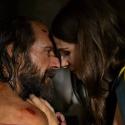
The first time I saw Michael Fassbender (b 1977) in the flesh, it was in Venice, in 2011. I was heading home on the last day of the film festival, where Steve McQueen’s Shame – starring the Irishman as a New York sex addict – had enjoyed an enthusiastically received premiere a week before. As I jumped off a vaporetto at Marco Polo Airport, I noticed Fassbender walking in the opposite direction, towards the water. Alone, with a tuxedo slung casually over his shoulder, the actor had obviously got “the call”, to return to the festival to collect a prize.
Indeed, that night he was on stage, flashing his blazing Cheshire Cat grin, to receive the Volpi Cup for best actor. It was the first of many such prizes, for a phenomenal performance, including the recent Best British Actor award from the London Film Critics Circle. His ability to slope in undetected as he did in Venice will be put to the test sooner rather than later, for Fassbender is fast becoming the most important actor of his generation.
He leaps on any opportunity to flash that smile
The actor was born in Heidelberg, to a German father and Northern Irish mother, then raised in Killarney, Co Kerry. After studying at the Drama Centre in London (but leaving early) he spent the best part of a decade working in television, before being cast as the IRA hunger striker Bobby Sands in McQueen’s Hunger. As Fassbender told the London critics, “Steve is my hero. He changed my life.”
One might say that Hunger and Shame present a similar package – artful, unsentimental, thought-provoking filmmaking, at the centre of which is a performance of daring and a rather beautiful intensity. Like one of his heroes, Robert De Niro, Fassbender will embrace physical transformation to embody a character (becoming skeletal in Hunger) and like De Niro he feels no need to court the audience’s sympathies; there is a disturbing absence about Shame’s Brandon, while his portrayal of Carl Jung in David Cronenberg’s A Dangerous Method doesn’t shy away from mocking his subject.
 Wildly different roles in Andrea Arnold’s Fish Tank (pictured right, Fassbender with Katie Jarvis), Tarantino’s Inglourious Basterds, as a younger version of Ian McKellen’s Magneto in X-Men: First Class and Rochester in Jane Eyre highlight his versatility. The only danger, at present, is over-exposure, though I suspect this thoughtful man has already calculated for that. After Ridley Scott’s Alien prequel Prometheus (and who could refuse that?) he’s planning a break, before a likely reunion with McQueen.
When I met him, back in London, it was to discuss A Dangerous Method. Adapted from his play The Talking Cure by Christopher Hampton, the film charts the relationship between the young Jung and his mentor, then rival Sigmund Freud, on the eve of World War I, as well as the love affair with former patient Sabina Spielrein. One might say that Fassbender is providing the ballast, rather than the flash of the film, compared to Viggo Mortensen’s rum and ruddy-nosed Freud, and Keira Knightley’s hysterical Speilrien. But if it’s a straight turn, it’s one bristling with understated irony.
In person, Fassbender is himself an interesting mixture of seriousness and mirth. Any question about his craft is addressed with earnest precision (I can’t help feeling there’s a bit of Jung in him) and an engagement that belies the notion that actors hate to discuss their work. At the same time, he leaps on any opportunity to flash that smile and lighten up. In discussing A Dangerous Method it was impossible not to first refer back to Shame and the echoes between the two films.
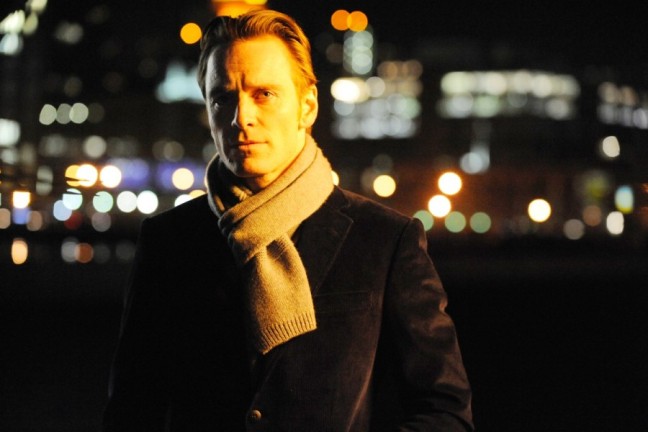 DEMETRIOS MATHEOU: What do you think Jung would have made of Brandon (pictured left)?
MICHAEL FASSBENDER: I think Freud would be more the man for him. But either would go through the history of the character and try to decipher where motivation starts. I would think that first and foremost Brandon has a problem with addiction. That’s the thing, you know, how a pattern of behaviour starts to form itself into ones life, and that pattern of behaviour is damaging to you yourself, and the relationships in your life, and your workplace. That for me would be the definition of addiction. I think there’s a very complicated character there.
What’s interesting is that both films put our relationship to sex and one another under the microscope. Jung and Brandon are men of their time, I suppose, products of their environment and the society they’re living in. But the two films are asking very similar questions.
One thing that Jung shares with Brandon is a sort of emotional constipation.
Well, yeah. When we see Jung at this point in his life he is young, ambitious and feels he has a lot to prove in his field – and that comes with a certain insecurity. I think in his later life he became much more self-assured, and more free in terms of his moral dilemmas with sexuality and extra-marital affairs. Toni Wolf was his mistress later. She was also a former patient, like Sabina, but lived in the same house as Jung and his wife. Isn’t that crazy?
 How did you approach Jung? No offence, but for me you almost play him like a bank manager, or an accountant (pictured right, Fassbender with Knightley).
Yes! Seriously, something you have to take into consideration is that he’s Swiss. The Swiss embody their physicality differently than the French, the Italians, the English. He’d probably be more Germanic on the Swiss level, too, and that’s what I wanted to bring to him, a sort of Swissness which is very correct. He was a very physical man, in that he liked to take walks, and hikes in the country; he was a sailor. But everything was "just so", there’s a ritual to the way he goes about eating, and working in his office and writing letters. I wanted him to be somebody with a dynamic that was moving forward, and somebody who on the outside appeared very much in control.
Whose idea was it, yours or Cronenberg’s, to keep Jung’s shirt and tie on during the sex scenes?
I do remember David and I were talking about it on the day, and I think we mutually came to the decision that it would be something interesting to play with – to show that there is no abandon, there is something still holding him back. But if it’s something that stands out it would probably be a specific idea of David’s.
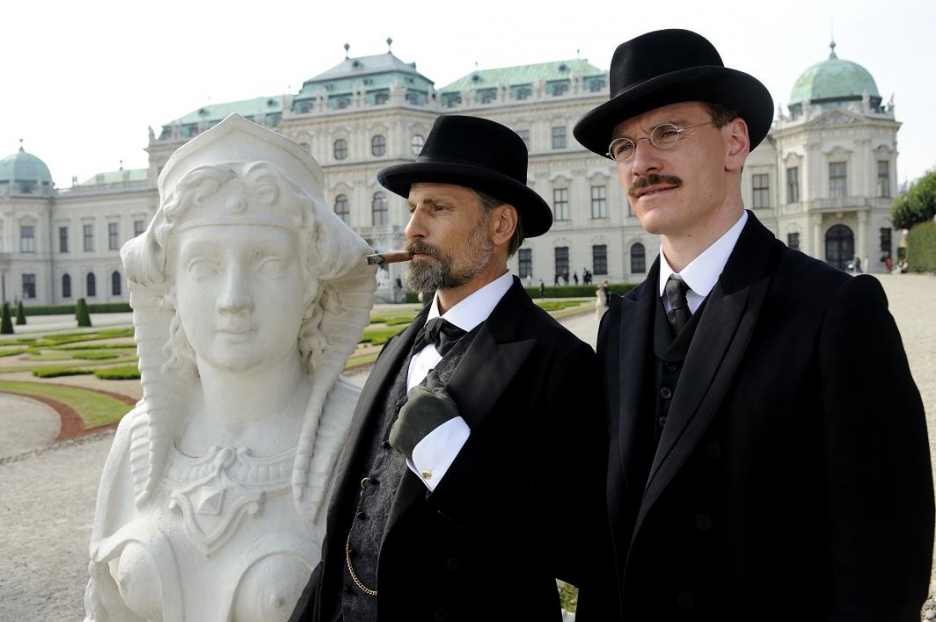 It’s very comic of course.
Absolutely. I thought the whole script was really funny, and wanted to play as much comedy as I could. Viggo and I really tried to push that together. We just couldn’t help ourselves. We were doing that first scene where Freud says, "Do you realise we’ve spent 13 hours having this discourse?" And in between takes Viggo kept pushing these ceramic penises closer to my cup of coffee, till they were surrounding the cup. Then I took a sip and the cream is on my moustache – at one point it was on my nose and everywhere. So we were just trying to have fun with it. And thankfully David is open. He’s been doing this long enough that he has the confidence and easiness to allow you to explore.
I do think people’s behaviour in general is funny, isn’t it? You know how when we get ruffled, or defensive, or we’re inspired by something, the way the body reacts to that mental state – I think these things are funny. And I think if you can bring that humour to something that is dealing with an academic and intellectual subject, it allows the audience to relax; they recognise that "OK, this doesn’t have to be a lesson". They can relax, and just watch these human beings, with their petty qualities and egos. I think it makes the work more accessible.
By the way, talking of the ceramics, I’m sure you noticed that Freud’s study had all these symbols around the place, it’s full of books, ornaments, Egyptian sort of stuff. And then you have Jung’s, which is more about space. I thought that was really clever of David and the art department, really clever.
I’ve heard many stories about Mortensen’s dedication to a role, the way he turns up on set with his own props and the like.
I think it’s the same with every film. People don’t know when he’s going to arrive, but it will always be before he’s due on set. He gets off the plane, rents a car himself and turns up one day and starts to decorate his trailer. So this time he brought some of the things from that Viennese world that Freud inhabited. And he wrote those letters in the film painstakingly, like Freud did. That’s his process, you know. It’s not apparent everywhere that this is what he’s doing, but these things add texture to his characters. I was never overwhelmed by it, because there was a real lightness and easiness to it. Viggo is a very independent soul, and a very gentle one.
Watch the trailer to A Dangerous Method
And your process?
I’m different. Both Keira and Viggo really went into the research, more than I did. I tend to spend more time with the script than most. I’ll probably read the script 250 times – that means you spend eight hours a day for three weeks, just repeating it, so that when I arrive on the set for the first day it doesn’t matter what scene we’re doing, because I’ve got the whole thing off by heart.
With this one, Christopher had written such a dense script, that I felt my own work revolved around trying to get the rhythm of it, and to respect the writing. It was written in such a way that I felt it was like a piece of music, and only after lots of repetition did I start to uncover the rhythms. Any extra research I could do was really a luxury. I did get a great book on Jung, which was like Jung for children – an idiot’s handbook. I think found pretty much everything I needed to find in that little book.
I understand that your sister is a neuro-psychologist.
Yeah. They call it neuro-scientist now; I can never keep up. She basically deals with behaviour. She specialises in ADD and ADHD in children.
How akin is that to psychology?
You’re still mapping out the brain, thinking about what part of the brain is responsible for certain behaviour, then considering how much of a certain behaviour is genetic, how much environmental. Is a drug adduct that way, for example, because they grew up in an environment with drugs? This is layman’s stuff - if she heard me she’d be going nuts.
Did you talk to her about Jung?
I did, yeah. She thought it was great that I was playing him. She’s a fan of Jung. Even though my sister is scientific, she is of that belief that there are a lot of unanswered things out there that science hasn’t yet been able to explain, or perhaps never will; so I think she likes that mystic element to Jung.
 Your dad’s a chef, your sister’s a scientist, you’re an actor. Quite a mix.
And my mum’s done various things. She worked in the administrative side of the hotel business, then when we took over the restaurant, when I was 16, she ran the front of house. So Dad was in the kitchen, she was running the outside. And yeah, it’s kinda mad. One interesting thing that Abi [writer Abi Morgan] and Steve did with Shame was create that sibling dynamic between Brandon and Sissy (pictured above right, Fassbender with Carey Mulligan). When we were growing up my sister always had her head in a book, while I preferred doing things physically – we grew up in the country, so I was out and about climbing trees, fishing, things like that. She wanted to go to university, I wanted to go out and get a job and be immediately in a practical environment. It’s like that with Sissy and Brandon. He is closed off with his emotions, she just can’t stop gushing her emotions over the first person she sees. And both of them are trying to find some semblance of connection, but with very different techniques, and problems.
It’s the interesting thing with siblings – you can have two very different personalities, but you know each other so well, and there’s a brutality and an honesty there, and a support system. Siblings know each other sometimes better than the parents know them.
Where did the acting urge spring from ?
It was down to this guy Donie Courtney, he was a former pupil of the secondary school I went to in Killarney, St Brendan’s College. He came back from the Gaiety Theatre in Dublin, where he studied, and set up these workshops. We didn’t have anything like that at our school until that point, so I started doing the workshops and I was "Wow, this feels right, I’d like to give this a go." I was 17. Then he set up a professional company in the town. So I started doing pantomime, and pub theatre. I spent six months watching Donie like a hawk, trying to soak up as much as I could. And then I just said, “Maybe I’ll try this myself”. With pure ignorance and naivety, but plenty of passion and enthusiasm. So when I was 18 I got my friends together and decided to direct and produce Reservoir Dogs, and play Mr Pink.
I guess that was the advantage of doing it myself: I got to cast myself in the best part. Mr Pink always appealed to me, because he was a survivor, an almost rat-like character, he would survive any sort of outcome. I just thought it was an interesting character to explore. I approached him more like [Robert De Niro’s] Johnny Boy in Mean Streets, than the Buscemi characterisation, like a loose cannon.
 Was it a success?
We did it in Ravel’s night club in Killarney, only for two nights, but it went down really well. We had 114 people for the first night, then 140, we packed out the club.
That would have been just a couple of years after the film’s release. Do you think it’s the only time Reservoir Dogs has been staged?
I think it did get staged again a couple of years later. We did it without really looking into copyright or anything like that. We did it for charity, so I think that’s a loophole. But then it was difficult to find a charity that would take our money, because no one wanted to be associated with Reservoir Dogs because of the violence and all that. In the end we found a private charity, for a little girl whose sight was impaired and needed an operation.
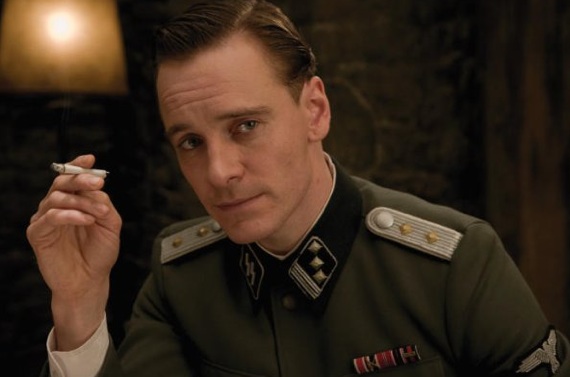
You’ve since worked for Tarantino, of course, on Inglourious Basterds (pictured above left). What did he say about your play?
I told him we gave the money to charity and he said [a good, squeaky likeness], “That’s cool, man. As long as you’re not making money out of my shit.”
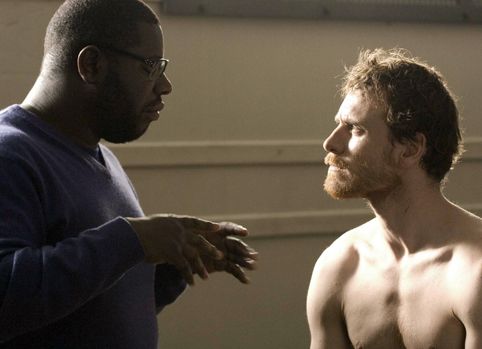 It’s hard to believe that Hunger was just three years ago (pictured right, Fassbender with Hunger director Steve McQueen). Since then you’ve worked with Tarantino, Andrea Arnold, Cronenberg, Ridley Scott. Have you taken stock of the speed at which your career has progressed?
Yeah, I have. At times you just go, “You’re a lucky bastard.” When I was 17 this position that I’m in now would have been the ultimate achievement for me. When I say achievement, I mean working for those people you’ve just listed, and to find a relationship with a director like Steve, where we’ve formed a really strong collaboration. My influence was the Scorsese films and what he achieved with De Niro, and also Sidney Lumet and Al Pacino – that was the dream, to find a collaboration like that. It’s nuts, as good as I could have ever hoped for.
Can you account for it?
I think it’s timing, being in the right place at the right time – and knowing that. I’ve seen some really talented actors, working around me, where I’m like “God, that guy, that girl, they’re really, really good.” And then I never see them again. I knew in 2007 that I was getting an opportunity with Hunger, I knew the door was being left open – and I managed to fucking slide in there. And then it’s about staying in the room before somebody realises that you’re not supposed to be there. And you do that by getting to work with somebody good on the next job and somebody who can elevate you, so hopefully you keep some quality to your work.
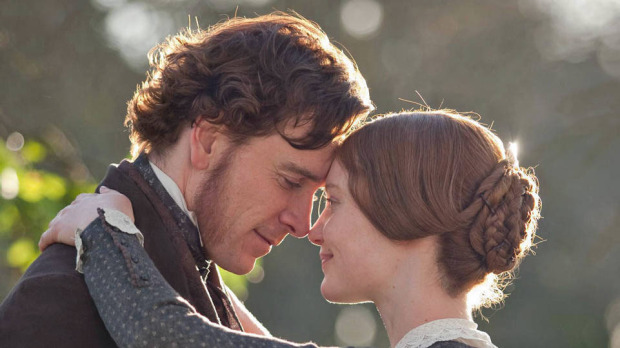 Cary Fukunaga has talked of a rather splendid lamb that you cooked on the set of Jane Eyre (pictured left, Fassbender with Mia Wasikowska). It made me think of Jeff Bridges’s famous gesture of giving self-made photo albums to the cast and crew. Do you imagine providing Fassbender’s film feast?
Yes, handing everyone a lamb chop on the way home! But that’s a good idea, actually, and my dad is always telling me I should cook more. Steve and I were saying that if we do the next film we should have a big cooking extravaganza for the crew. Breaking bread with people and sharing a meal together is a very special experience.
Of course, the film’s caterers might not be amused.
Well, exactly. They might have something to say about that.